From cognitive need to problematic use: a chained mediation path moderated by academic stress and AI literacy
Yong Kong, Tongqiang Dong, Ziyi Yang, Yu Fang, Ning Chen

TL;DR
This study explores how lower cognitive need leads to problematic use of Generative AI in university students, influenced by academic stress and AI literacy.
Contribution
The study identifies a new 'cognitive relief to avoidance' mechanism in AI use and emphasizes AI literacy as a protective factor.
Findings
Lower need for cognition increases positive affect, leading to avoidance motivation and problematic AI use.
High academic stress amplifies the pathway from lower cognition to problematic use.
High AI literacy reduces dependency risks by attenuating the mediation chain.
Abstract
The rapid adoption of Generative AI (GenAI) in higher education raises concerns about psychological dependency. Grounded in the I-PACE model, this study investigates how lower need for cognition (NFC) is associated with problematic use via positive affect and Avoidance-Oriented GenAI Motivation, moderated by academic stress and AI literacy. To test the hypothesized model, we employed a two-wave, time-lagged survey design with a sample of university students (N = 452). Data were analyzed using structural equation modeling (SEM) to assess the serial mediation effects and the moderated mediation dynamics. Analysis confirmed a serial mediation chain: lower NFC predicted stronger positive affect, increasing avoidance motivation and subsequent problematic use. This pathway was significantly amplified by high academic stress but attenuated by high AI literacy, which neutralized dependency…
Click any figure to enlarge with its caption.
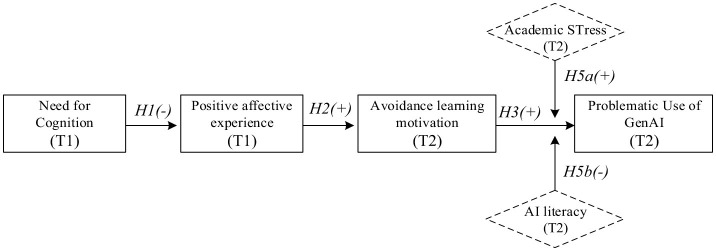 Figure 1
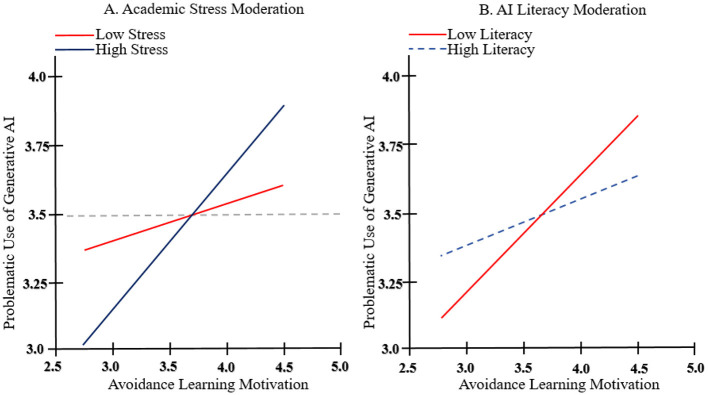 Figure 2
Peer Reviews
No public reviews on file for this paper yet. If you reviewed it on a platform where reviews are public (OpenReview, ICLR, NeurIPS, ICML), you can paste yours below so the community can read it here.
Videos
No videos yet. Explain this paper in a talk, walkthrough, or lecture? Add one.
Taxonomy
TopicsDigital Mental Health Interventions · Artificial Intelligence in Healthcare and Education · Impact of Technology on Adolescents