Focus on sex hormone axis disorder: exploring the susceptibility mechanism of dry eye in perimenopausal women
Manhui Zhu, Yufei Wang, Yuhang Na, Yuanyuan Tu, E. Song

TL;DR
This paper explores why perimenopausal women are highly susceptible to dry eye disease, focusing on hormonal changes and related factors.
Contribution
The paper highlights the role of sex hormone axis disorder as a central mechanism in dry eye among perimenopausal women.
Findings
Disruption of sex hormones due to ovarian failure is a key factor in tear film imbalance in perimenopausal women.
Chronic inflammation, neuroendocrine changes, and depression further increase dry eye risk in this group.
Personalized management strategies are needed for effective prevention and treatment of dry eye in perimenopausal women.
Abstract
Dry eye (DE) is a disease that affects the ocular surface in multiple aspects. The main feature of this disease is the disruption of tear film balance. If not effectively controlled, DE can cause ocular discomfort, pain and visual impairment. These problems will seriously affect patients’ quality of life. Perimenopausal women are at extremely high risk of DE, and their pathogenesis and risk factors have distinct stage specificity. The core view is that the disorder of sex hormones caused by ovarian failure is the initial and core link leading to the imbalance of tear film homeostasis. On this basis, chronic immune inflammatory response, neuroendocrine changes, perimenopausal depression, sleep disorders and the use of specific drugs such as hormone replacement therapy (HRT), as important contributing factors, further amplify the risk of disease in this group. Through a comprehensive…
Genes, proteins, chemicals, diseases, species, mutations and cell lines named across the full text — each resolved to its canonical identifier and authoritative record.
Click any figure to enlarge with its caption.
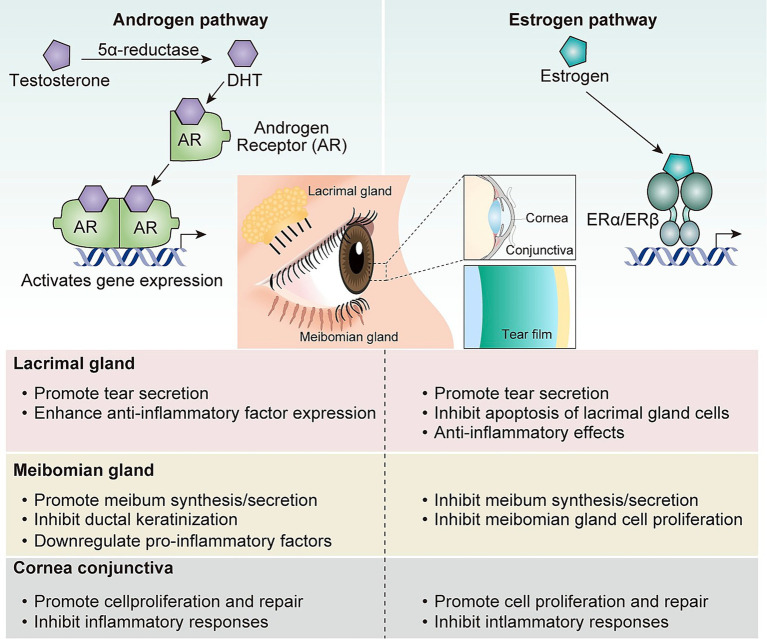 Figure 1
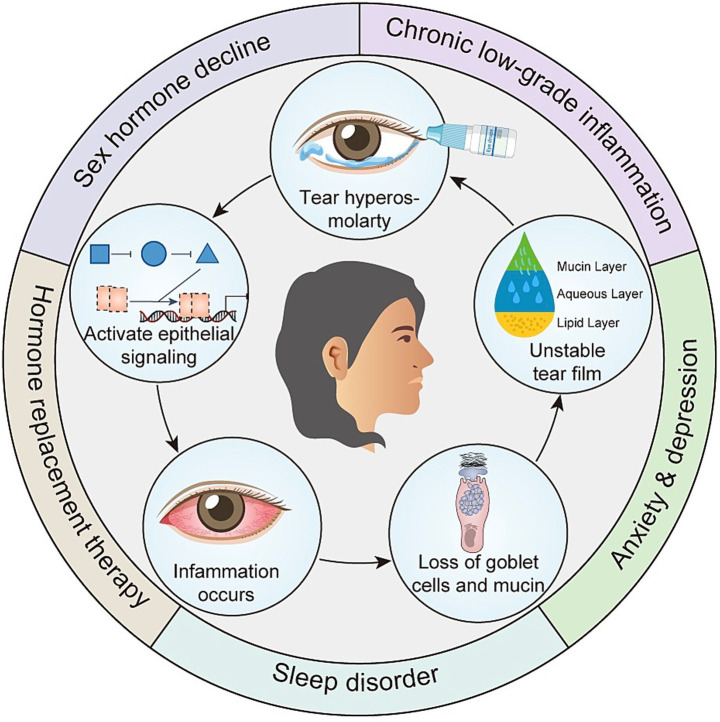 Figure 2
Peer Reviews
No public reviews on file for this paper yet. If you reviewed it on a platform where reviews are public (OpenReview, ICLR, NeurIPS, ICML), you can paste yours below so the community can read it here.
Videos
No videos yet. Explain this paper in a talk, walkthrough, or lecture? Add one.
Taxonomy
TopicsOcular Surface and Contact Lens · Dermatology and Skin Diseases · Urticaria and Related Conditions