Measuring Accuracy (Classification Probabilities, Positive, and Negative Predictive Values) of Executive Function Electroencephalogram Metrics in Attention-Deficit/Hyperactivity Disorder Diagnosis: Protocol for and Perspectives From the SINCRONIA Study
Hilario Blasco-Fontecilla, Javier Sánchez-Cerezo, Irene Gómez, Georgelina Abreu-Fernández, Sandra Ortiz, Jesús F Villoria, Miguel Blanco, Ana García, Julia Ballesteros, Roldán Martínez, Gerardo Gálvez, Fernando Maestú, Álvaro López-Medrano

TL;DR
The SINCRONIA study aims to develop an EEG-based diagnostic tool for ADHD to improve diagnosis accuracy in children.
Contribution
The study introduces a novel EEG-based classification algorithm for ADHD diagnosis with potential biomarkers.
Findings
The study will evaluate EEG biomarkers for ADHD diagnosis in children aged 7-12.
EEG-based diagnosis is expected to outperform traditional neuropsychological tests like the Conners test.
Abstract
Attention deficit/hyperactivity disorder (ADHD) is the most prevalent neurodevelopmental disorder worldwide, affecting approximately 5%‐7% of school-aged children and 2%‐5% of adults worldwide. However, there is still no reliable diagnostic tool for it. The lack of specific biomarkers further complicates the accurate diagnosis of ADHD. The SINCRONIA study seeks to develop and optimize an electroencephalogram (EEG)-based ADHD diagnostic classification algorithm by identifying biomarkers that provide optimal diagnostic performance. This protocol introduces a single-center, case-control study involving at least 165 participants, aged between 7 and 12 years, that is being conducted at the Puerta de Hierro University Hospital in Madrid, Spain. Participants will be allocated to 3 groups, including ADHD predominantly inattentive, ADHD predominantly combined or hyperactive/impulsive, and a…
Genes, proteins, chemicals, diseases, species, mutations and cell lines named across the full text — each resolved to its canonical identifier and authoritative record.
Click any figure to enlarge with its caption.
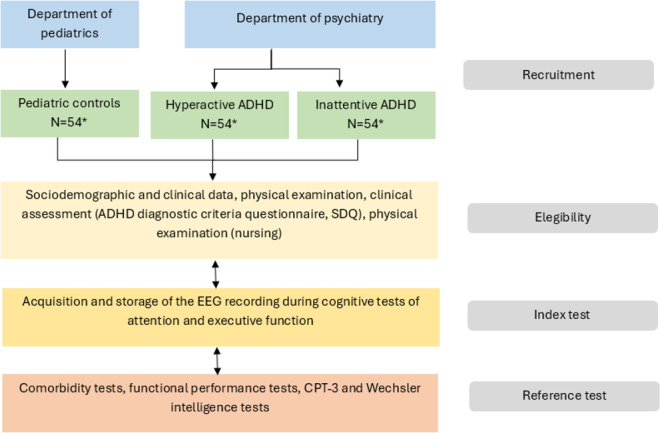 Figure 1
Peer Reviews
No public reviews on file for this paper yet. If you reviewed it on a platform where reviews are public (OpenReview, ICLR, NeurIPS, ICML), you can paste yours below so the community can read it here.
Videos
No videos yet. Explain this paper in a talk, walkthrough, or lecture? Add one.
Taxonomy
TopicsAttention Deficit Hyperactivity Disorder · Functional Brain Connectivity Studies · EEG and Brain-Computer Interfaces