Isoflurane causes muscle contraction in Drosophila melanogaster despite inducing hyperpolarized state
Joshua Griffith, Jiwoo Kim, Robin Cooper

TL;DR
This study shows that isoflurane causes muscle contractions in fruit fly larvae even though it hyperpolarizes the muscle membrane.
Contribution
The novel finding is that isoflurane induces muscle contraction via intracellular calcium release despite membrane hyperpolarization.
Findings
Muscle contraction was not inhibited by dantrolene or ryanodine.
Thapsigargin inhibited isoflurane-induced muscle contraction by depleting sarcoplasmic reticulum calcium.
Blebbistatin blocked isoflurane-induced contractions and allowed membrane hyperpolarization.
Abstract
Isoflurane is a commonly used volatile anesthetic; however, its mechanisms are not well characterized. To better understand mechanisms of action, isoflurane was applied to model larval Drosophila muscle preparations. Membrane potential, evoked transmissions, and observations of muscle behavior were recorded. Muscle contraction was not inhibited by dantrolene (10 mM) or ryanodine (100 µM). Thapsigargin (1 mM), which depleted the sarcoplasmic reticulum of Ca 2+ , inhibited muscle contraction. Blebbistatin blocked contractions induced by isoflurane, allowing for membrane hyperpolarization. Isoflurane releases stored intracellular calcium from the sarcoplasmic reticulum of the skeletal muscle, causing muscle contraction despite direct hyperpolarization of the membrane.
Genes, proteins, chemicals, diseases, species, mutations and cell lines named across the full text — each resolved to its canonical identifier and authoritative record.
Click any figure to enlarge with its caption.
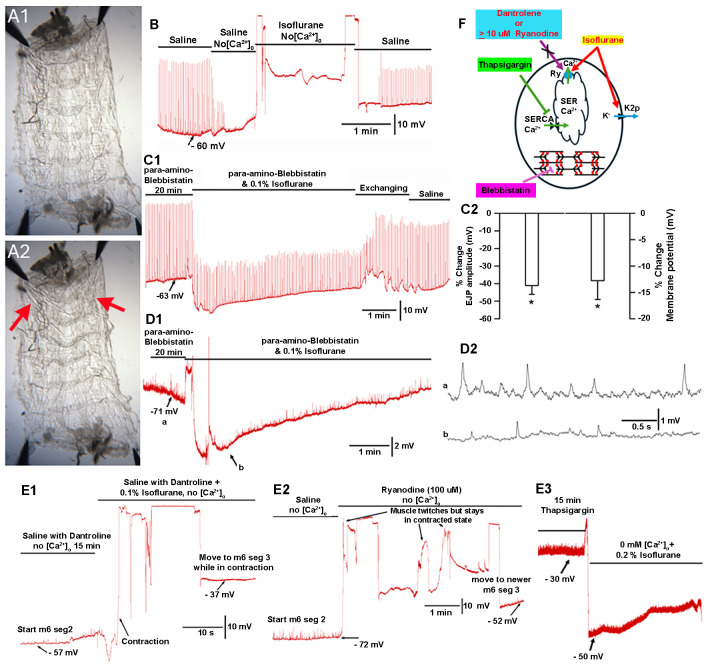 Figure 1
Peer Reviews
No public reviews on file for this paper yet. If you reviewed it on a platform where reviews are public (OpenReview, ICLR, NeurIPS, ICML), you can paste yours below so the community can read it here.
Videos
No videos yet. Explain this paper in a talk, walkthrough, or lecture? Add one.
Taxonomy
TopicsNeurobiology and Insect Physiology Research · Ion channel regulation and function · Physiological and biochemical adaptations