Should Love be Explicitly Stated as a Core Enabling Concept in the Medical Curriculum?
Colin P Doherty, Claire L Donohoe

TL;DR
This paper argues that love, as a commitment to human dignity, should be taught in medical education to balance modern healthcare's focus on metrics.
Contribution
The novel proposal is to explicitly define and integrate love as an ethical core concept in medical training.
Findings
Love is framed as a multidimensional ethical commitment encompassing empathy and respect.
Professional boundaries and reflective practice are essential to prevent love from becoming a narcissistic illusion.
Humanistic assessment is suggested as an alternative to metrics-driven healthcare models.
Abstract
The concept of love, defined as a multidimensional ethical commitment to human dignity encompassing empathy, compassion, and respect, should be explicitly integrated into the medical curriculum. This commitment is considered the “secret of quality” (Donabedian) and a necessary counterbalance to the reductive, metrics-driven model of modern healthcare. Acknowledging the risk of love becoming a narcissistic illusion (Lacanian critique), its implementation requires strict professional boundaries, “Self-as-Instrument” training via reflective practice and humanistic assessment over measurable metrics.
Genes, proteins, chemicals, diseases, species, mutations and cell lines named across the full text — each resolved to its canonical identifier and authoritative record.
Click any figure to enlarge with its caption.
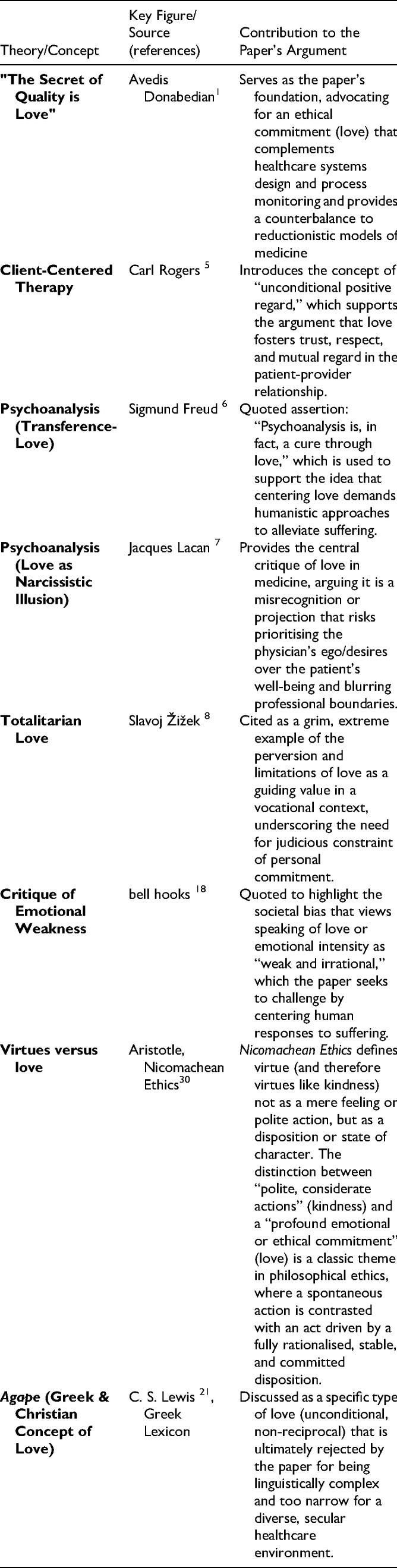 Figure 1
Peer Reviews
No public reviews on file for this paper yet. If you reviewed it on a platform where reviews are public (OpenReview, ICLR, NeurIPS, ICML), you can paste yours below so the community can read it here.
Videos
No videos yet. Explain this paper in a talk, walkthrough, or lecture? Add one.
Taxonomy
TopicsPatient Dignity and Privacy · Empathy and Medical Education · Ethics in medical practice