Psoas muscle volume as a diagnostic indicator for sarcopenia: criteria development and comparison with traditional diagnostic approaches
Woorim Choi, Chul-Ho Kim, Ji Wan Kim

TL;DR
This study proposes using psoas muscle volume measured via CT scans as a new diagnostic tool for sarcopenia, showing strong correlations with existing muscle mass indicators.
Contribution
The study introduces CT-based psoas muscle volume as a novel diagnostic criterion for sarcopenia.
Findings
Psoas muscle volume (PV) declines sharply with age, especially in men.
PV indices showed strong correlations with appendicular skeletal muscle (ASM) indices, with PV/BMI having the highest diagnostic accuracy.
T-score adjustment of -2.0 improved alignment with known sarcopenia prevalence rates.
Abstract
Sarcopenia significantly impacts quality of life and increases the risk for various health issues. This study aims to establish a new, effective diagnostic criterion for sarcopenia based on psoas muscle volume (PV) using computed tomography (CT). We analyzed the population distribution of psoas muscle volume (PV), assessed its correlation with ASM indices, and developed CT-based diagnostic criteria for sarcopenia. A total of 3,999 adults (2,085 men, 1,914 women; aged 22–89) who underwent abdominal CT and bioimpedance analysis (BIA) were included. Psoas muscle volume was automatically segmented using a deep-learning algorithm. Correlations with ASM indices were evaluated, and diagnostic criteria were established using (1) linear regression, (2) ROC analysis, and (3) T-score analysis referencing young, non-sarcopenic adults. The distribution of PV indices peaked in the 30s and declined…
Genes, proteins, chemicals, diseases, species, mutations and cell lines named across the full text — each resolved to its canonical identifier and authoritative record.
Click any figure to enlarge with its caption.
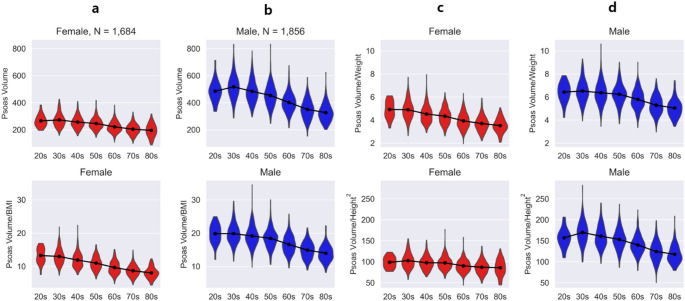 Figure 1
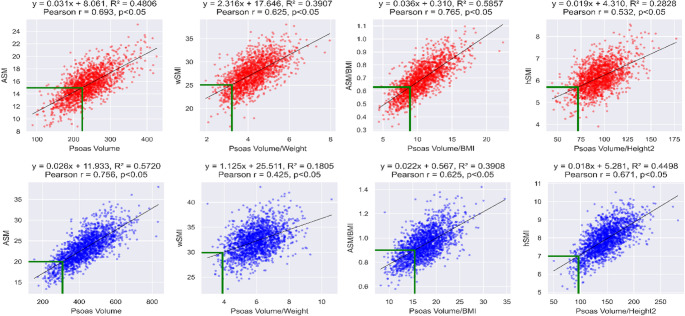 Figure 2
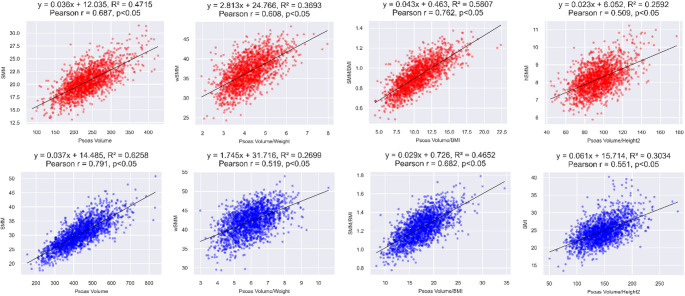 Figure 3
Peer Reviews
No public reviews on file for this paper yet. If you reviewed it on a platform where reviews are public (OpenReview, ICLR, NeurIPS, ICML), you can paste yours below so the community can read it here.
Videos
No videos yet. Explain this paper in a talk, walkthrough, or lecture? Add one.
Taxonomy
TopicsNutrition and Health in Aging · Body Composition Measurement Techniques · Dysphagia Assessment and Management