Ten Years of Laparoscopic Pectopexy: A Case Series Analysis
Guenter Noé, Elisavet Farsaki, Michael Anapolski, Anna Pitsillidi

TL;DR
This study analyzes 10 years of laparoscopic pectopexy outcomes, finding most failures occur within 4 years and addressing lateral defects improves long-term success.
Contribution
The study provides long-term outcome data for laparoscopic pectopexy and identifies lateral defect severity as the strongest predictor of failure.
Findings
Median recurrence-free survival was 9.34 years and reoperation-free survival was 9.56 years.
Apical re-fixation achieved a 94.9% long-term success rate over 10 years.
Lateral defect severity was the strongest predictor of failure (p < 0.001).
Abstract
Pelvic organ prolapse (POP) often causes significant urinary, bowel, pain, and sexual symptoms, and treatment success is increasingly defined by symptom relief rather than anatomical correction alone. Long-term outcome data for laparoscopic pectopexy (LP) remain limited. We conducted a retrospective cohort study of all women undergoing multicompartment POP repair with LP and native tissue repair of level 2 and 3 defects at a tertiary referral center between 2010 and 2019. The primary outcome was prolapse recurrence, defined as POP-Q stage II or higher. Secondary outcomes included de novo POP, surgical reoperation, and complications. Time-to-event outcomes were analyzed with Kaplan–Meier survival curves to estimate freedom from recurrence and freedom from reoperation. A total of 832 patients were included (median age of 63 years). Median recurrence-free survival was 9.34 years (IQR…
Genes, proteins, chemicals, diseases, species, mutations and cell lines named across the full text — each resolved to its canonical identifier and authoritative record.
Click any figure to enlarge with its caption.
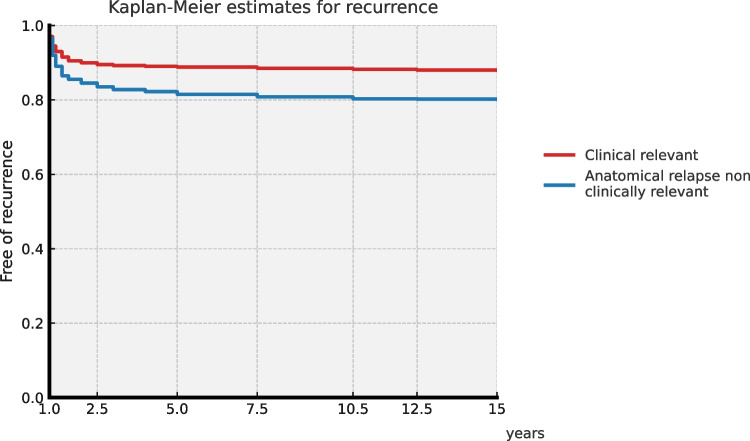 Figure 1
Peer Reviews
No public reviews on file for this paper yet. If you reviewed it on a platform where reviews are public (OpenReview, ICLR, NeurIPS, ICML), you can paste yours below so the community can read it here.
Videos
No videos yet. Explain this paper in a talk, walkthrough, or lecture? Add one.
Taxonomy
TopicsReconstructive Facial Surgery Techniques · Surgical Sutures and Adhesives · Spinal Dysraphism and Malformations