UPDhmm: detecting uniparental disomy from NGS trio data
Marta Sevilla-Porras, Carlos Ruiz-Arenas, Luis A Pérez-Jurado

TL;DR
UPDhmm is a new tool that detects chromosomal abnormalities called uniparental disomies in genomic data from families, improving detection accuracy and clinical relevance.
Contribution
UPDhmm introduces a Hidden Markov Model-based method for precise detection of UPD subtypes using trio NGS data, outperforming existing tools.
Findings
UPDhmm outperformed existing methods in detecting UPD events in exome and genome data simulations.
UPDhmm identified two UPD events in autism patients, including one previously unreported.
UPDhmm is implemented in R and available as a Bioconductor package.
Abstract
Uniparental disomies (UPDs) are copy-neutral chromosomal alterations that occur when both copies of a chromosome pair (entire or segmental) come from one parent. UPDs, including isodisomies (identical parental chromosome) and heterodisomies (two different homologs from the same parent), reflect meiotic and/or mitotic aberrations of chromosomal segregation that can be associated with congenital or acquired disease. Despite their relevance, current methods to detect UPDs using sequence data (exomes or genomes) have limited sensitivity for small events, cannot precisely determine the UPD sub-type or coordinates, and perform poorly when including individuals or populations with consanguinity. We present UPDhmm, a novel tool that uses trio-based sequence data (proband and parents) and models inheritance patterns. UPDhmm predicts the most likely inheritance scenario, normal Mendelian…
Genes, proteins, chemicals, diseases, species, mutations and cell lines named across the full text — each resolved to its canonical identifier and authoritative record.
Click any figure to enlarge with its caption.
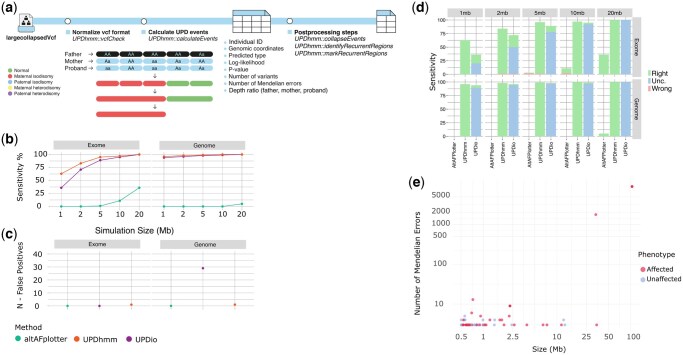 Figure 1
Peer Reviews
No public reviews on file for this paper yet. If you reviewed it on a platform where reviews are public (OpenReview, ICLR, NeurIPS, ICML), you can paste yours below so the community can read it here.
Videos
No videos yet. Explain this paper in a talk, walkthrough, or lecture? Add one.
Taxonomy
TopicsGenomic variations and chromosomal abnormalities · Genetic Associations and Epidemiology · Genomics and Rare Diseases