Parasitic surveillance in wolves of central Italy: a focus on the Abruzzo region
Sabrina Vanessa Patrizia Defourny, Mariasole Colombo, Gianluca D’Amico, Stefania Salucci, Antonio Cocco, Maria Chiara Cantelmi, Daniela Averaimo, Marco Rulli, Gianfranco Romeo, Susanna Tora, Marina Baffoni, Nicola De Dominicis, Nicola D’Alterio, Antonio Petrini

TL;DR
This study examines parasitic infections in wolves from central Italy, showing high parasite prevalence and highlighting their role in pathogen transmission to humans and domestic animals.
Contribution
The study presents the largest parasitological survey of wolves in Europe, revealing zoonotic parasite circulation and emphasizing wolves as sentinels for public health.
Findings
80% of wolves tested positive for at least one parasite, with Trichinella spp. detected in 28.7% of samples.
Common parasites included Ancylostomatidae nematodes (62%) and Trichuris vulpis (32%) in fecal samples.
Leishmania spp. were found in 7.1% of wolves, indicating potential zoonotic risk.
Abstract
Monitoring parasitic infections in wildlife is essential for assessing ecosystem health and pathogen dynamics, particularly in apex predators like the wolf (Canis lupus). As top-level carnivores with wide-ranging habitats and diverse interactions with prey, wolves can serve as effective sentinels for the circulation of parasitic agents within ecosystems. The present study aimed at monitoring parasitic infections, particularly those of zoonotic importance, in wolves from central Italy. The study was conducted on 169 wolf carcasses recovered between 2018 and 2024. Leishmania spp. and Trichinella spp. infections were evaluated using molecular techniques (on 169 spleen and 150 striated muscle samples, respectively), while intestinal and extra-intestinal parasites were investigated using flotation and Baermann tests (147 fecal samples). Of the 169 wolves included in the study, 89 (52.66%)…
Genes, proteins, chemicals, diseases, species, mutations and cell lines named across the full text — each resolved to its canonical identifier and authoritative record.
Click any figure to enlarge with its caption.
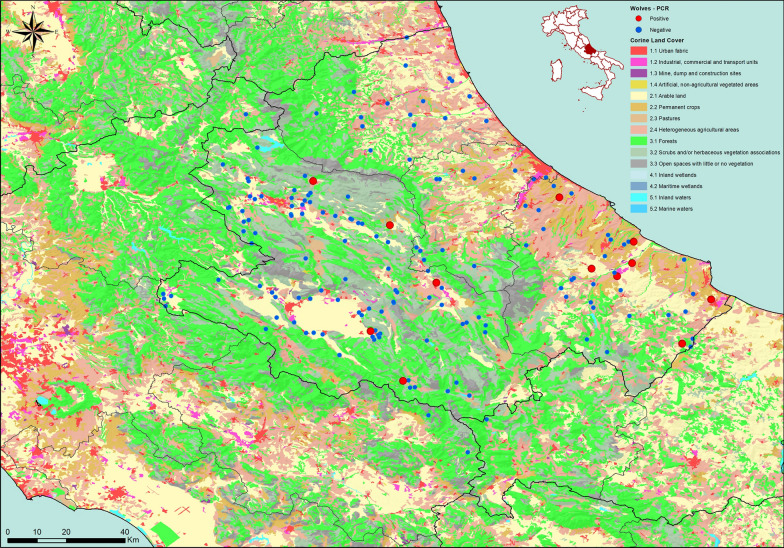 Figure 1
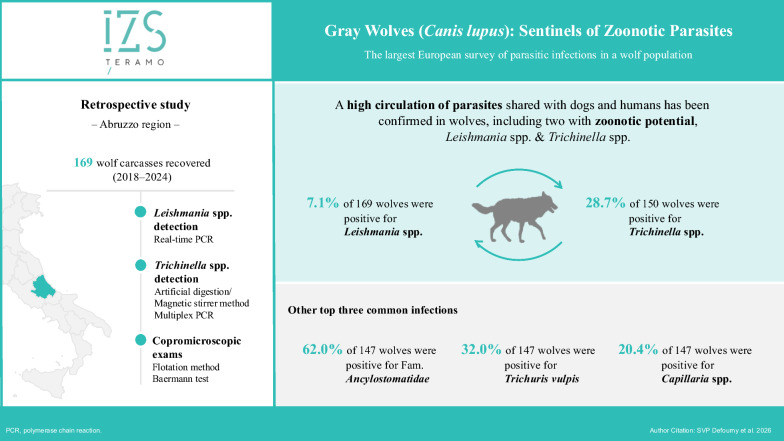 Figure 2
Peer Reviews
No public reviews on file for this paper yet. If you reviewed it on a platform where reviews are public (OpenReview, ICLR, NeurIPS, ICML), you can paste yours below so the community can read it here.
Videos
No videos yet. Explain this paper in a talk, walkthrough, or lecture? Add one.
Taxonomy
TopicsParasitic Diseases Research and Treatment · Parasites and Host Interactions · Trypanosoma species research and implications