Integration of ATAC-seq and RNA-seq reveals temperature-responsive regulatory regions in Plasmodium falciparum asexual stages
Yuhong Zhang, Yi Zhao, Guixing Zheng, Shanli He, Jiale Xiao, Haochen Ma, Jun Huang, Yanwei Qi

TL;DR
This study finds that low temperature affects chromatin and gene activity in early malaria parasite stages, revealing temperature-responsive regulatory regions.
Contribution
First integrative analysis of ATAC-seq and RNA-seq in Plasmodium falciparum under low temperature stress.
Findings
Low temperature induces 1083 differentially accessible chromatin regions in ring stages, mostly promoter gains.
41 genes show coordinated changes in chromatin accessibility and expression, linked to temperature response.
Trophozoite stages show no significant chromatin reconfiguration under low temperature.
Abstract
Malaria remains a critical parasitic disease in tropical regions, with environmental temperature significantly influencing the development and transmission of Plasmodium falciparum. While low temperature triggers gametocyte differentiation in mosquito, the molecular mechanisms underlying temperature-responsive chromatin and transcriptional dynamics in asexual stages (ring and trophozoite) remain unclear. This study integrates Assay for Transposase-Accessible Chromatin with Sequencing (ATAC-seq) and RNA-sequencing (RNA-seq) to characterize genome-wide chromatin accessibility and gene expression profiles in P. falciparum under human body temperature (37 °C) and mosquito-mimicking temperature (26 °C). Synchronized ring (45 h post-invasion) and trophozoite (70 h post-invasion) stages were subjected to temperature treatments (37 °C versus 26 °C). ATAC-seq was used to identify accessible…
Genes, proteins, chemicals, diseases, species, mutations and cell lines named across the full text — each resolved to its canonical identifier and authoritative record.
Click any figure to enlarge with its caption.
 Figure 1
 Figure 2
 Figure 3
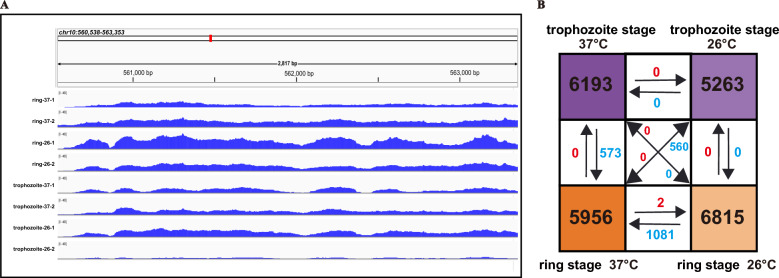 Figure 4
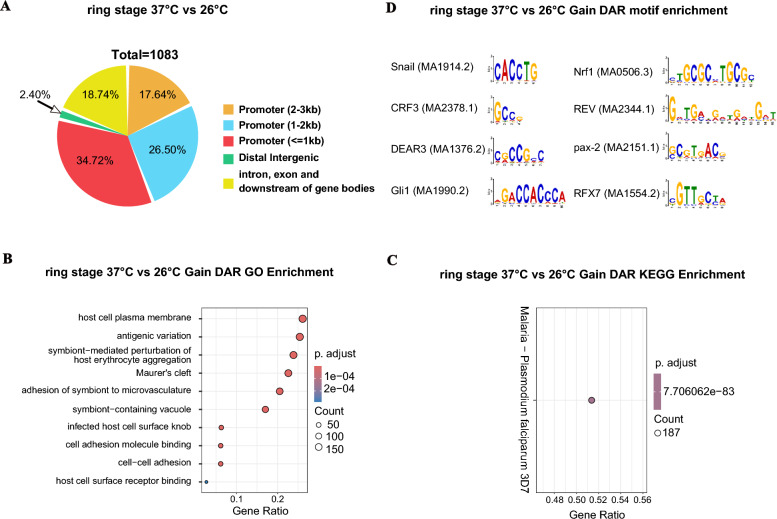 Figure 5
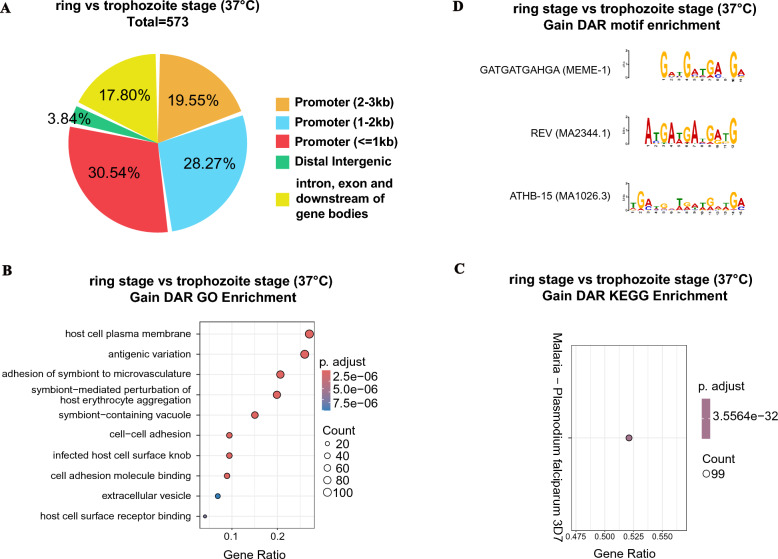 Figure 6
 Figure 7
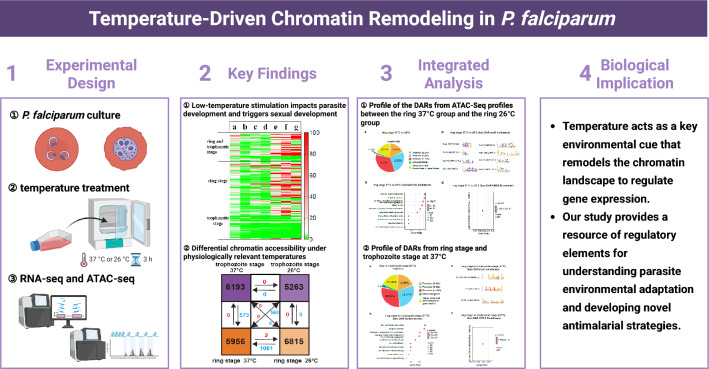 Figure 8
Peer Reviews
No public reviews on file for this paper yet. If you reviewed it on a platform where reviews are public (OpenReview, ICLR, NeurIPS, ICML), you can paste yours below so the community can read it here.
Videos
No videos yet. Explain this paper in a talk, walkthrough, or lecture? Add one.
Taxonomy
TopicsMalaria Research and Control · Invertebrate Immune Response Mechanisms · Sperm and Testicular Function