Call combination order and iterations may shift meaning in sooty mangabey vocal sequences
Auriane Le Floch, Cédric Girard-Buttoz, Christof Neumann, Tanit Souha Azaiez, Natacha Bande, Roman M. Wittig, Klaus Zuberbühler, Catherine Crockford

TL;DR
Sooty mangabeys may use call order and repetition to create different meanings in their vocal sequences, similar to human language.
Contribution
The study shows combinatorial meaning in non-alarm contexts in a monkey species, beyond great apes.
Findings
Female sooty mangabeys use call order (e.g., 'grunt_twitter' vs. 'twitter_grunt') to signal different contexts.
Iterative call sequences also show context-specific meaning, suggesting a role in communication.
Combinatorial meaning in monkeys may extend beyond alarm calls to affiliative interactions.
Abstract
Human language expands meaning through the structured combination of sounds, but such mechanisms remain rare in nonhuman animals, raising questions about their evolution. Shifts in meaning from single calls to combinations appear across a range of combinations and contexts in apes, but current evidence from other species is mainly restricted to alarm contexts. To address this, we applied a quantitative, whole-repertoire approach to assess meaningful combinatorial capacities in sooty mangabeys (Cercocebus atys), a forest-dwelling monkey. We recorded 1751 vocal utterances from two groups in the Taï National Park, Ivory Coast. Using context of production as a proxy for potential meaning, we focused on two mechanisms: (1) bigrams—sequences of two different calls, and (2) iteration—reoccurrence of the same call type interspersed with others. Euclidean distance analyses suggested…
Genes, proteins, chemicals, diseases, species, mutations and cell lines named across the full text — each resolved to its canonical identifier and authoritative record.
Click any figure to enlarge with its caption.
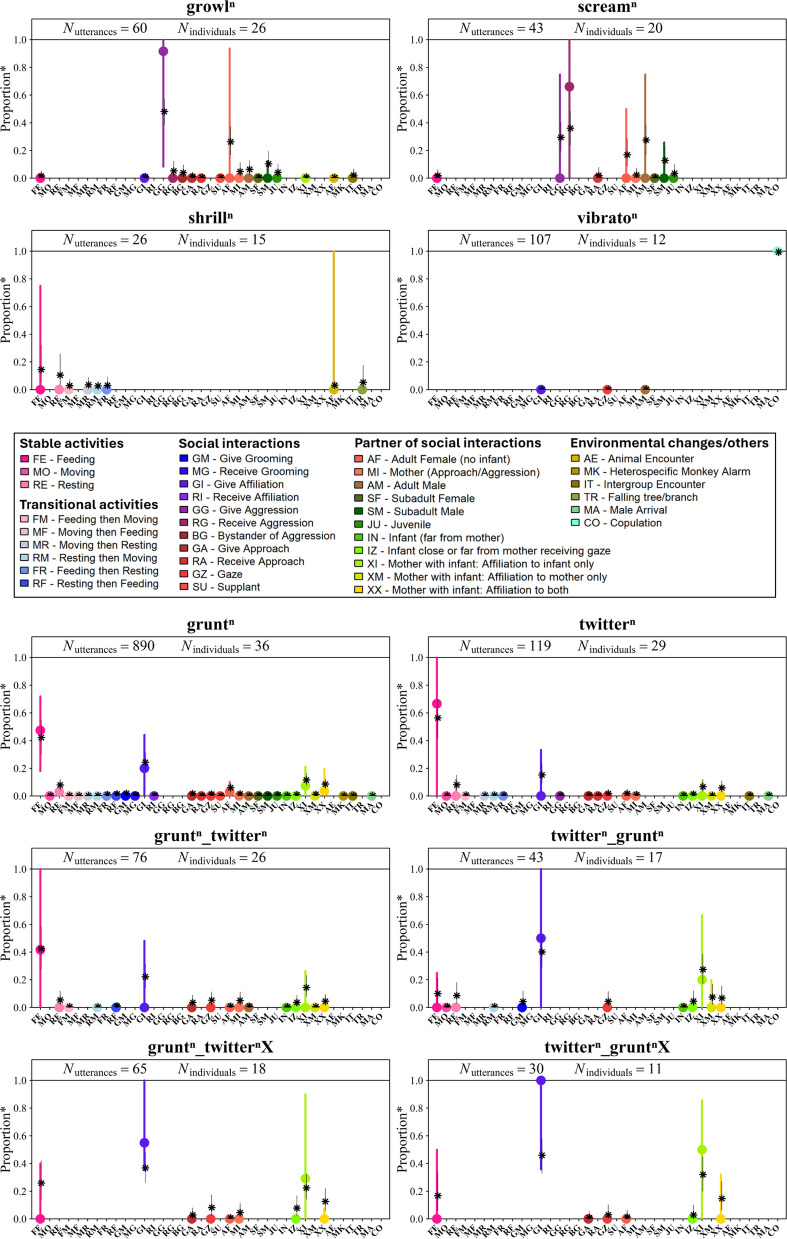 Figure 1
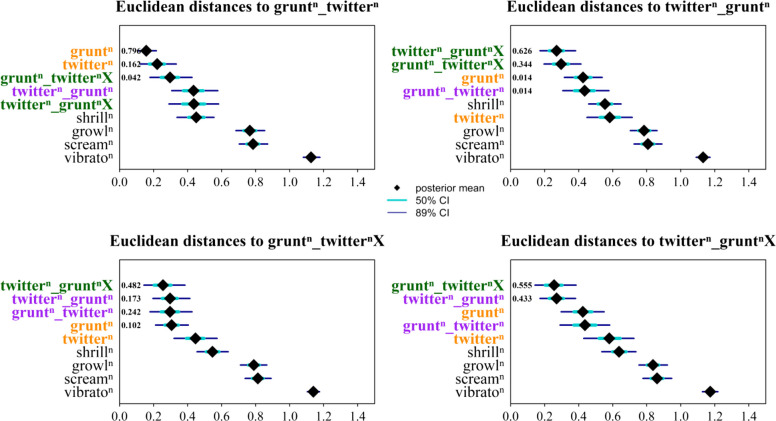 Figure 2
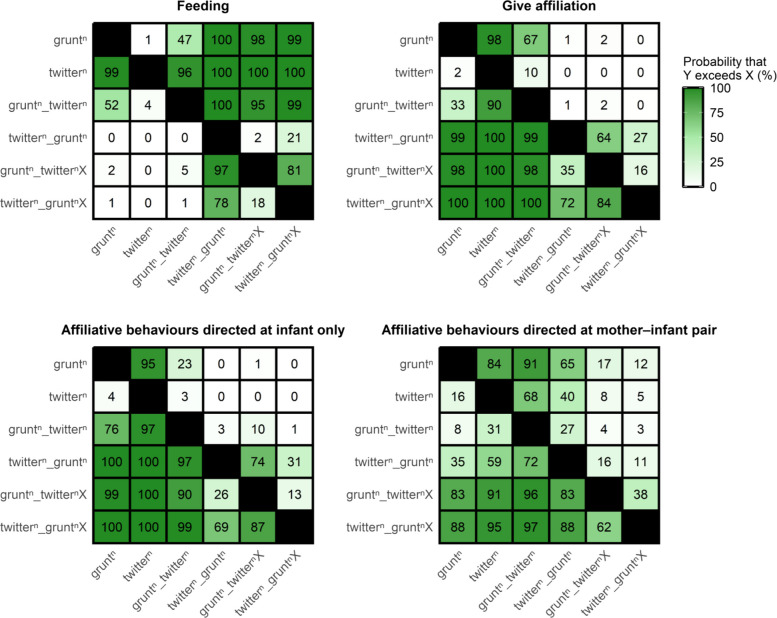 Figure 3
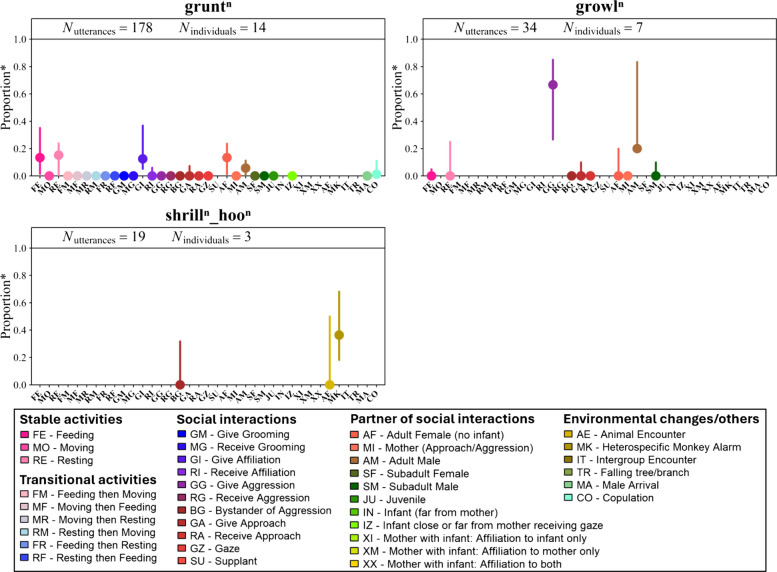 Figure 4
Peer Reviews
No public reviews on file for this paper yet. If you reviewed it on a platform where reviews are public (OpenReview, ICLR, NeurIPS, ICML), you can paste yours below so the community can read it here.
Videos
No videos yet. Explain this paper in a talk, walkthrough, or lecture? Add one.
Taxonomy
TopicsAnimal Vocal Communication and Behavior · Phonetics and Phonology Research · Primate Behavior and Ecology