Guidelines vs. generative AI in CKD patient education: the role of prompt engineering and expert blinded evaluation
Lutfullah Zahit Koc, Sevgi Gulsen Koc, Ayca Inci, Osman Cagin Buldukoglu, Gokhan Koker, Edgar V. Lerma

TL;DR
This study shows that AI models, especially when using structured prompts, can create better CKD patient education content than guidelines, with improved clarity and accessibility.
Contribution
The study introduces the effectiveness of prompt engineering in improving AI-generated CKD education content for better readability and accuracy.
Findings
AI models outperformed guideline responses in all CLEAR Tool domains, with ChatGPT-4o mini scoring highest.
Structured prompts significantly improved AI readability, reducing literacy requirements to around 7th-grade level.
Prompt engineering can enhance AI's usability for populations with limited health literacy.
Abstract
This study aimed to evaluate the accuracy, content quality, and readability of patient education responses related to chronic kidney disease (CKD) generated by large language models (ChatGPT-4o mini and Gemini) compared to guideline group. Fifteen frequently asked CKD-related questions were selected using global Google Trends data and posed to both AI models and guideline-based sources. Responses were anonymized and evaluated by four independent nephrology professors using the CLEAR Tool, assessing completeness, appropriateness, evidence basis, and clarity. Both AI models significantly outperformed guideline responses across all CLEAR Tool domains (p < 0.001), with ChatGPT-4o mini achieving the highest median score (21.0 [IQR: 5.0] vs. Gemini: 17.0 [IQR: 5.0], Guideline: 13.0 [IQR: 2.0]). Initial readability analysis showed that guideline responses were easier to comprehend…
Genes, proteins, chemicals, diseases, species, mutations and cell lines named across the full text — each resolved to its canonical identifier and authoritative record.
Click any figure to enlarge with its caption.
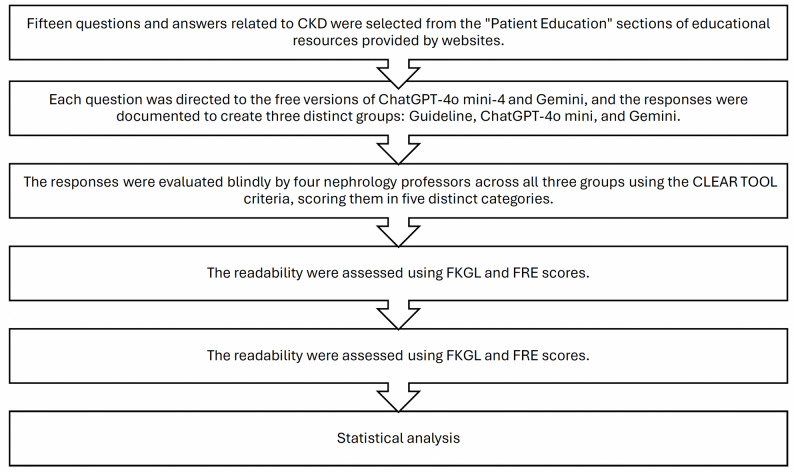 Figure 1
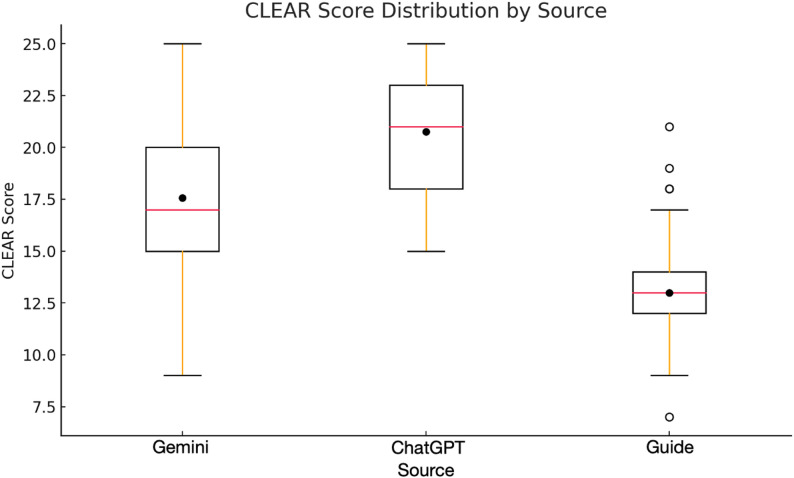 Figure 2
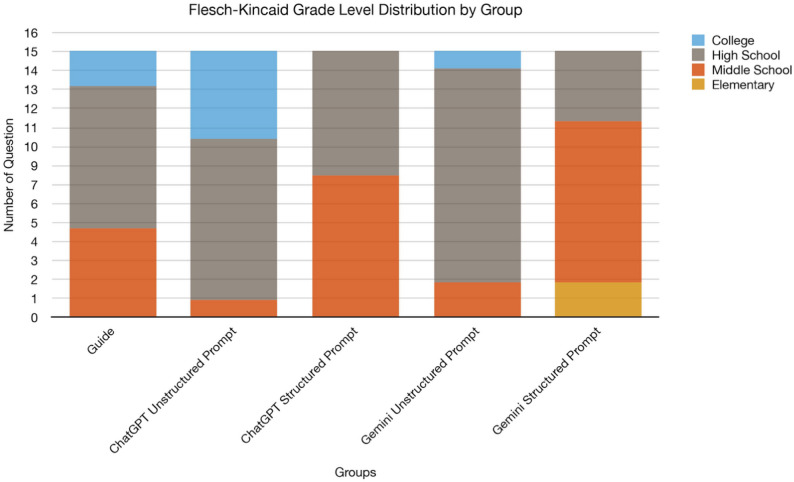 Figure 3
Peer Reviews
No public reviews on file for this paper yet. If you reviewed it on a platform where reviews are public (OpenReview, ICLR, NeurIPS, ICML), you can paste yours below so the community can read it here.
Videos
No videos yet. Explain this paper in a talk, walkthrough, or lecture? Add one.
Taxonomy
TopicsArtificial Intelligence in Healthcare and Education · Health Literacy and Information Accessibility · Social Media in Health Education