Traversing the effects of ploidy changes in different Eragrostis curvula genotypes through high‐throughput RNA sequencing
D. F. Santoro, J. Carballo, M. C. Pasten, C. A. Gallo, E. Albertini, V. Echenique

TL;DR
This study explores how extra chromosome sets in Eragrostis curvula grass affect gene activity, revealing trade-offs between stress tolerance and forage quality.
Contribution
The study identifies ploidy-sensitive genes and their roles in stress tolerance and biomass digestibility in Eragrostis curvula.
Findings
Higher ploidy levels in Eragrostis curvula are linked to increased stress tolerance and changes in cell wall and lignin-related genes.
A trade-off between stress tolerance and forage digestibility is observed at higher ploidy levels.
Ploidy-sensitive genes and transcriptional networks suggest a rewiring of gene regulation with increasing chromosome sets.
Abstract
Polyploidization has played a key role in plant genome evolution. Eragrostis curvula (Schrad.) Ness, a perennial forage grass species of the Poaceae family, is an excellent model for investigating genome duplication due to its natural variation in ploidy levels. To explore the transcriptomic consequences of polyploidy, we performed high‐throughput RNA‐Seq on leaf tissue from 10 E. curvula genotypes ranging from diploid to octoploid. Differential expression analyses revealed that the number of differentially expressed genes increased with increasing ploidy, suggesting a rewiring of the gene regulatory network. Several putative genes associated with stress tolerance and epigenetic regulation were modulated at higher ploidy levels. Forage digestibility and saccharification efficiency were likely altered at higher ploidy levels, mainly due to the upregulation of putative genes involved in…
Genes, proteins, chemicals, diseases, species, mutations and cell lines named across the full text — each resolved to its canonical identifier and authoritative record.
Click any figure to enlarge with its caption.
 Figure 1
 Figure 2
 Figure 3
 Figure 4
 Figure 5
 Figure 6
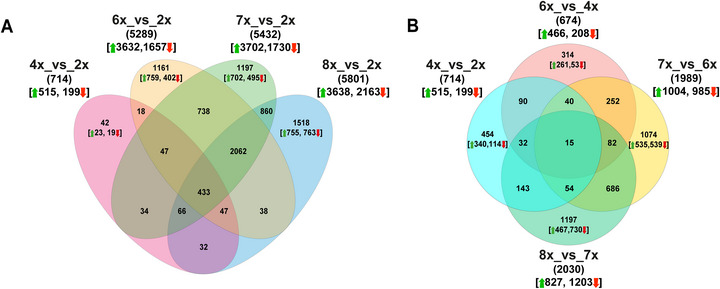 Figure 7
Peer Reviews
No public reviews on file for this paper yet. If you reviewed it on a platform where reviews are public (OpenReview, ICLR, NeurIPS, ICML), you can paste yours below so the community can read it here.
Videos
No videos yet. Explain this paper in a talk, walkthrough, or lecture? Add one.
Taxonomy
TopicsChromosomal and Genetic Variations · Plant Molecular Biology Research · Plant Taxonomy and Phylogenetics