“Steak Dry Aging”: An Innovative Approach to Producing High‐Yield, High‐Quality Dry‐Aged Beef
Jean Carlos dos Santos, Angélica Sousa Guimarães, Lorrany Ramos do Carmo, Márcia Cristina Teixeira da Silveira, Alcinéia de Lemos Souza Ramos, Leandro Sâmia Lopes, Eduardo Mendes Ramos

TL;DR
A new steak dry-aging method increases yield and reduces waste while maintaining quality, making premium dry-aged beef more affordable and scalable.
Contribution
The study introduces a novel steak dry-aging protocol that improves yield and process efficiency without compromising quality.
Findings
StDA increased saleable yield by up to 35% compared to conventional dry aging.
StDA preserved sensory attributes and microbiological quality similar to traditional methods.
StDA allows aging during distribution, reducing trimming and processing time.
Abstract
This study evaluated a novel steak dry‐aging (StDA) protocol in which portioned beef steaks were dry‐aged until reaching an average weight loss of 15% and subsequently wet‐aged to achieve a total aging time of either 14 or 28 days. The new protocol was compared with conventional dry aging (DA) for 28 days and unaged controls. Under the experimental conditions, StDA increased saleable yield (up to 35% higher than DA) and reduced trimming steps during processing. Physicochemical composition, water activity, total free amino acids, and microbiological quality (< 3.5 log CFU/g) were similar between DA and StDA samples. StDA aged for 28 days had a free amino acid profile comparable to DA, but with higher glutamic acid content (2.30 vs. 0.80 mg/g protein), associated with umami flavor, and lower taurine content (0.59 vs. 1.13 mg/g protein). DA samples had lower shear force (27.45 vs. 35.54 N)…
Genes, proteins, chemicals, diseases, species, mutations and cell lines named across the full text — each resolved to its canonical identifier and authoritative record.
Click any figure to enlarge with its caption.
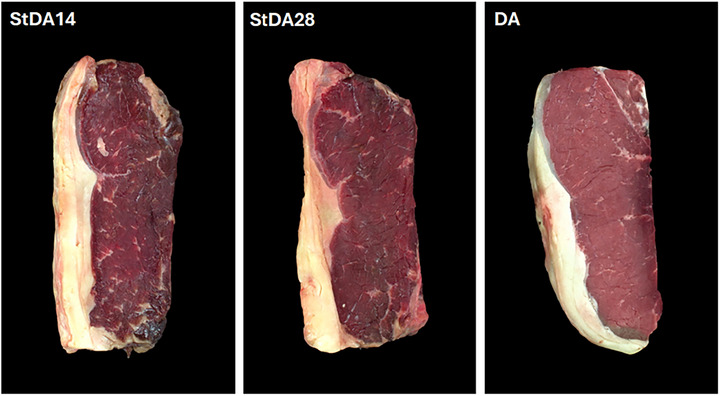 Figure 1
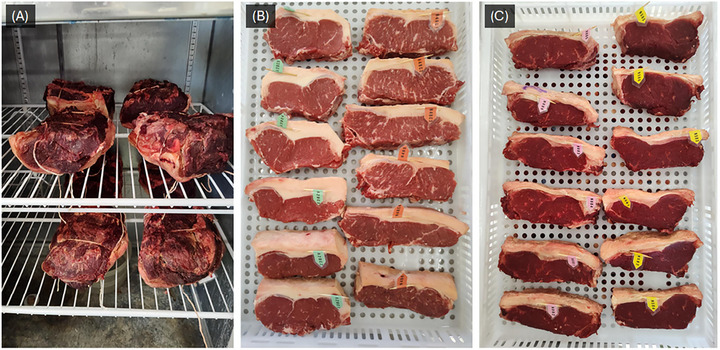 Figure 2
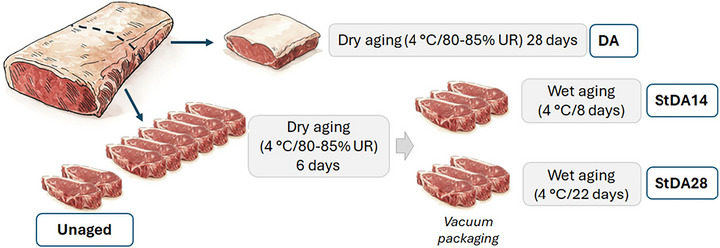 Figure 3
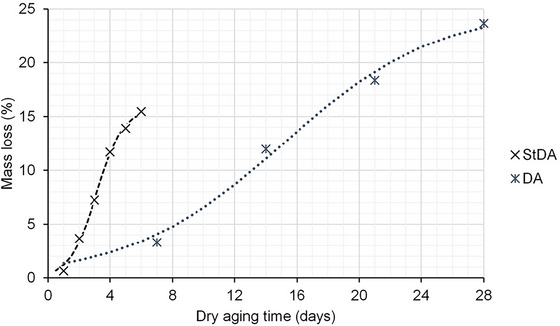 Figure 4
Peer Reviews
No public reviews on file for this paper yet. If you reviewed it on a platform where reviews are public (OpenReview, ICLR, NeurIPS, ICML), you can paste yours below so the community can read it here.
Videos
No videos yet. Explain this paper in a talk, walkthrough, or lecture? Add one.
Taxonomy
TopicsMeat and Animal Product Quality · Polyamine Metabolism and Applications · Aquaculture Nutrition and Growth