Sex Alters Hypoxic Responses in Caenorhabditis elegans
Andrew P. Bischer, Katherine E. Neyland, Nada Ahmed Selim, Andrew P. Wojtovich

TL;DR
This study shows that male C. elegans are more resistant to low oxygen than hermaphrodites, and their movement is less affected by sudden oxygen changes.
Contribution
The study reveals that neuronal sex influences hypoxic responses and that sex determination components can alter these responses independently of biological sex.
Findings
C. elegans males are more resistant to long-term hypoxic injury than hermaphrodites.
Male worms show reduced sensitivity of locomotory speed to acute oxygen changes.
Sex determination pathway overexpression can modify hypoxic responses regardless of biological sex.
Abstract
The expression of shared behaviors can exhibit sexual dimorphism, which is often mediated by neuronal sex. However, the role of behavioral entrainment by environmental conditions as a function of underlying sex has been less studied. Here, we demonstrate that Caenorhabditis elegans males are more resistant to long-term hypoxic injury than hermaphrodites and that their locomotory speed exhibits reduced sensitivity to acute changes in oxygen. Using cell-specific sex reversal, we investigated whether neuronal biological sex influences oxygen-dependent locomotory behavior. These data suggest that the overexpression of sex determination pathway components can modify hypoxic behavioral responses independently of underlying biological sex.
Genes, proteins, chemicals, diseases, species, mutations and cell lines named across the full text — each resolved to its canonical identifier and authoritative record.
Click any figure to enlarge with its caption.
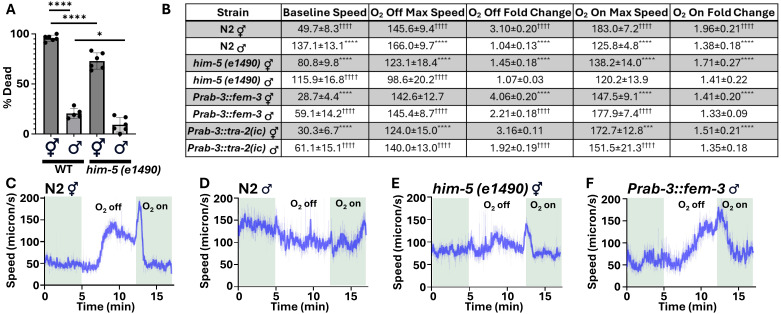 Figure 1
Peer Reviews
No public reviews on file for this paper yet. If you reviewed it on a platform where reviews are public (OpenReview, ICLR, NeurIPS, ICML), you can paste yours below so the community can read it here.
Videos
No videos yet. Explain this paper in a talk, walkthrough, or lecture? Add one.
Taxonomy
TopicsGenetics, Aging, and Longevity in Model Organisms · Evolution and Genetic Dynamics · Neurobiology and Insect Physiology Research