Developing and Validating Measures of Structural Ableism to Improve Health Outcomes for the Disability Community: Protocol for a Mixed Methods Study
Rupa S Valdez, Bonnielin K Swenor, Franz Castro, Caroline Cerilli, Bailey A Middleton, Kara S Fitzgibbon, Ashley Shew, Varshini Varadaraj, Hari Srinivasan, Diana Cejas

TL;DR
This study aims to develop and validate measures of structural ableism to better understand and address health disparities in the disability community.
Contribution
The study introduces a novel mixed-methods approach to measure structural ableism, a previously unquantified form of structural oppression.
Findings
The project will create individual and community-level measures of structural ableism through a three-phase mixed-methods approach.
The study emphasizes community engagement and inclusion of diverse disability perspectives across all research phases.
Initial progress includes analyzing over 50 texts to characterize structural ableism, with full measures expected by 2029.
Abstract
Structural ableism, defined as the processes, policies, and institutions that privilege able-bodied people over disabled people, is a root cause of health inequalities faced by the disability community. Unlike other forms of structural oppression, there are currently no adequate measurements for structural ableism and its impacts. Therefore, a necessary first step to addressing health inequities that impact the disability community is to create validated measures of structural ableism. This paper outlines the methods of an ongoing project that aims to develop and validate measures of structural ableism. The resulting measures will facilitate the identification of relationships between structural ableism and health outcomes at both an individual and community level. This project will take place across 3 phases. In Phase I, we will characterize the multiple factors that comprise the…
Genes, proteins, chemicals, diseases, species, mutations and cell lines named across the full text — each resolved to its canonical identifier and authoritative record.
Click any figure to enlarge with its caption.
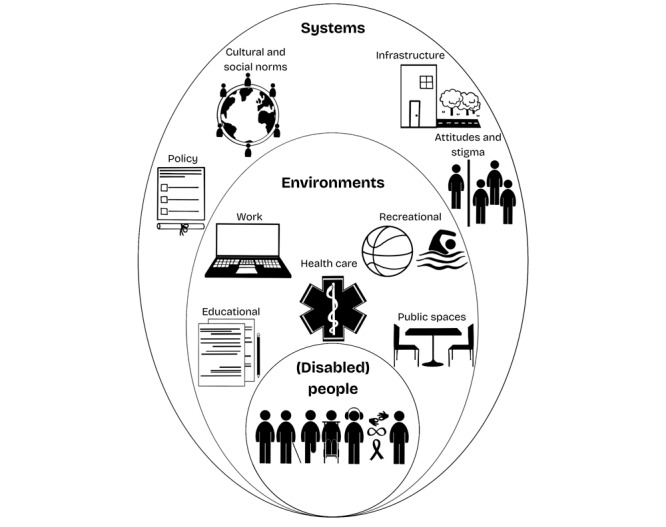 Figure 1
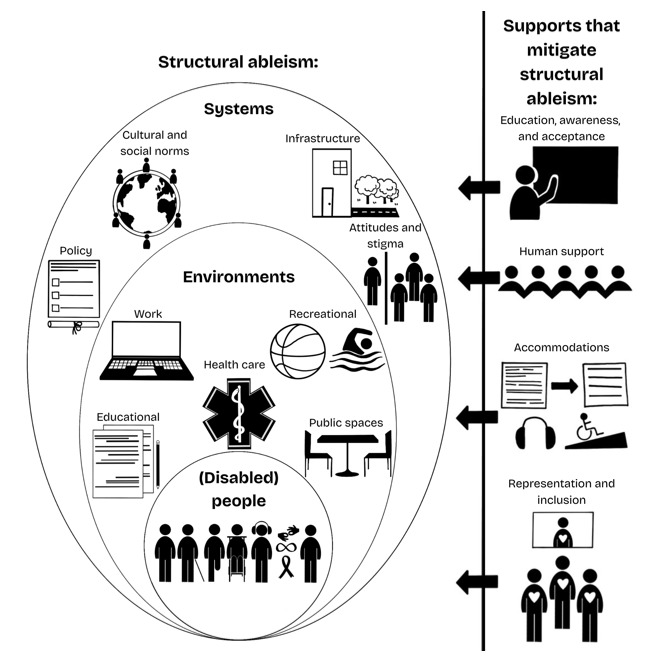 Figure 2
Peer Reviews
No public reviews on file for this paper yet. If you reviewed it on a platform where reviews are public (OpenReview, ICLR, NeurIPS, ICML), you can paste yours below so the community can read it here.
Videos
No videos yet. Explain this paper in a talk, walkthrough, or lecture? Add one.
Taxonomy
TopicsDisability Rights and Representation · Cerebral Palsy and Movement Disorders · Down syndrome and intellectual disability research