Seasonal variability of the microzooplankton biomass and community composition on the Northeast US Shelf
Frankie Lopez, Pierre Marrec, Susanne Menden-Deuer

TL;DR
This study examines how microzooplankton biomass and community composition vary seasonally on the Northeast US Shelf and their impact on marine food webs.
Contribution
The study provides new insights into the seasonal and spatial variability of microzooplankton and their role in marine food web dynamics.
Findings
Dinoflagellate biomass shifts seasonally from larger winter cells to smaller summer cells.
Ciliate biomass does not show consistent seasonal trends.
Microzooplankton community composition anomalies correlate with changes in phytoplankton size structure.
Abstract
Grazing on phytoplankton by microzooplankton is a critical process in making energy available to higher trophic levels, shaping marine food webs, and biogeochemical cycling. Despite its key role, the drivers of grazing remain poorly constrained due to the concurrent influences of biotic and abiotic factors. To elucidate the impact of microzooplankton biomass and community composition on grazing rates, we measured ciliate and dinoflagellate biomass in boreal summer and winter from 2018-2023, at three stations spanning the Northeast US Shelf from coastal Rhode Island, USA to the shelf break. This record of microzooplankton biomass encompasses the seasonal and spatial variability from shore to shelf. Dinoflagellate biomass showed a clear seasonal shift from larger (>20 μm) cells in winter to smaller ones in summer, while ciliate biomass lacked seasonal trends. Anomalies in community…
Click any figure to enlarge with its caption.
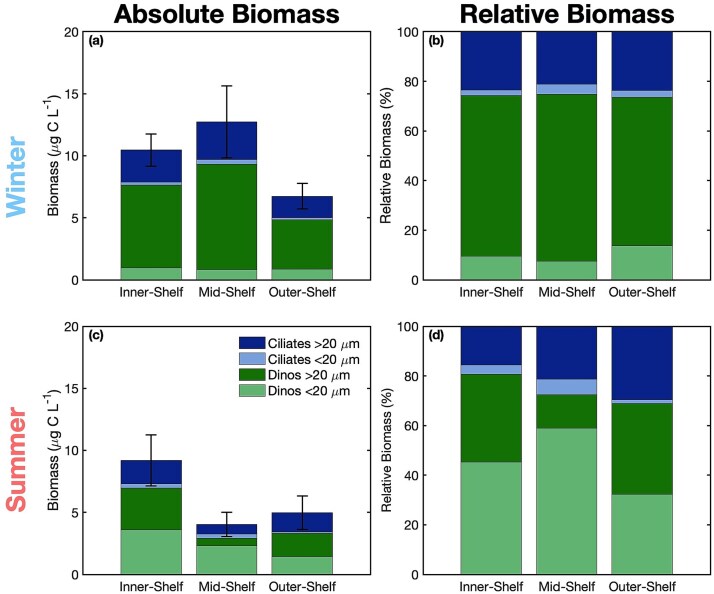 Figure 1
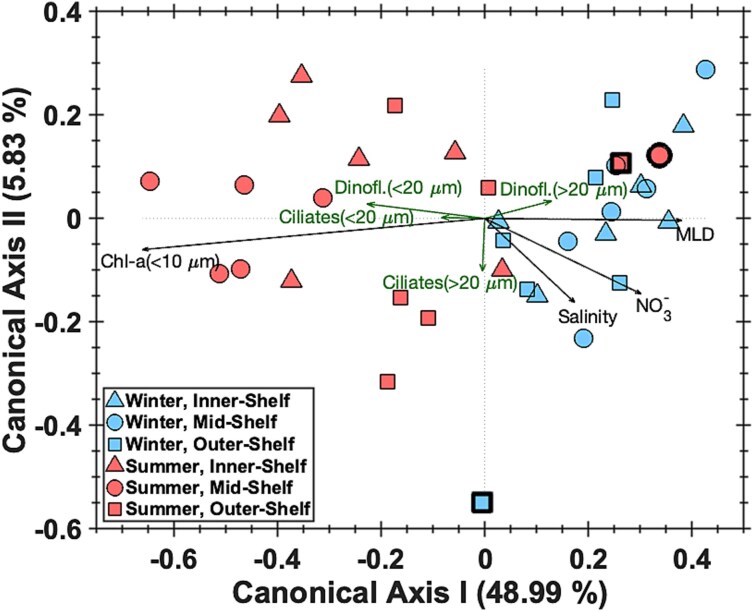 Figure 2
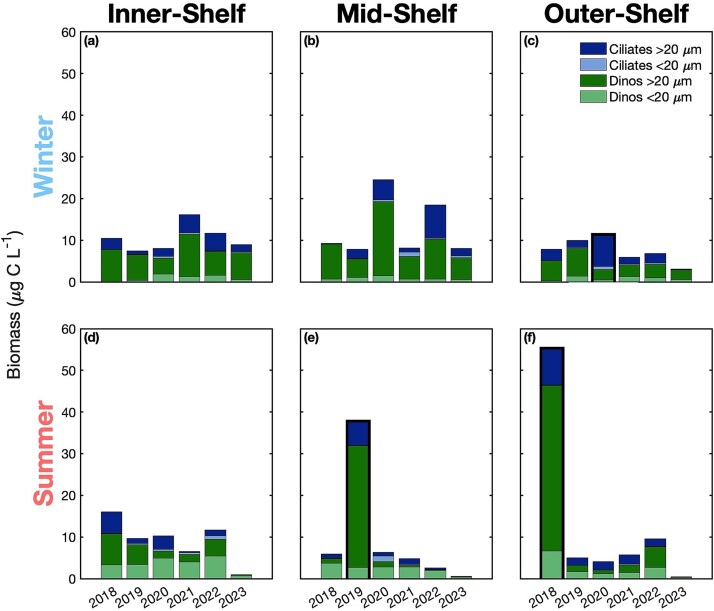 Figure 3
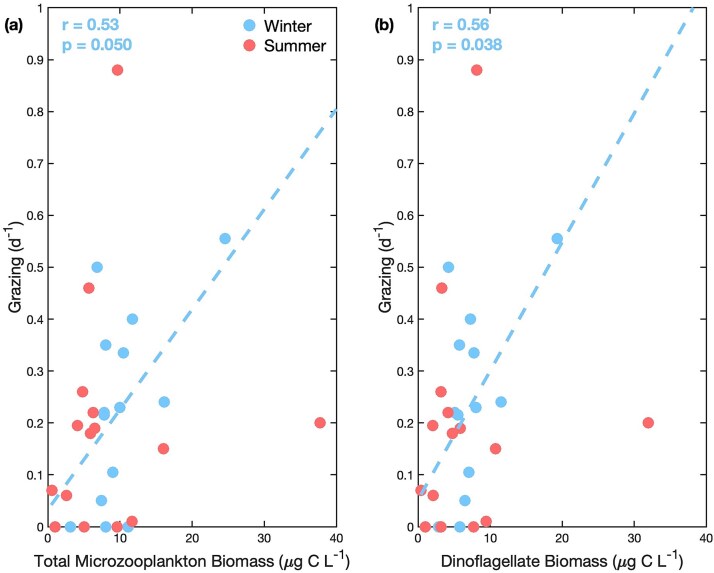 Figure 4
Peer Reviews
No public reviews on file for this paper yet. If you reviewed it on a platform where reviews are public (OpenReview, ICLR, NeurIPS, ICML), you can paste yours below so the community can read it here.
Videos
No videos yet. Explain this paper in a talk, walkthrough, or lecture? Add one.
Taxonomy
TopicsMarine and coastal ecosystems · Oceanographic and Atmospheric Processes · Marine Toxins and Detection Methods