A Stellar magnesium to silicon ratio in the atmosphere of an exoplanet
Jorge A. Sanchez, Peter C. B. Smith, Krishna Kanumalla, Luis Welbanks, Michael R. Line, Stefan Pelletier, Steven Desch, Patrick Young, Jennifer Patience, Jacob Bean, Matteo Brogi, Dan Jaffe, Gregory N. Mace, Megan Weiner Mansfield, Vatsal Panwar, Vivien Parmentier, Lorenzo Pino

TL;DR
This study finds that the magnesium to silicon ratio in the atmosphere of the exoplanet WASP-189b matches that of its host star, supporting the idea that planetary compositions reflect their formation environment.
Contribution
The study empirically validates the assumption that exoplanet refractory element ratios mirror their host star's.
Findings
Mg/Si, Fe/Mg, and Si/Fe ratios in WASP-189b's atmosphere are consistent with stellar values.
The refractory-to-volatile ratio in the exoplanet's atmosphere is enhanced by a factor of 2.
Detection of Fe i, Mg i, Si i, H2O, CO, and OH in the atmosphere confirms the presence of refractory and volatile species.
Abstract
The elemental compositions of exoplanets encode information about their formation environments and internal structures. While volatile ratios such as carbon-to-oxygen (C/O) are used to trace formation location, the rock-forming elements–magnesium (Mg), silicon (Si), and iron (Fe)–govern interior mineralogy and are commonly assumed to reflect the host star’s abundances. Yet this assumption remains largely untested. Ultra-hot Jupiters, gas-giant exoplanets with dayside temperatures above 3000 K, provide rare access to refractory elements that remain gaseous. Here we present high-resolution thermal emission spectroscopy of the exoplanet WASP-189b (\documentclass[12pt]{minimal} \usepackage{amsmath} \usepackage{wasysym} \usepackage{amsfonts} \usepackage{amssymb} \usepackage{amsbsy} \usepackage{mathrsfs} \usepackage{upgreek} \setlength{\oddsidemargin}{-69pt}…
Genes, proteins, chemicals, diseases, species, mutations and cell lines named across the full text — each resolved to its canonical identifier and authoritative record.
Click any figure to enlarge with its caption.
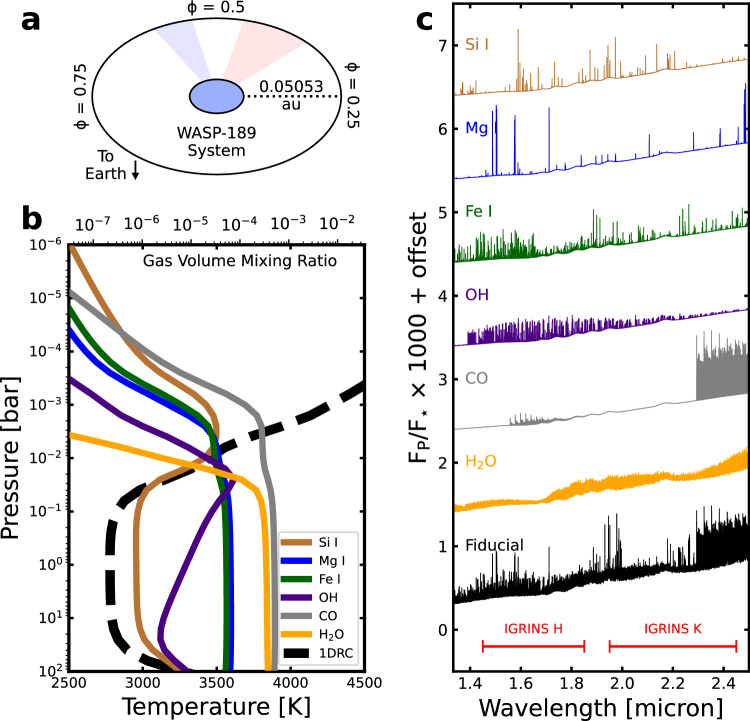 Figure 1
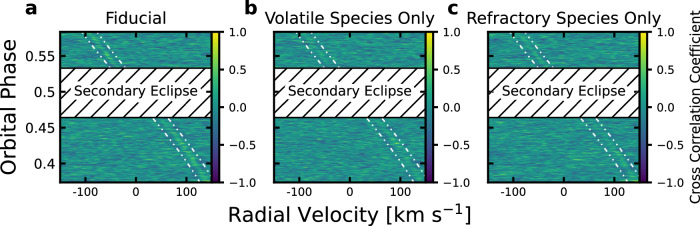 Figure 2
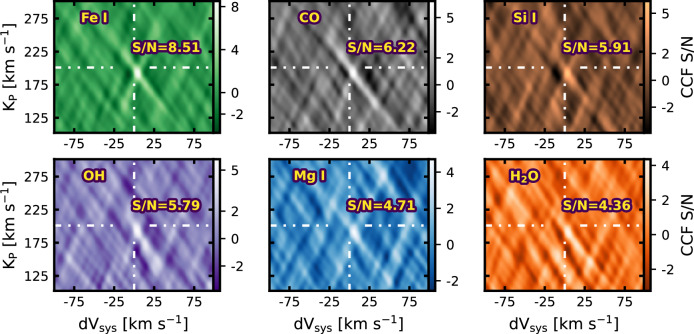 Figure 3
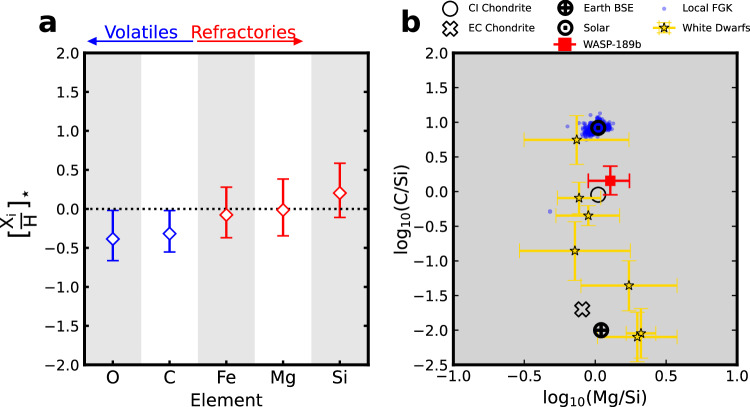 Figure 4
Peer Reviews
No public reviews on file for this paper yet. If you reviewed it on a platform where reviews are public (OpenReview, ICLR, NeurIPS, ICML), you can paste yours below so the community can read it here.
Videos
No videos yet. Explain this paper in a talk, walkthrough, or lecture? Add one.
Taxonomy
TopicsStellar, planetary, and galactic studies · Astrophysics and Star Formation Studies · Astronomy and Astrophysical Research