Thirty years of contact angles reveal universal design rules for wetting control
Amir Karimdoost Yasuri

TL;DR
This paper identifies universal thresholds for superhydrophilic and superhydrophobic surfaces using a large dataset of contact angle measurements.
Contribution
The study provides empirically validated universal design rules for wetting behavior across diverse materials and surface geometries.
Findings
Superhydrophilicity is defined by contact angles ≲ 20°, and superhydrophobicity by ≳ 150°.
These thresholds are geometry-dominated and consistent across material types.
The dataset serves as a benchmark for predictive wettability design and machine learning models.
Abstract
Wettability, commonly quantified by the static contact angle (θ), governs critical interfacial phenomena including anti-icing, self-cleaning, adhesion control, and lubrication. Although conceptual thresholds for superhydrophilic and superhydrophobic states are widely cited, their empirical validation across material classes has remained limited by the absence of a comprehensive, rigorously verified dataset spanning diverse surfaces and liquids. Here, we compile and systematically analyze 110 curated static contact-angle measurements reported between 1995 and 2025, encompassing polymers, metals, oxides, self-assembled monolayers (SAMs), and micro-/nano-textured surfaces measured with multiple probe liquids. Our meta-analysis quantitatively confirms the existence of universal critical thresholds, with θ ≲ 20° defining superhydrophilicity and θ ≳ 150° defining superhydrophobicity.…
Genes, proteins, chemicals, diseases, species, mutations and cell lines named across the full text — each resolved to its canonical identifier and authoritative record.
Click any figure to enlarge with its caption.
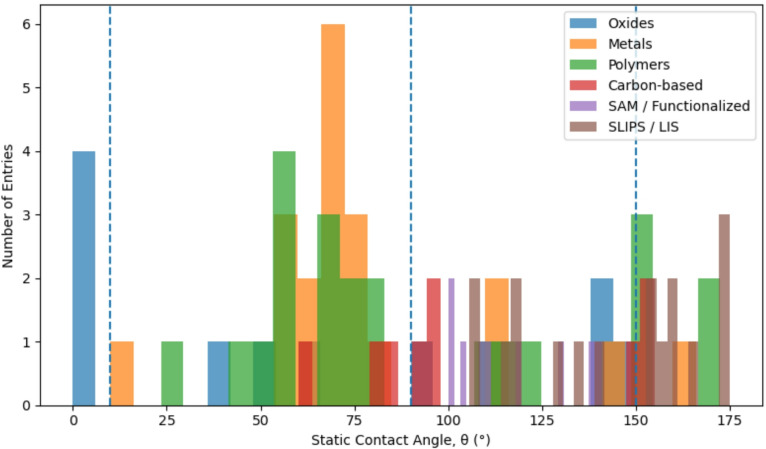 Figure 1
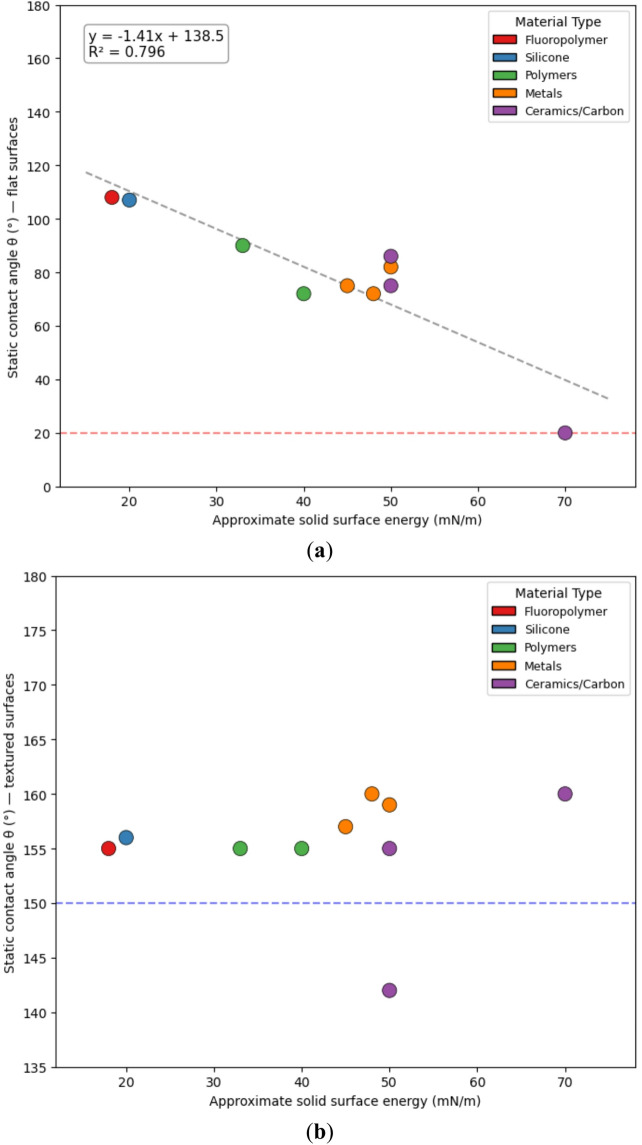 Figure 2
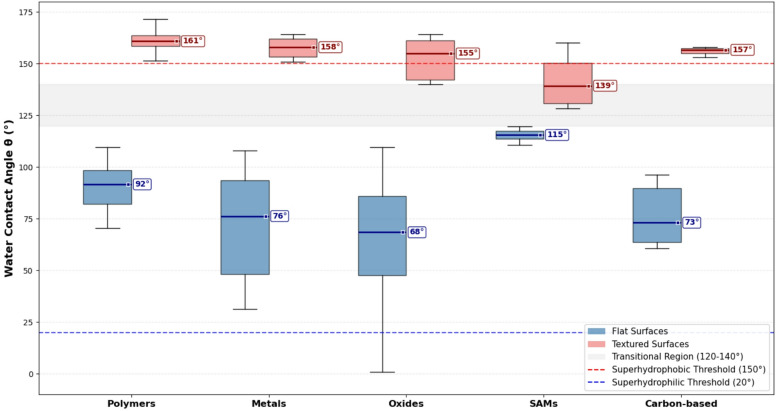 Figure 3
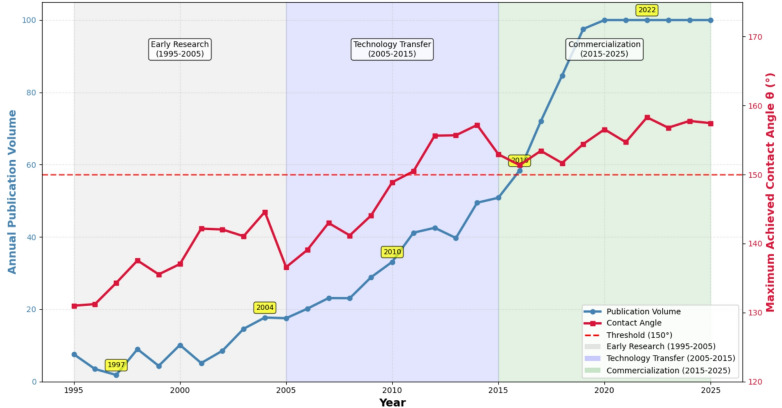 Figure 4
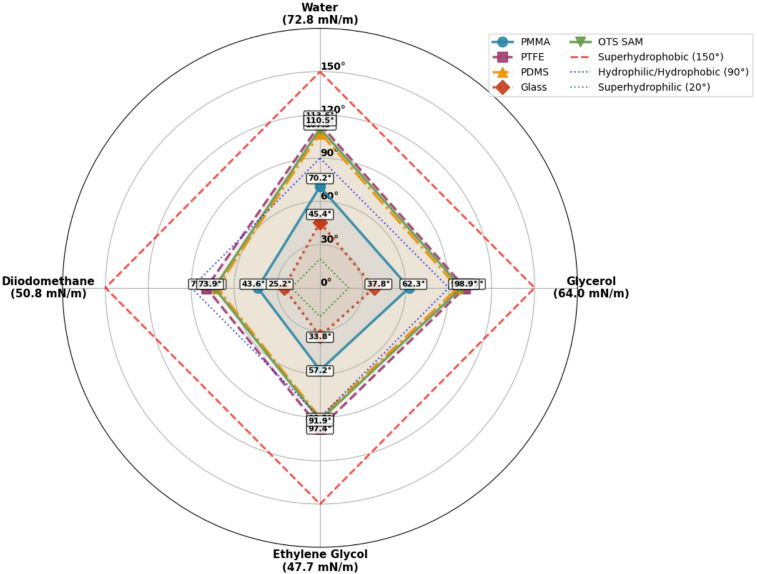 Figure 5
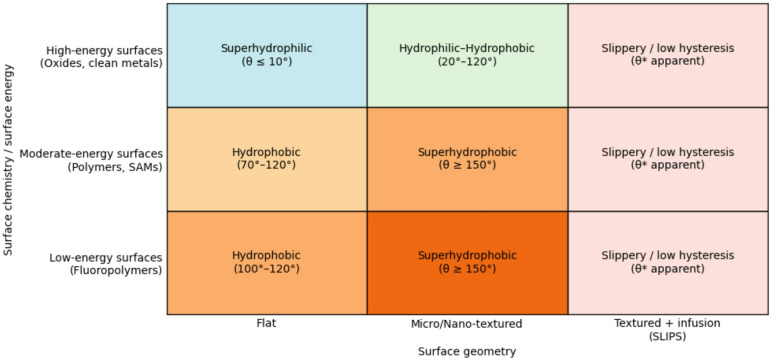 Figure 6
Peer Reviews
No public reviews on file for this paper yet. If you reviewed it on a platform where reviews are public (OpenReview, ICLR, NeurIPS, ICML), you can paste yours below so the community can read it here.
Videos
No videos yet. Explain this paper in a talk, walkthrough, or lecture? Add one.
Taxonomy
TopicsSurface Modification and Superhydrophobicity · Adhesion, Friction, and Surface Interactions · Mechanical stress and fatigue analysis