Prediction of strong Cu(I)–He interaction at open metal sites enables isotope-selective helium adsorption
Elvira Gouatieu Dongmo, Shubhajit Das, Felix Moncada, Toshiki Riemer-Wulf, Thomas Heine

TL;DR
Researchers discovered that copper(I) sites can strongly bind helium, enabling the separation of helium isotopes at low temperatures.
Contribution
The study reveals unexpectedly strong Cu(I)-He interactions and predicts isotope-selective adsorption at practical temperatures.
Findings
Cu(I) sites with proper ligands bind helium with up to 19 kJ mol-1 energy.
The Cu(I)-He interaction causes significant 4He/3He zero-point energy differences.
Zeolites and MOFs with undercoordinated Cu(I) sites show a predicted 4He/3He separation factor of up to three at 20 K.
Abstract
Helium is generally known as an inert element due to its high ionization potential, zero electron affinity, and low polarizability. Here, we demonstrate that Cu(I) sites with favorably coordinated ligands reach unexpectedly large He binding energies, up to 19 kJ mol-1, due to He polarization and charge accumulation along the Cu-He bond. First, we perform accurate electronic structure calculations on a series of Cu(I)-He gas phase clusters to elucidate the nature of the Cu-He interaction. Then, we establish a predictive model to study larger systems hosting Cu(I) sites, including crown ethers, zeolites and metal-organic frameworks (MOFs). The strong Cu(I)-He interaction induces significant differences in the 4He/3He zero-point energies, allowing prediction of selective isotope adsorption at technologically relevant temperatures (20–77 K). In particular, undercoordinated Cu(I) sites found…
Genes, proteins, chemicals, diseases, species, mutations and cell lines named across the full text — each resolved to its canonical identifier and authoritative record.
Click any figure to enlarge with its caption.
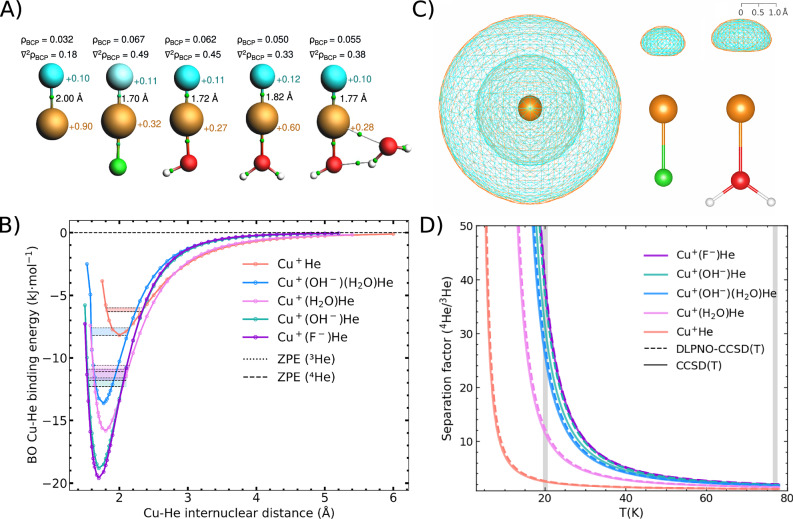 Figure 1
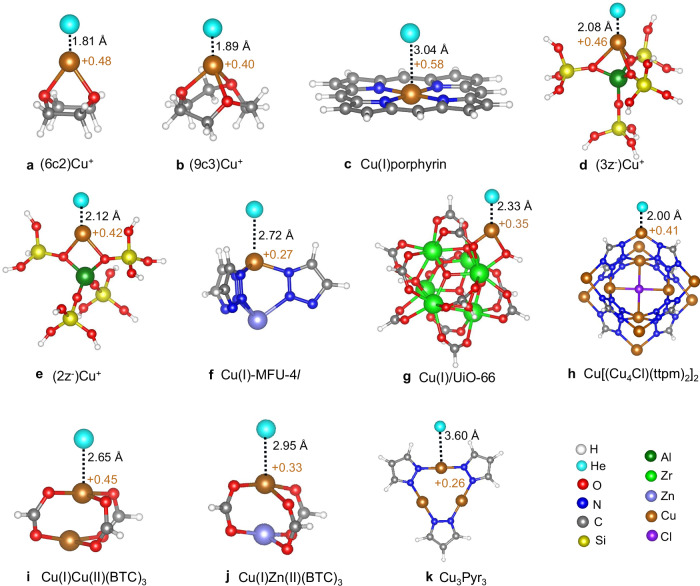 Figure 2
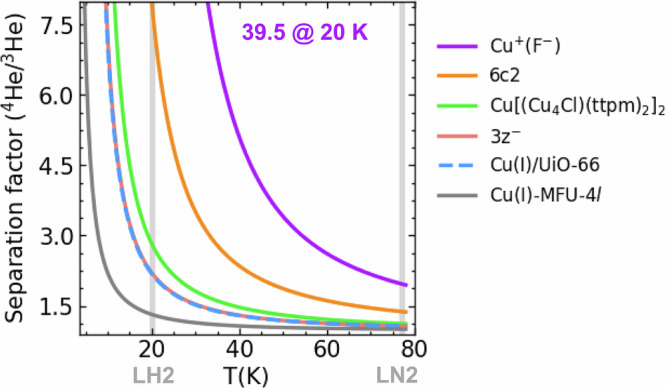 Figure 3
Peer Reviews
No public reviews on file for this paper yet. If you reviewed it on a platform where reviews are public (OpenReview, ICLR, NeurIPS, ICML), you can paste yours below so the community can read it here.
Videos
No videos yet. Explain this paper in a talk, walkthrough, or lecture? Add one.
Taxonomy
TopicsInorganic Fluorides and Related Compounds · Metal-Organic Frameworks: Synthesis and Applications · Advanced NMR Techniques and Applications