AGGRESCAN and its evolution: A two-decade perspective on protein aggregation prediction
Giulia Pesce, Oriol Solé, Oriol Bárcenas, Salvador Ventura

TL;DR
This paper reviews the development and impact of the Aggrescan platform, a tool for predicting protein aggregation, over the past two decades.
Contribution
The paper introduces Aggrescan4D and highlights the integration of AlphaFold models for proteome-scale aggregation analysis.
Findings
Aggrescan has evolved from sequence-based to structure-based and now includes 4D analysis.
AlphaFold integration enables large-scale exploration of aggregation determinants.
The platform is widely used in biotechnology and biomedical research for protein redesign.
Abstract
Protein aggregation is a widespread phenomenon with profound biological, biomedical, and biotechnological implications. In human disease, aberrant protein self-assembly is a hallmark of numerous neurodegenerative disorders, whereas in the biopharmaceutical industry, aggregation complicates the production, stability, and formulation of therapeutic proteins. The Aggrescan platform was one of the first empirically based tools designed to predict aggregation-prone regions (APRs) within protein sequences. It has since expanded to incorporate three-dimensional structural contexts and environmental conditions. This review provides a comprehensive overview of the development, application, and impact of the Aggrescan family of tools, which includes AGGRESCAN, Aggrescan3D, and the recent Aggrescan4D. We examine the algorithmic foundations, empirical validation, and key use cases spanning fields…
Genes, proteins, chemicals, diseases, species, mutations and cell lines named across the full text — each resolved to its canonical identifier and authoritative record.
Click any figure to enlarge with its caption.
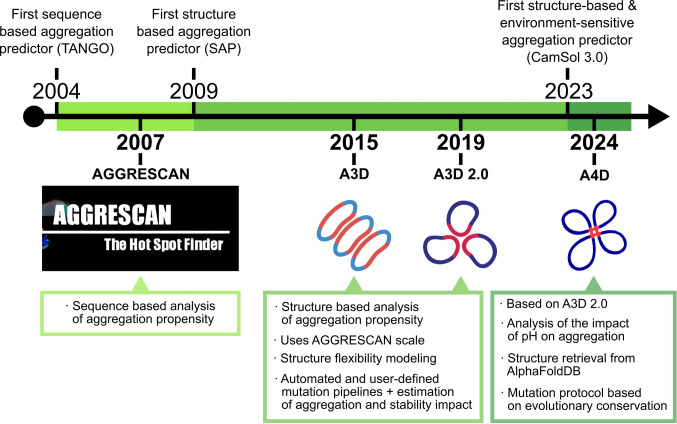 Figure 1
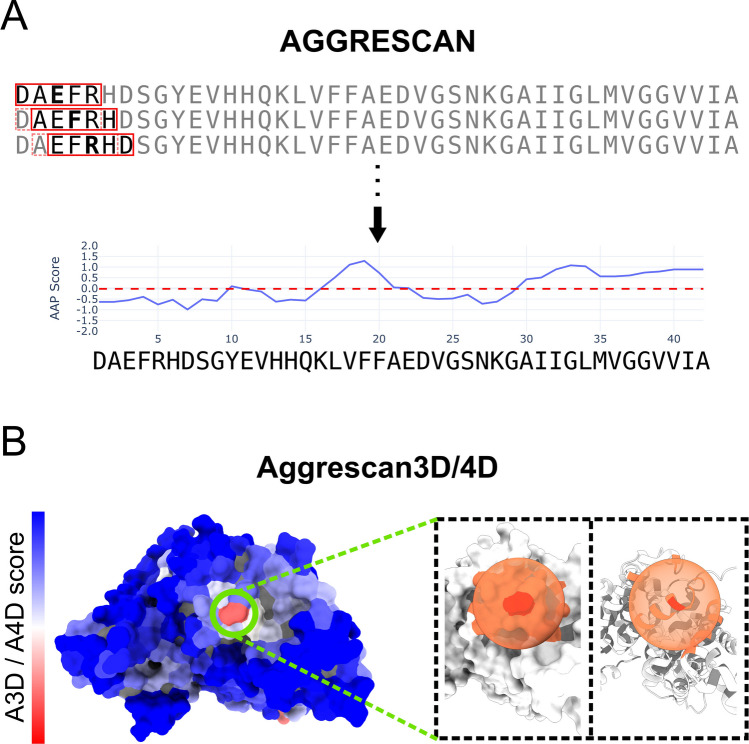 Figure 2
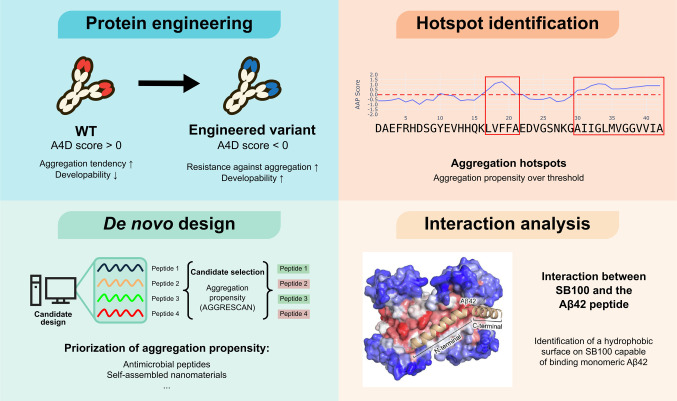 Figure 3
Peer Reviews
No public reviews on file for this paper yet. If you reviewed it on a platform where reviews are public (OpenReview, ICLR, NeurIPS, ICML), you can paste yours below so the community can read it here.
Videos
No videos yet. Explain this paper in a talk, walkthrough, or lecture? Add one.
Taxonomy
TopicsMachine Learning in Bioinformatics · Cell Image Analysis Techniques · Bioinformatics and Genomic Networks