Non-cascade random walks in solid-state high harmonic generation
Zitan Zuo, Yiwen Wang, Shengzhe Pan, Lulu Han, Yidan Xu, Dian Wu, Shicheng Jiang, Jian Wu

TL;DR
Researchers developed a new way to perform high-dimensional random walks using light's orbital angular momentum in a solid-state system, avoiding the need for cascaded setups.
Contribution
A non-cascade, high-dimensional random walk in the OAM space of light using solid-state high-harmonic spectroscopy is demonstrated.
Findings
Nonlinear crystal symmetry dictates the orbital angular momentum distribution of generated harmonics.
The approach enables ultrafast, high-dimensional random walks without cascaded implementations.
This method offers a compact and stable platform for photonic information processing.
Abstract
Random walks—both classical and quantum—unlocked new possibilities in search algorithms and information processing. Although linear photonic systems, with flexible tunability and multiple degrees of freedom, have served as efficient carriers for random walks, they typically require cascaded implementations, presenting a potential limitation on realizing integrated photonic circuits. In this work, we demonstrate a non-cascade, high-dimensional random walk in the orbital angular momentum (OAM) space of light using solid-state high-harmonic spectroscopy. The crystal nonlinearity enables the simultaneous conversion of multiple photons into a series of harmonics with distinct colors and whose OAM distributions are determined by the symmetry of the crystal. This approach reveals the dynamics of photonic degrees of freedom in high-harmonic generation can be naturally framed as an ultrafast,…
Genes, proteins, chemicals, diseases, species, mutations and cell lines named across the full text — each resolved to its canonical identifier and authoritative record.
Click any figure to enlarge with its caption.
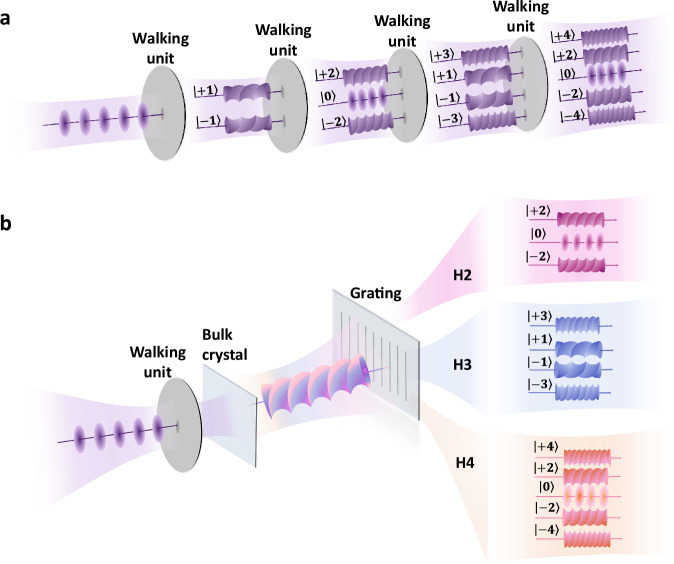 Figure 1
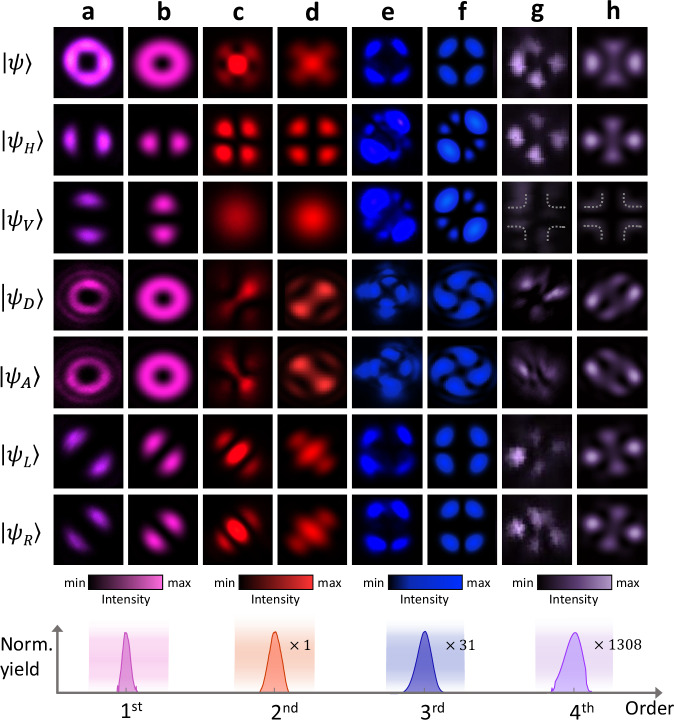 Figure 2
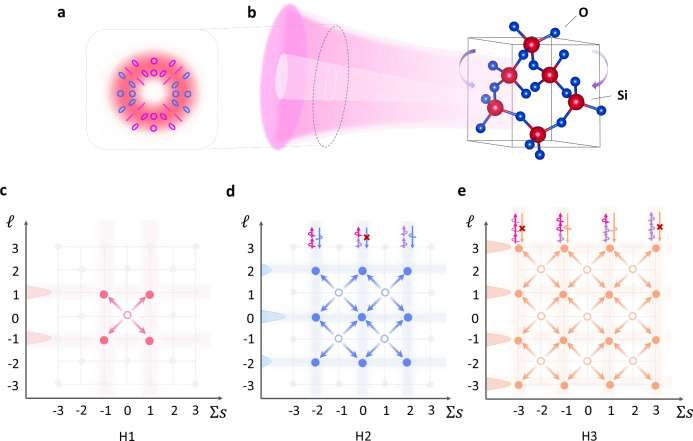 Figure 3
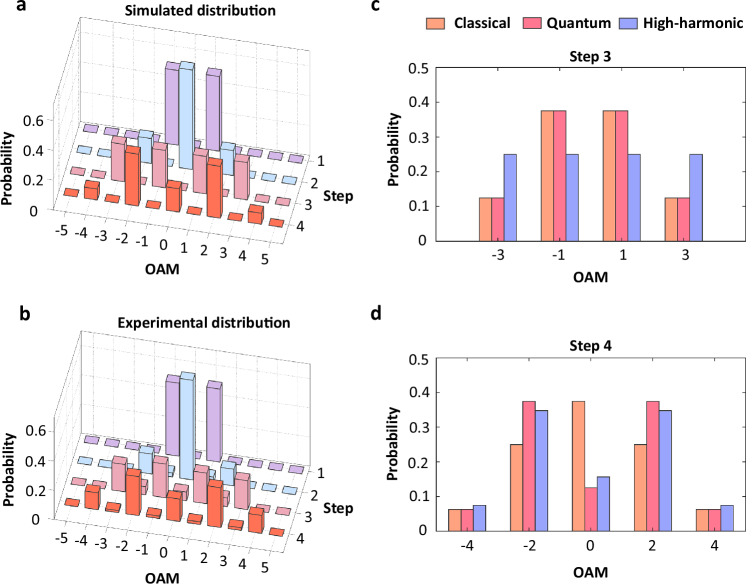 Figure 4
Peer Reviews
No public reviews on file for this paper yet. If you reviewed it on a platform where reviews are public (OpenReview, ICLR, NeurIPS, ICML), you can paste yours below so the community can read it here.
Videos
No videos yet. Explain this paper in a talk, walkthrough, or lecture? Add one.
Taxonomy
TopicsOrbital Angular Momentum in Optics · Photonic Crystals and Applications · Neural Networks and Reservoir Computing