Leveraging machine learning for digital gait analysis in ataxia using sensor-free motion capture
Philipp Wegner, Marcus Grobe-Einsler, Lara Reimer, Fabian Kahl, Berkan Koyak, Tim Elter, Alexander Lange, Okka Kimmich, Daniel Soub, Felix Hufschmidt, Sarah Bernsen, Mónica Ferreira, Thomas Klockgether, Jennifer Faber

TL;DR
Researchers used machine learning on video recordings to accurately assess walking problems in ataxia patients, detecting subtle changes that traditional methods miss.
Contribution
The study introduces sensor-free motion capture with ML to improve gait assessment in ataxia, capturing longitudinal and pre-symptomatic changes.
Findings
ML models accurately predicted clinical gait scores with an F1-score of 63.99%, slightly better than human ratings.
The model detected subtle gait changes in pre-symptomatic patients with an F1-score of 75.96%.
Longitudinal gait changes were captured with a Pearson’s correlation coefficient of −0.626, significantly better than human ratings.
Abstract
Gait disturbances are the clinical hallmark of ataxia. Their severity is assessed within a well-established clinical scale, which only allows coarse scoring and does not reflect the complexity of individual gait deterioration. We investigated whether sensor-free motion capture enables to replicate clinical scoring and improve the assessment of gait disturbances. The normal walking task during clinical assessment was videotaped in 91 ataxia patients and 28 healthy controls. A full-body pose estimation model (AlphaPose) was used to extract positions, distances, and angles over time while walking. The resulting time series were analyzed with four machine learning (ML) models, which were combinations of feature extraction (tsfresh, ROCKET) and prediction methods (XGBoost, Ridge). First, in a regression and classification approach, we trained the ML models on reconstructing the clinical…
Genes, proteins, chemicals, diseases, species, mutations and cell lines named across the full text — each resolved to its canonical identifier and authoritative record.
Click any figure to enlarge with its caption.
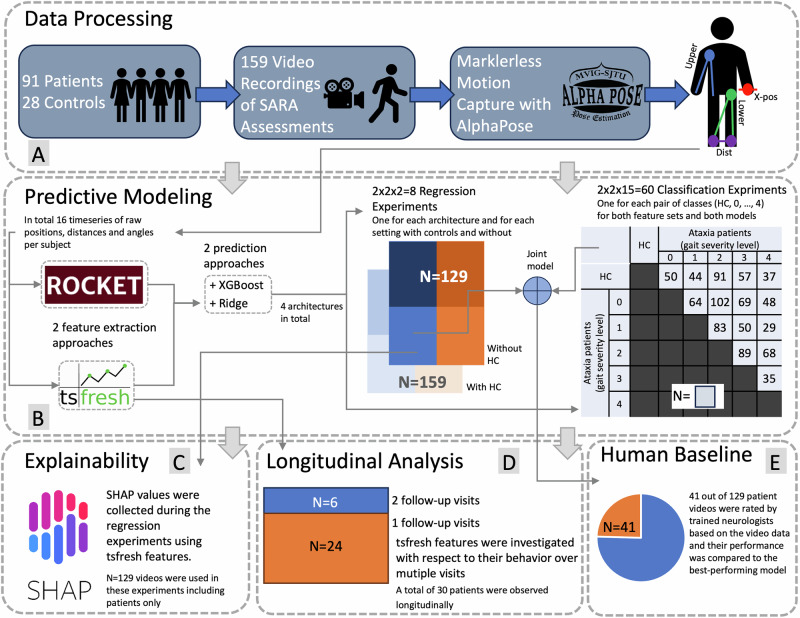 Figure 1
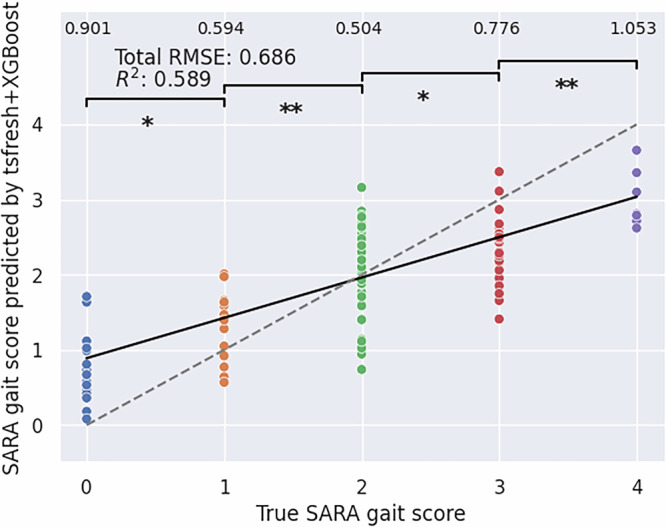 Figure 2
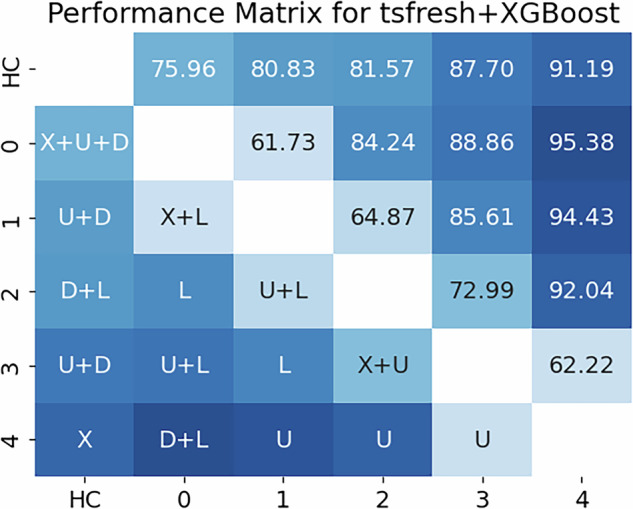 Figure 3
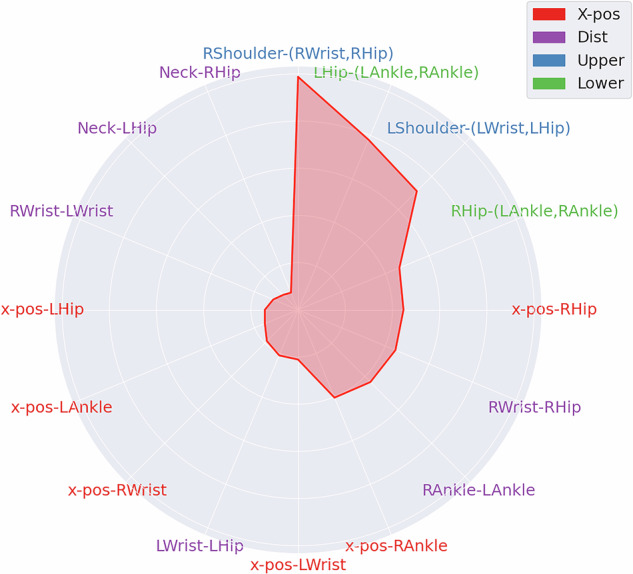 Figure 4
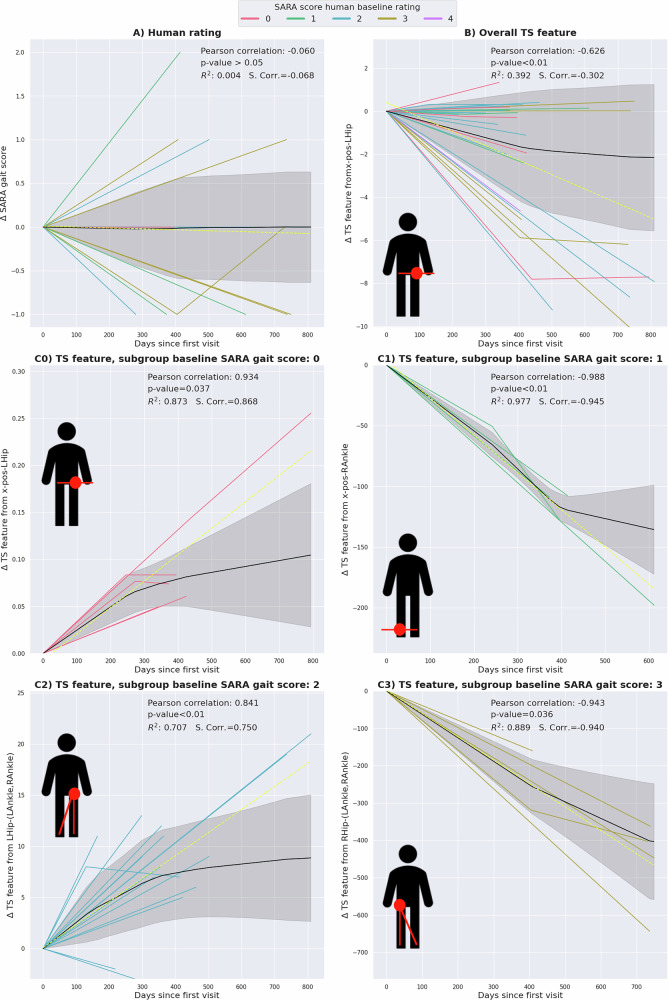 Figure 5
Peer Reviews
No public reviews on file for this paper yet. If you reviewed it on a platform where reviews are public (OpenReview, ICLR, NeurIPS, ICML), you can paste yours below so the community can read it here.
Videos
No videos yet. Explain this paper in a talk, walkthrough, or lecture? Add one.
Taxonomy
TopicsBalance, Gait, and Falls Prevention · Genetic Neurodegenerative Diseases · Gait Recognition and Analysis