Minor groove tetrads: a potent and versatile capping interaction for i-motif structures
Miguel Garavís, Bartomeu Mir, Israel Serrano-Chacón, Cristina Cabrero, Cristina Ugedo, Irene Gómez-Pinto, Núria Escaja, Carlos González

TL;DR
Minor groove tetrads stabilize i-motif DNA structures, enabling versatile and responsive DNA nanostructures for biosensing and nanotechnology.
Contribution
Minor groove tetrads are introduced as a novel capping interaction that enhances i-motif stability and versatility.
Findings
MGTiMs show exceptional thermal and pH stability with tunable topology.
MGTiMs integrate into duplex junctions without distorting DNA geometry.
MGT stabilization synergizes with chemical modifications for real-time monitoring.
Abstract
Minor groove tetrads (MGTs) have emerged as powerful structural elements capable of enhancing the stability and versatility of i-motif DNA structures. These non-canonical tetrads, formed by the minor groove association of two Watson–Crick or mismatched base pairs, act as capping platforms that reinforce hemiprotonated C:C⁺ stacks, enabling i-motif folding even at neutral pH. The resulting MGT-containing i-motifs (MGTiMs) display exceptional thermal and pH stability, tunable topology, and remarkable structural plasticity. Recent studies have revealed that MGTiMs can form compact architectures with only two C:C⁺ pairs, undergo reversible pH-dependent conformational transitions, and integrate seamlessly into duplex junctions without distorting B-DNA geometry. These insights may add new principles for rational i-motif engineering, guiding the design of predictable, homogeneous, and…
Genes, proteins, chemicals, diseases, species, mutations and cell lines named across the full text — each resolved to its canonical identifier and authoritative record.
Click any figure to enlarge with its caption.
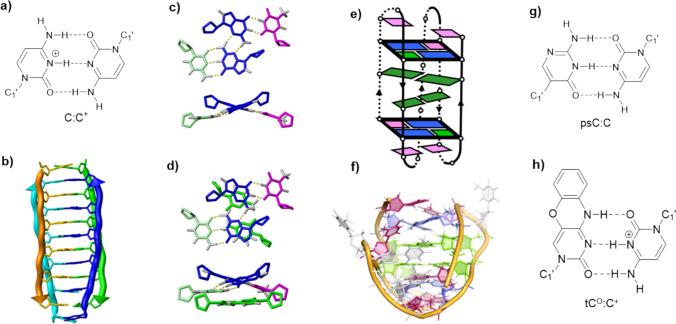 Figure 1
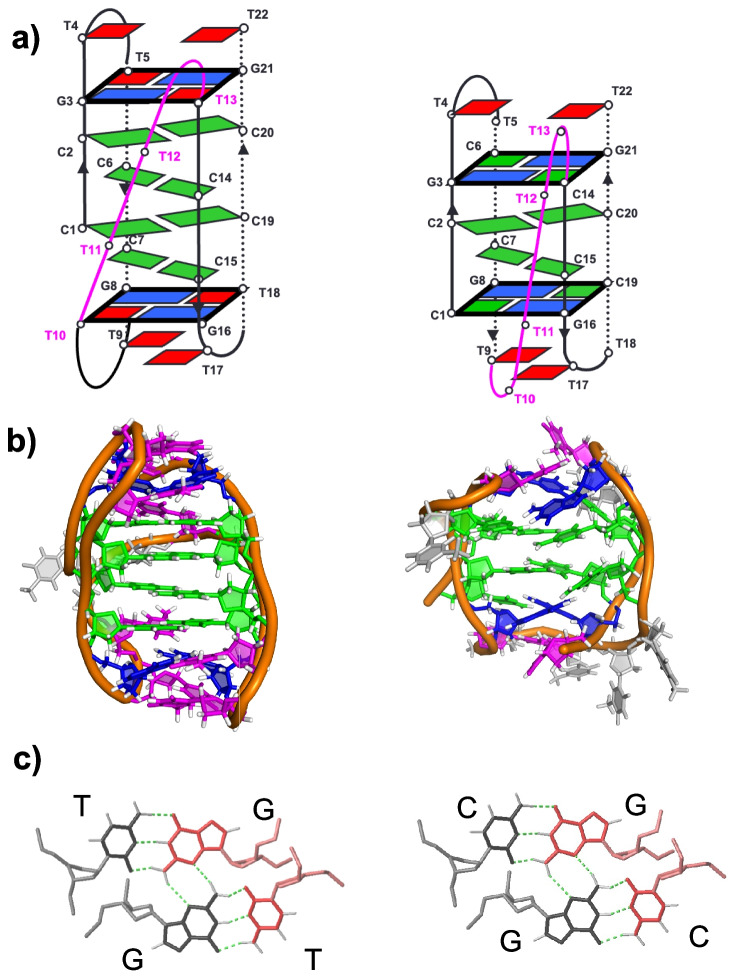 Figure 2
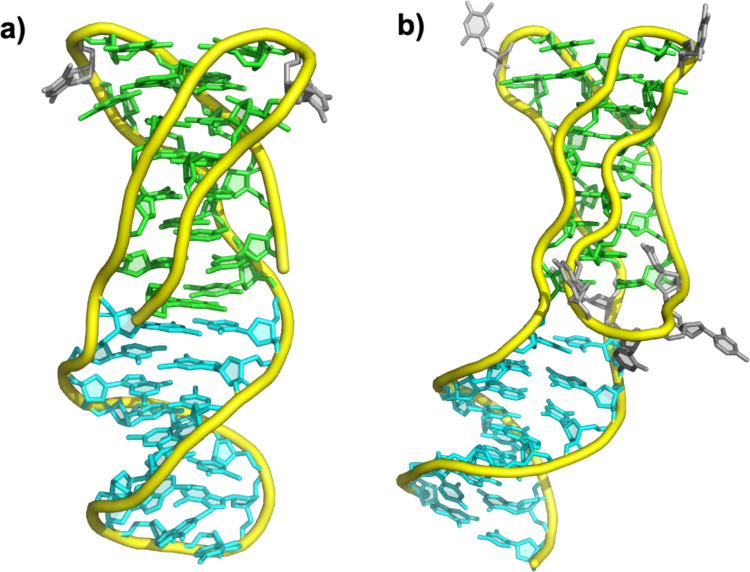 Figure 3
Peer Reviews
No public reviews on file for this paper yet. If you reviewed it on a platform where reviews are public (OpenReview, ICLR, NeurIPS, ICML), you can paste yours below so the community can read it here.
Videos
No videos yet. Explain this paper in a talk, walkthrough, or lecture? Add one.
Taxonomy
TopicsDNA and Nucleic Acid Chemistry · Advanced biosensing and bioanalysis techniques · Supramolecular Self-Assembly in Materials