High-resolution X-ray imaging via spatially decoupled heavy-atom antennas in organic scintillators
Chensen Li, Yaohui Li, Minghui Wu, Fan-Cheng Kong, Binxia Jia, Zonghang Liu, Xilong Wei, Philip C. Y. Chow, Zhicheng Wang, Xiaoming Li, Bo Xu, Zheng Zhao, Ryan T. K. Kwok, Jacky W. Y. Lam, Yucheng Liu, Shengzhong Frank Liu, Ben Zhong Tang

TL;DR
This paper introduces a new design for organic scintillators that improves X-ray imaging performance by optimizing light yield and resolution.
Contribution
The novel spatially decoupled heavy-atom antenna strategy enables high-performance organic scintillators for advanced X-ray imaging.
Findings
The scintillator achieves a short radiative lifetime of 3.74 ns and a high photoluminescence quantum yield of 100%.
It demonstrates a narrow radioluminescence bandwidth of 56 nm and a large Stokes shift of 110 nm.
The design supports spatial resolution around 50 lp mm-1, suitable for sensitive X-ray detection.
Abstract
Organic scintillators are promising for X-ray imaging due to low cost, sustainability, and tunable structures, but their commercial use is limited by poor understanding of charge transfer design for balancing light yield, decay, and bandwidth. Here, we propose a spatially decoupled heavy atom antenna strategy, integrating alkyl bromides into a hybridized local and charge-transfer scaffold to create a scintillator. This architecture leverages the moderate charge-transfer state to deliver an optimal combination of a short radiative lifetime (3.74 ns), a narrow radioluminescence bandwidth (56 nm), a large Stokes shift (110 nm) and a high photoluminescence quantum yield of 100%. As a result, this scintillator exhibits excellent radioluminescence properties, rendering it suitable for highly sensitive X-ray detections. In this work, we elucidate a general design principle for creating…
Genes, proteins, chemicals, diseases, species, mutations and cell lines named across the full text — each resolved to its canonical identifier and authoritative record.
Click any figure to enlarge with its caption.
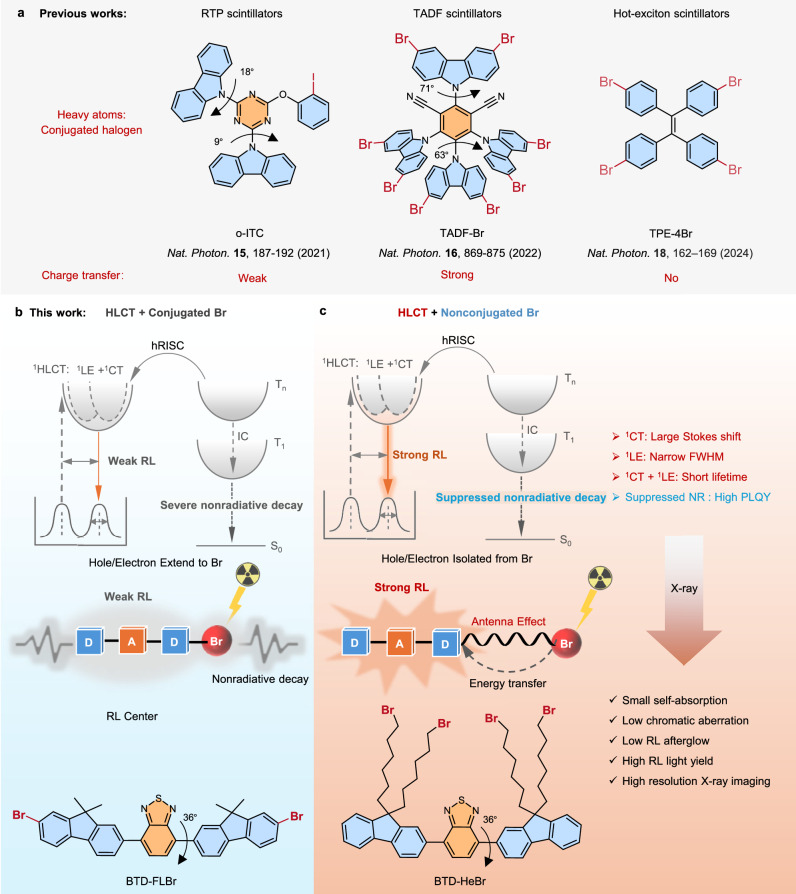 Figure 1
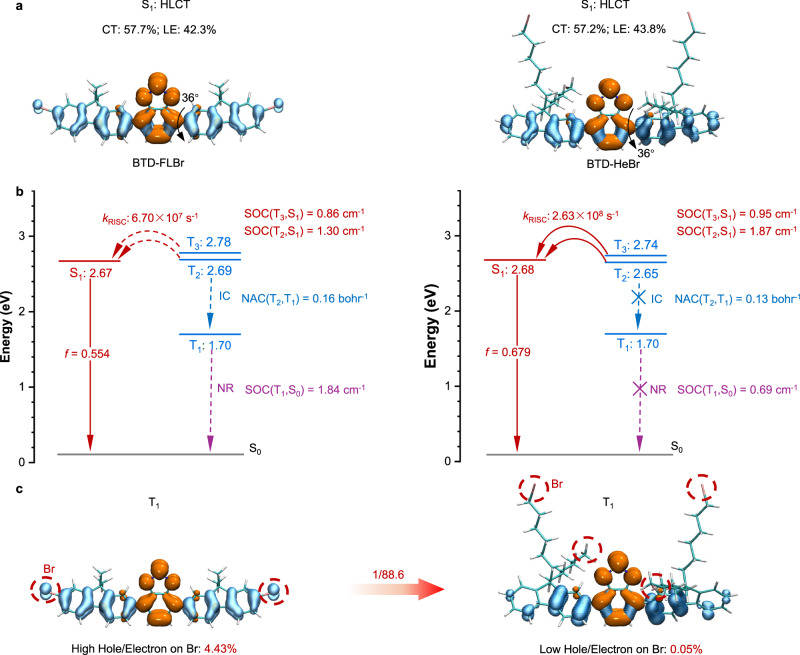 Figure 2
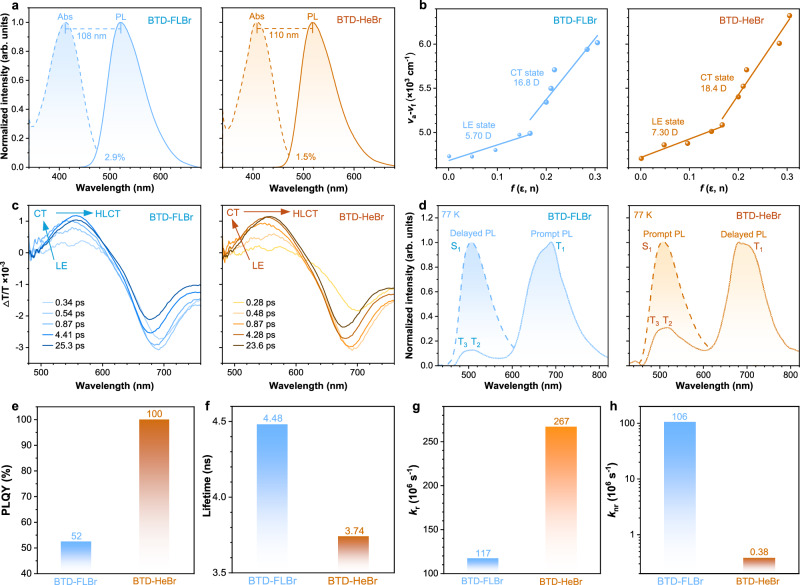 Figure 3
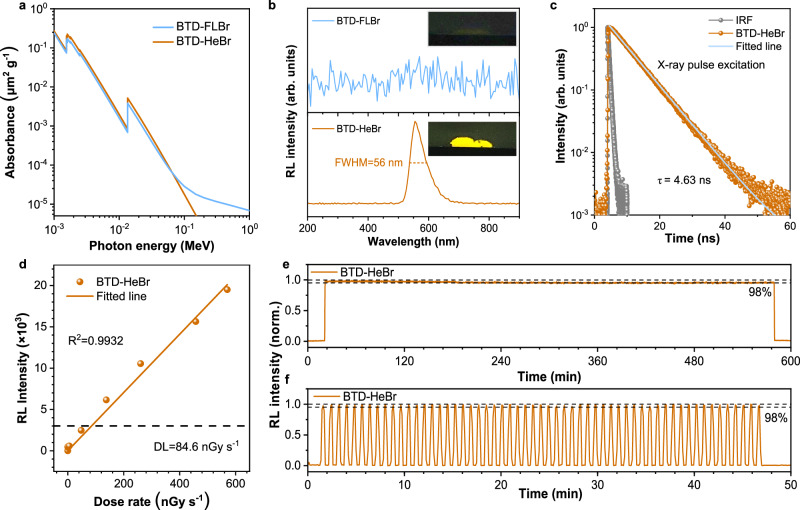 Figure 4
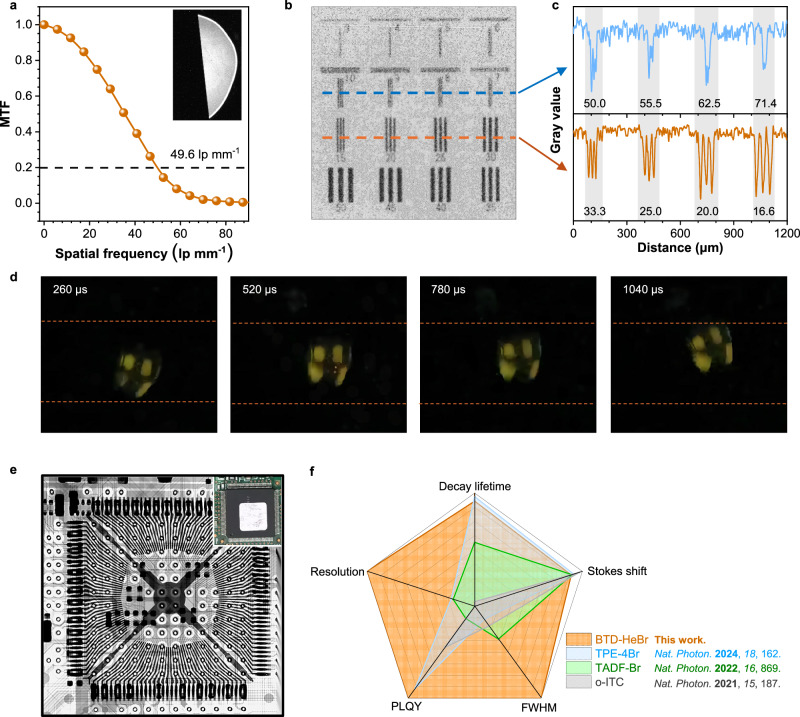 Figure 5
Peer Reviews
No public reviews on file for this paper yet. If you reviewed it on a platform where reviews are public (OpenReview, ICLR, NeurIPS, ICML), you can paste yours below so the community can read it here.
Videos
No videos yet. Explain this paper in a talk, walkthrough, or lecture? Add one.
Taxonomy
TopicsRadiation Detection and Scintillator Technologies · Covalent Organic Framework Applications · Luminescence and Fluorescent Materials