The Patient Acceptable Symptom State for Commonly Used Patient-Reported Outcomes After Nonoperative Management of Hip Femoroacetabular Impingement Syndrome
Graeme Hoit, Daniel B. Whelan, Valerie Lemieux, Brent Bates, Tim Dwyer, John Theodoropoulos, Jaskarndip Chahal

TL;DR
This study identifies symptom improvement thresholds for non-surgical hip treatment outcomes, helping doctors and researchers evaluate patient progress.
Contribution
Establishes Patient Acceptable Symptom State (PASS) values for nonoperative FAIS treatment, previously unknown.
Findings
PASS for iHOT-33 is 50, HOS-ADL is 66, and pain VAS is 36 after nonoperative FAIS treatment.
Older age and higher baseline iHOT-33 scores predict better outcomes.
Radiographic markers and symptom duration did not significantly affect achieving PASS.
Abstract
Patient Acceptable Symptom State (PASS) values for commonly used patient-reported outcome measures are known for operatively treated patients with femoroacetabular impingement syndrome (FAIS) but have not been established for those undergoing nonoperative treatment. First, to determine the PASS for International Hip Outcome Tool–33 (iHOT-33), Hip Outcome Score–Activities of Daily Living (HOS-ADL), and pain visual analog scale (VAS) in patients with FAIS treated nonoperatively; second, to assess the baseline factors that were associated with achieving PASS. Cohort study (diagnosis); Level of evidence, 2. Patients with FAIS who were treated nonoperatively with an expert-validated physical therapy protocol at 2 academic centers were prospectively enrolled. Patients completed the iHOT-33, HOS-ADL, and pain VAS at baseline and 6 months after beginning treatment. Receiver operating…
Genes, proteins, chemicals, diseases, species, mutations and cell lines named across the full text — each resolved to its canonical identifier and authoritative record.
Click any figure to enlarge with its caption.
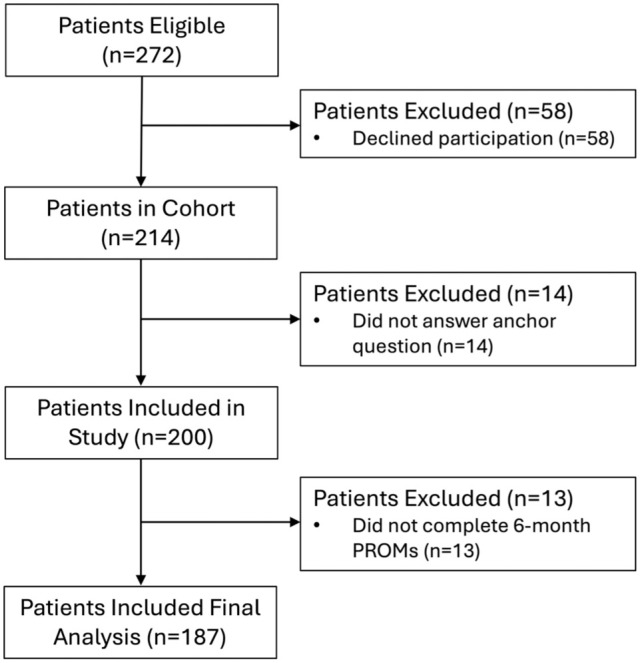 Figure 1
 Figure 2
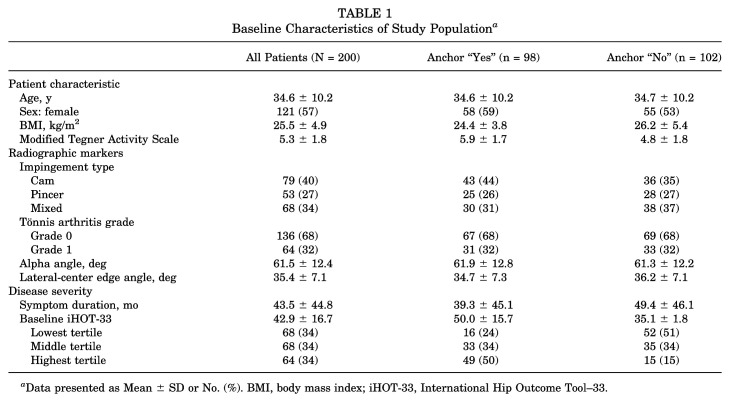 Figure 3
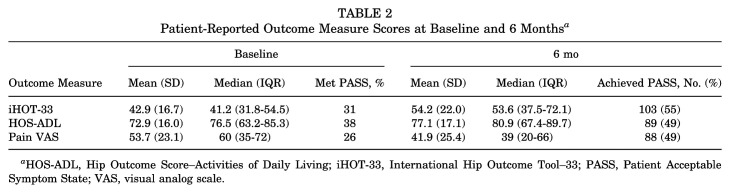 Figure 4
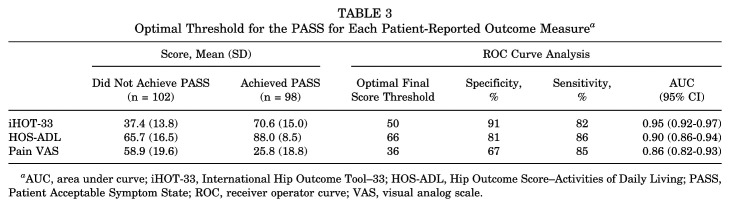 Figure 5
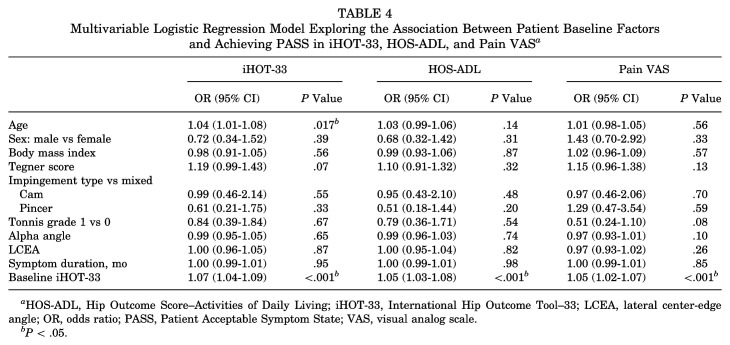 Figure 6
Peer Reviews
No public reviews on file for this paper yet. If you reviewed it on a platform where reviews are public (OpenReview, ICLR, NeurIPS, ICML), you can paste yours below so the community can read it here.
Videos
No videos yet. Explain this paper in a talk, walkthrough, or lecture? Add one.
Taxonomy
TopicsHip disorders and treatments · Orthopaedic implants and arthroplasty · Shoulder Injury and Treatment