Metastatic HPV-Related Multiphenotypic Sinonasal Carcinoma: A Case Report and Review of the Literature
Rachel Stemme, Wassim Najjar, Tanguy Y. Seiwert, Harry Quon, Lisa M. Rooper, Debraj Mukherjee, Nicholas R. Rowan

TL;DR
This paper reports the first case of a rare HPV-related cancer spreading to the liver, challenging its known indolent behavior.
Contribution
The first documented case of metastatic liver involvement in HPV-related multiphenotypic sinonasal carcinoma.
Findings
HMSC can exhibit aggressive systemic progression, including early liver metastasis.
HPV35, a rare subtype, was identified in this case of HMSC.
Early detection of distant metastases is critical for managing HMSC.
Abstract
Human papillomavirus (HPV)–related multiphenotypic sinonasal carcinoma (HMSC) is a rare neoplasm characterized by a paradoxical clinical course. Despite its high-grade histologic features, HMSC exhibits an unexpectedly indolent clinical behavior, marked by frequent local recurrences but limited metastatic potential. We report the first case of HMSC metastasis to the liver with the earliest known distant progression. A 53-year-old male who presented with unilateral epistaxis was found to have T4aN0M0 HPV35-positive HMSC of the left maxillary sinus, with erosion into the orbital floor. He underwent induction chemotherapy, endoscopic resection with negative margins, and adjuvant chemoradiation. He did well until surveillance PET-CT at 10 months revealed asymptomatic hepatic metastases confirmed by biopsy. He was treated with transarterial chemoembolization and pembrolizumab before…
Genes, proteins, chemicals, diseases, species, mutations and cell lines named across the full text — each resolved to its canonical identifier and authoritative record.
Click any figure to enlarge with its caption.
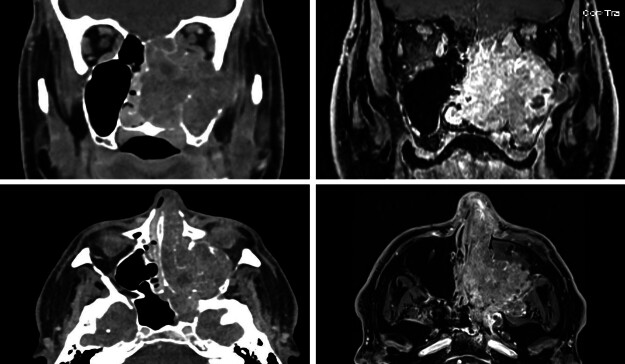 Fig. 1
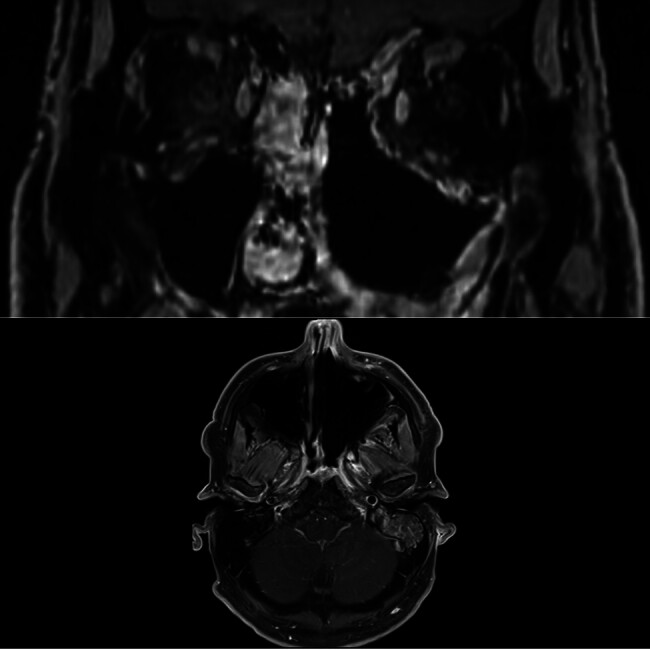 Fig. 2
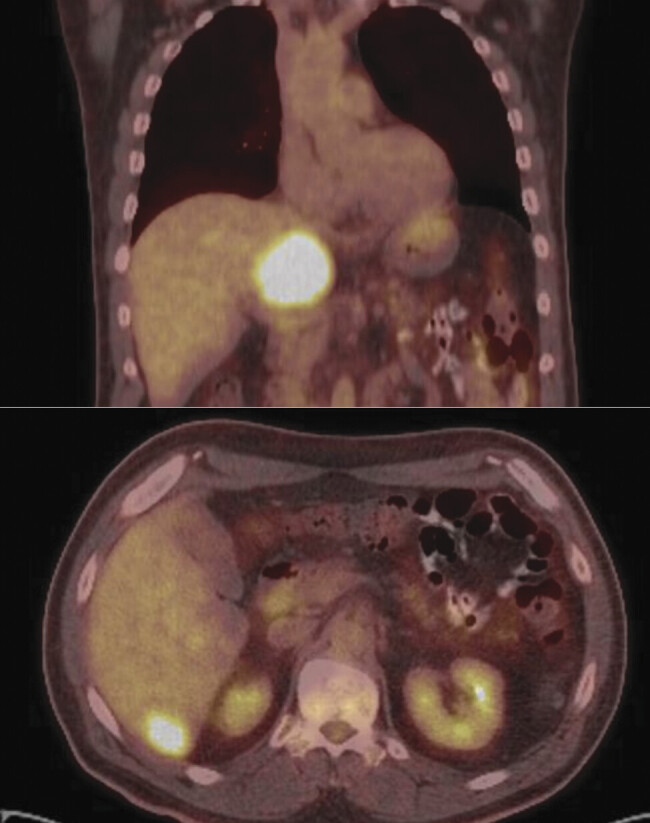 Fig. 3
Peer Reviews
No public reviews on file for this paper yet. If you reviewed it on a platform where reviews are public (OpenReview, ICLR, NeurIPS, ICML), you can paste yours below so the community can read it here.
Videos
No videos yet. Explain this paper in a talk, walkthrough, or lecture? Add one.
Taxonomy
TopicsHead and Neck Surgical Oncology · Head and Neck Cancer Studies · Brain Metastases and Treatment
Introduction
Human papillomavirus (HPV)-related multiphenotypic sinonasal carcinoma (HMSC), newly described in 2013, is characterized by high-grade histopathological features. 1 HMSC typically exhibits invasive local growth with a tendency for local recurrence. 2 Despite its locally aggressive behavior, HMSC is considered to have a relatively indolent clinical course with limited metastatic potential and a more favorable prognosis compared with other aggressive sinonasal malignancies. 3
Case Report
A 53-year-old male with a history of daily cigar-smoking presented with 6-months of progressive unilateral epistaxis, nasal congestion, and facial pressure. Anterior rhinoscopy revealed a mass obstructing the left nasal airway. CT imaging revealed a 5 cm × 8 cm expansile lesion occupying the left maxillary sinus with erosion of the left orbital floor ( Fig. 1 ). A biopsy and imaging were diagnostic of T4aN0M0 HMSC. Immunohistochemistry demonstrated diffuse positivity for p16, and in situ hybridization confirmed the presence of high-risk HPV RNA. Treatment included induction chemotherapy (carboplatin/paclitaxel), with moderate treatment response, followed by orbital-sparing endoscopic resection with negative margins, and adjuvant chemoradiotherapy (cisplatin) to a cumulative dose of 7,500 cGy. Initial surveillance found no evidence of recurrent or locoregional disease ( Fig. 2 ). Due to insurance difficulties, a PET-CT was delayed until 10 months post-treatment, which revealed an asymptomatic liver mass and multiple liver lesions ( Fig. 3 ). A biopsy confirmed metastatic HMSC. Subsequently, the patient underwent three transarterial chemoembolization procedures with doxorubicin and immunotherapy with pembrolizumab. Despite 5 months of continuous treatment, he has experienced progressive liver disease and locoregional recurrence in the cavernous sinus.
Preoperative computed tomography (CT) and magnetic resonance imaging (MRI) of 8.1 cm × 4.8 cm × 6.5 cm (AP × TV × CC) left HPV-related multhiphenotypic sinonasal carcinoma (HMSC) with extensive bony destruction.
Postsurgical resection and adjuvant chemoradiotherapy, magnetic resonance imaging (MRI) of left HPV-related multiphenotypic carcinoma (HMSC) without evidence of residual or recurrent tumor.
Positron emission tomography/computed tomography (PET/CT) obtained 10 months posttreatment showing FDG-avid 7.7 cm × 5.7 cm caudate lobe mass and scattered FDG-avid liver lesions.
Literature Review
The “paradoxical” nature of HMSC was first highlighted in a 49-patient case series, where one-third had local recurrence, while distant metastases (DM) occurred in two cases. 2 One patient had DM in the lung and finger 144 months after surgery and radiotherapy, and another had DM in the lung 96 months after surgery. A review of 79 HMSC cases reinforced its typically indolent clinical course, identifying no regional metastases and only one tumor-related death. 3 However, in 2019, early distant metastasis to the lung was reported, occurring 23 months after treatment. 4
In the United States, HPV-related sinonasal neoplasms are increasingly prevalent with significant prognostic implications. 5 6 7 HMSC is most often associated with HPV type 33, but HPV types 35, 56, and 16 have also been reported. 3 This is notably different from HPV-related oropharyngeal SCC, where HPV type 16 predominates.
More aggressive presentations of HMSC with intracranial extension and rapid local recurrence complicate the establishment of a definitive treatment strategy. 8 9 10 Although typical treatment of HMSC has consisted of surgery and radiotherapy, the role of induction chemotherapy may also be considered and is an area of interest in the management of sinonasal SCC more broadly. 11 12 13
We report the first case of hepatic metastasis from HMSC and the earliest known instance of distant disease progression. This case demonstrates that HMSC can exhibit aggressive systemic behavior, contradicting current understanding of its typically indolent course. These findings underscore the importance of continued monitoring in HPV-related disease and support investigating induction chemotherapy or ctDNA surveillance for patients with HMSC.
The reference list from the paper itself. Each links out to its DOI / PubMed record.
- 1Bishop J A Guo T W Smith D F Human papillomavirus-related carcinomas of the sinonasal tract Am J Surg Pathol 2013370218519223095507 10.1097/PAS.0b 013e 3182698673 PMC 3545097 · doi ↗ · pubmed ↗
- 2Bishop J A Andreasen S Hang J FHPV-related multiphenotypic sinonasal carcinoma: an expanded series of 49 cases of the tumor formerly known as HPV-related carcinoma with adenoid cystic carcinoma-like features Am J Surg Pathol 201741121690170128877065 10.1097/PAS.0000000000000944 PMC 5680105 · doi ↗ · pubmed ↗
- 3Zupancic MNäsman A Human papillomavirus-related multiphenotypic sinonasal carcinoma-an even broader tumor entity?Viruses 20211309186134578442 10.3390/v 13091861 PMC 8472460 · doi ↗ · pubmed ↗
- 4Rodarte A I Parikh A S Gadkaree S K Human papillomavirus related multiphenotypic sinonasal carcinoma: report of a case with early and progressive metastatic disease J Neurol Surg Rep 20198004 e 41e 4331737465 10.1055/s-0039-3399571 PMC 6855919 · doi ↗ · pubmed ↗
- 5Lewis J S Jr Human papillomavirus in sinonasal tract tumors-another head and neck “hot spot” for prognostically favorable viral disease Surg Pathol Clin 2024170459961439489552 10.1016/j.path.2024.07.002 · doi ↗ · pubmed ↗
- 6Amanian A Ishii M Fakhry C London N R Jr Epidemiologic trends in human papillomavirus-associated sinonasal squamous cell carcinoma JAMA Otolaryngol Head Neck Surg 20241500760961838842800 10.1001/jamaoto.2024.1311 PMC 11157445 · doi ↗ · pubmed ↗
- 7Costantino A Haughey B Zhu J Sinonasal squamous cell carcinoma in the United States: temporal and geographic patterns associated with HPV testing and positivity Oral Oncol 202415410685538788337 10.1016/j.oraloncology.2024.106855 · doi ↗ · pubmed ↗
- 8Hung Y Chung Y Y Chen M L Guo J YHPV-related sinonasal carcinoma with adenoid cystic-like features with intracranial invasion Ear Nose Throat J 2018970719119230036429 · pubmed ↗