Stepwise Palatal Prosthetic Rehabilitation After Pediatric Ischemic Stroke
Satoru Kusaka, Yuria Asao, Tatsuya Akitomo, Yuko Iwamoto, Ryota Nomura

TL;DR
This paper presents a case study on using stepwise palatal prosthetics to help a child with oral dysfunction after multiple strokes.
Contribution
The study introduces a tolerance-oriented, stepwise prosthetic strategy for pediatric stroke rehabilitation.
Findings
Tongue pressure and speech improved with palatal prosthetics.
Gains were maintained after discontinuation, suggesting motor relearning.
The approach highlights the need for individualized prosthetic adjustment.
Abstract
Pediatric ischemic stroke is rare but may result in severe oral dysfunction. Evidence for prosthetic oral rehabilitation is well established in adults, whereas pediatric data remains limited. We report a pediatric patient with persistent dysphagia and articulatory impairment following recurrent ischemic stroke who underwent stepwise palatal prosthetic intervention. Treatment began with a palatal augmentation prosthesis to establish tolerance and promote tongue–palate contact, followed by a palatal lift prosthesis providing gentle velopharyngeal support. Tongue pressure measurements, oral diadochokinesis, and speech intelligibility improved during appliance use, with gains largely maintained after discontinuation, suggesting motor relearning rather than transient mechanical assistance. This case illustrates the potential value of a tolerance-oriented, stepwise prosthetic strategy in…
Genes, proteins, chemicals, diseases, species, mutations and cell lines named across the full text — each resolved to its canonical identifier and authoritative record.
Click any figure to enlarge with its caption.
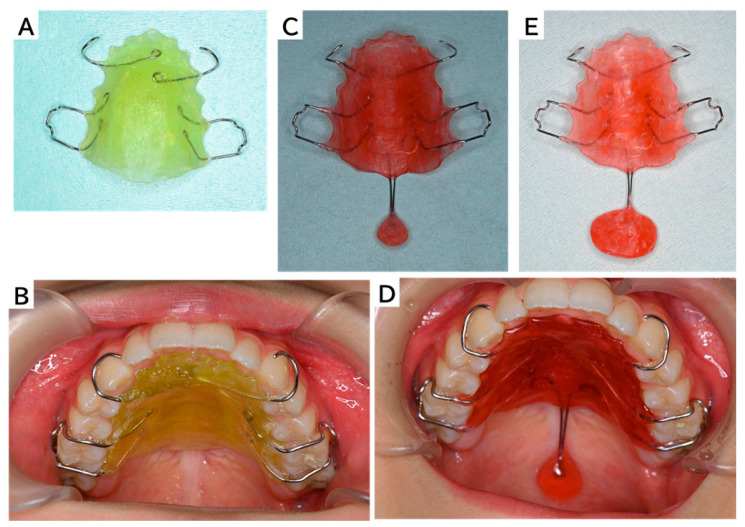 Figure 1
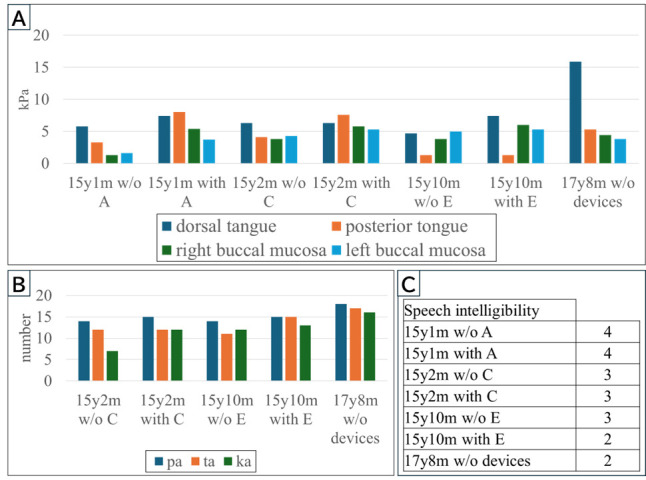 Figure 2
Peer Reviews
No public reviews on file for this paper yet. If you reviewed it on a platform where reviews are public (OpenReview, ICLR, NeurIPS, ICML), you can paste yours below so the community can read it here.
Videos
No videos yet. Explain this paper in a talk, walkthrough, or lecture? Add one.
Taxonomy
TopicsDysphagia Assessment and Management · Cleft Lip and Palate Research · Obstructive Sleep Apnea Research
Timeline of intervention: PAP (1 month) → PAP with movable PLP (5 months) → modified asymmetric PLP (11 months).
The case highlights that a gradual, tolerance-oriented introduction of prostheses may be a useful rehabilitation strategy in pediatric strokes, while also underscoring the need for individualized device design and further clinical research. Because this is a single-patient observation, generalization should be made cautiously. In the present case, the patient did not exhibit severe feeding intolerance or nutritional instability, allowing safe implementation of gradual prosthetic intervention. The stepwise protocol may therefore be most applicable to patients with stable general health, sufficient cognitive understanding, and adequate tolerance to intraoral stimulation. Conversely, careful consideration may be required in patients presenting with marked oral hypersensitivity, pronounced gag reflex, significant nutritional compromise, or limited ability to cooperate with device use and training. Individual patient characteristics, including medical status and behavioral adaptability, should guide prosthetic decision-making.
Because this report reflects the currently available observation period, evaluation of longer-term outcomes remains a subject for future study.
The reference list from the paper itself. Each links out to its DOI / PubMed record.
- 1Yoshida M. Endo Y. Nishimura R. Masuda S. Amano J. Tsuga K. Palatal augmentation prosthesis (PAP) can improve swallowing function for the patients in rehabilitation hospital J. Prosthodont. Res.20196319920110.1016/j.jpor.2018.11.00930553811 · doi ↗ · pubmed ↗
- 2La Velle W.E. Hardy J.C. Palatal lift prostheses for treatment of palatopharyngeal incompetence J. Prosthet. Dent.19794230831510.1016/0022-3913(79)90222-1289764 · doi ↗ · pubmed ↗
- 3Ono T. Hamamura M. Honda K. Nokubi T. Collaboration of a dentist and speech-language pathologist in the rehabilitation of a stroke patient with dysarthria: A case study Gerodontology 20052211611910.1111/j.1741-2358.2005.00057.x 15934356 · doi ↗ · pubmed ↗
- 4Hirasaki M. Takagi D. Umeda Y. Moriwaki M. Katagiri N. Nomoto A. Ohno T. Fujishima I. A Case of Dysphagia and Dysarthria Improved by Flexible-palatal Lift/augmentation Combination Prosthesis Prog. Rehabil. Med.202382023000610.2490/prm.2023000636866153 PMC 9970843 · doi ↗ · pubmed ↗
- 5Rilo B. Fernández-Formoso N. da Silva L. Pinho J.C. A simplified palatal lift prosthesis for neurogenic velopharyngeal incompetence J. Prosthodont.20132250650810.1111/jopr.1202423387878 · doi ↗ · pubmed ↗