Finishing Performance, Meat Quality, and Economic Efficiency of Retired Thoroughbred Versus Belgian-Cross Geldings Under an Identical Total Mixed Ration: A Pilot Study
Chanwool Park, Chansung Jeong, Miyeon Son, Junkoo Yi

TL;DR
Belgian-crossbred horses outperformed retired Thoroughbreds in meat production efficiency and quality under identical feeding conditions in a Korean study.
Contribution
This study provides empirical evidence on the meat production efficiency of retired racehorses versus meat-type horses under identical feeding systems.
Findings
Belgian-crossbreds gained weight faster and produced heavier usable meat compared to retired Thoroughbreds.
Belgian-crossbreds had higher intramuscular fat content, improving meat quality and flavor.
Despite higher feed costs, Belgian-crossbreds had a better economic feed conversion ratio and positive profit margin.
Abstract
Horses leaving racing in South Korea can enter the meat market, but it is unclear whether retired racehorses are efficient producers of meat. In this study, we compared retired Thoroughbred geldings with Belgian-crossbred geldings during a 181-day feeding period under the same conditions of the same housing and the same mixed diet with free access. Belgian-crossbred horses ate more, but gained weight much faster and produced heavier usable meat weight at slaughter. Their loin meat also contained more fat within the marbling, which can make the cooked meat juicier and more flavorful for consumers. Although the total feed cost per animal was higher for the Belgian-crossbreds, the feed cost needed to produce one kilogram of weight gain was much lower, giving a positive estimated profit. Retired Thoroughbreds showed the opposite trend. These results can help farmers choose suitable animals…
Genes, proteins, chemicals, diseases, species, mutations and cell lines named across the full text — each resolved to its canonical identifier and authoritative record.
Click any figure to enlarge with its caption.
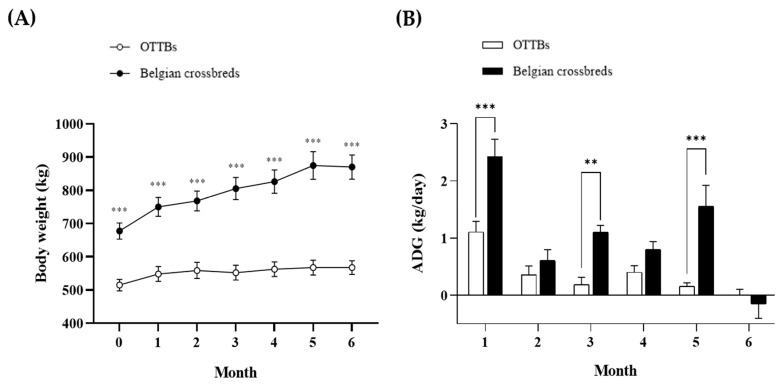 Figure 1
- —Korea government (MSIT)
- —Ministry of Education and Gyeonggi Province
Peer Reviews
No public reviews on file for this paper yet. If you reviewed it on a platform where reviews are public (OpenReview, ICLR, NeurIPS, ICML), you can paste yours below so the community can read it here.
Videos
No videos yet. Explain this paper in a talk, walkthrough, or lecture? Add one.
Taxonomy
TopicsVeterinary Equine Medical Research · Meat and Animal Product Quality · Ruminant Nutrition and Digestive Physiology
1. Introduction
Horse meat is increasingly valued as a high-quality animal protein, and in several countries, it is produced as a differentiated livestock product with distinctive organoleptic characteristics [1,2,3]. In South Korea, however, a meaningful share of horse meat originates from horses leaving the racing industry, particularly off-the-track Thoroughbred geldings [4,5]. These animals are selected and trained for speed and endurance rather than for rapid fattening, yet they may enter finishing systems that were designed primarily for meat production [6,7]. Because retired racehorses are already present in the supply chain, evidence-based finishing strategies are needed to improve efficiency, product consistency, and economic returns while supporting the efficient and welfare-conscious utilization of these animals [4,8,9].
Many previous studies describing horse meat characteristics have compared breeds or horse types under different ages, diets, and management conditions [3,10,11,12,13,14,15]. Such comparisons are useful for general description but are harder to translate into on-farm decisions because production purpose and feeding intensity differ substantially among studies [3]. For finishing enterprises, the most actionable endpoints are those that determine profitability and marketability: dry matter intake, average daily gain, gain-to-feed ratio, carcass weight and yield, and marbling-related traits such as intramuscular fat [14,15,16]. Belgian-crossbred horses, which typically have greater mature size and draft-type influence than Thoroughbreds, represent a practical contrasting type that may better suit short, intensive finishing [6,17,18,19].
Therefore, the objective of this pilot study was to compare a 181-day fattening program and subsequent carcass and meat quality outcomes between off-the-track Thoroughbred geldings and Belgian-crossbred geldings maintained under the same management and fed the same total mixed ration [20,21,22]. As a pilot, we expected Belgian-crossbred geldings to show higher feed efficiency, more favorable carcass and meat quality traits, and improved feed-cost efficiency compared with off-the-track Thoroughbred geldings when finished under identical management and an identical total mixed ration. We focused on finishing performance, carcass traits, longissimus thoracis et lumborum meat quality (including proximate composition), and a feed-cost-based economic assessment [3,11,23,24]. By centering the analysis on the fattening period and outcomes most relevant to producers, this work aims to provide practical, preliminary evidence to guide breed-appropriate finishing decisions in the Korean horse meat sector [4,25]. Given the pilot sample size, these findings are presented as preliminary benchmarks under standardized management, and larger multi-site studies are warranted to confirm generalizability.
2. Materials and Methods
2.1. Animals and Finishing Design
Ten adult geldings were enrolled: off-the-track Thoroughbred geldings (n = 5; initial body mass 515.2 ± 17.3 kg; age 119.6 ± 21.8 months) and Belgian-crossbred geldings (n = 5; initial body mass 677.6 ± 24.3 kg; age 66.0 ± 2.4 months). Horses were finished for 181 days under the same management conditions. The study protocol was approved by the Institutional Animal Care and Use Committee of the Gyeonggi Province Livestock Promotion Center (Approval No. GPLP/001/21; approved on 14 June 2021).
2.2. Diet and Feeding Management
A forage-based total mixed ration was offered ad libitum throughout the 181-day finishing period [20,21]. The ration was formulated to meet the nutrient requirements for adult horses under a finishing (weight-gain) program as recommended by the National Research Council [26]. On a dry matter basis, the TMR contained 16.89% crude protein and an estimated 2.65 Mcal/kg metabolizable energy (estimated from TDN, 73.27% DM). Feed was supplied twice daily, and refusals were maintained to ensure free access [20,21]. The ingredient and chemical composition of the experimental ration are provided in Supplementary Tables S1 and S2.
2.3. Growth Performance and Feed Intake
Body weight was recorded monthly at a consistent time relative to feeding. Feed offering and refusal rates were measured to determine individual daily intake. Dry matter intake (DMI) was calculated from feed intake and the analyzed dry matter content. Average daily gain (ADG) was calculated as total body-weight gain divided by 181 days. Feed efficiency was expressed as gain-to-feed ratio (G/F: kg gain per kg dry matter intake) [16]. Monthly DMI and body-weight trajectories are provided in Supplementary Tables S3 and S5, and daily nutrient intakes are summarized in Supplementary Table S4.
2.4. Blood Analysis (Health Monitoring)
To monitor physiological status during the finishing period, blood samples were collected at multiple time points and analyzed for serum biochemistry and hematology using commercial analyzers [27,28]. Full results are reported in Supplementary Table S6.
2.5. Slaughter, Carcass Traits, and Meat Quality Evaluation
Carcass weight was defined as hot carcass weight after exsanguination and removal of non-carcass components (i.e., excluding blood, hide, head, distal limbs, and visceral organs), according to the national grading standards (MAFRA Notice No. 2018-109) [29]. Dressing percentage was calculated as (carcass weight/pre-slaughter body mass) × 100. Retail-cut yields (20 cuts) are presented in Supplementary Table S7.
2.6. Proximate Composition and Detailed Meat Profiles
Longissimus thoracis et lumborum samples were analyzed for proximate composition (moisture, crude protein, crude fat, crude ash) [3,11]. Detailed profiles (minerals, amino acids, and fatty acids) are reported in Supplementary Tables S8–S10 [30,31,32,33].
2.7. Economic Evaluation
Economic performance was assessed from feed cost, cumulative weight gain, and economic feed conversion ratio (EFCR; KRW per kg gain). Total feed cost per head was calculated using the observed intake, ration unit price, and the 181-day feeding duration. EFCR was calculated as total feed cost divided by total weight gain. Estimated gross revenue and gross margin were calculated using a proxy willingness-to-pay value (26,961 KRW/kg gain) applied to live-weight gain [25,34,35]. The economic assessment was treated as a deterministic calculation based on observed intake and gain. To evaluate the sensitivity of gross margin to key assumptions, a one-way sensitivity analysis (±10% and ±20%) was conducted for the proxy willingness-to-pay value and for the TMR unit price; the results are provided in Supplementary Table S11.
2.8. Statistical Analysis
Normality was assessed using the Shapiro–Wilk test together with visual inspection of Q–Q plots, and the homogeneity of variances was evaluated using Levene’s test. Continuous outcomes were compared between groups using a two-sided Welch’s t-test when distributional assumptions were considered acceptable; otherwise, the Mann–Whitney U test was applied. Ordinal outcomes were analyzed using the Mann–Whitney U test. Statistical significance was defined as α = 0.05 (two-sided). Given the pilot sample size, inferential analyses were limited to prespecified primary endpoints, while monthly trajectories were presented descriptively. Analyses were performed using IBM SPSS Statistics, version 26.0 (IBM Corp., Armonk, NY, USA).
3. Results
3.1. Finishing Performance
Belgian-crossbred geldings consumed more feed and exhibited substantially greater growth over the 181-day finishing period (Table 1 and Figure 1). Mean dry matter intake was higher in Belgian-crossbreds than in off-the-track Thoroughbreds (Supplementary Table S3). Consistent with this, Belgian-crossbreds showed markedly greater total weight gain and average daily gain, resulting in higher feed efficiency (gain-to-feed ratio) than off-the-track Thoroughbreds (Table 1). Monthly body-weight trajectories further demonstrated a clear separation between groups across the finishing period (Figure 1A), and monthly average daily gain was higher in Belgian-crossbreds (Figure 1B). Monthly intake and growth data are provided in Supplementary Tables S3 and S5.
3.2. Carcass Traits and Meat Quality
Carcass and meat quality outcomes favored Belgian-crossbreds (Table 2). Belgian-crossbreds produced heavier carcasses and showed a higher marbling score and a better overall meat quality grade than off-the-track Thoroughbreds. Under the national grading system used in this study, meat quality grade is assigned based on marbling and related quality attributes, with lower numerical grades indicating higher quality. Proximate composition of longissimus thoracis et lumborum supported these grading differences, with higher crude fat (intramuscular fat) and lower moisture in Belgian-crossbreds. The amino acid composition of the longissimus thoracis et lumborum is presented in Table 3 (units: g/100 g, wet weight). Overall, the profile was broadly comparable between groups, with similar totals of essential amino acids (8.514 ± 0.25 vs. 8.535 ± 0.22) and non-essential amino acids (9.136 ± 0.25 vs. 9.058 ± 0.22) in off-the-track Thoroughbreds and Belgian-crossbreds, respectively. Glutamic acid was the most abundant amino acid in both groups, consistent with its major contribution to meat flavor-related taste components, and methionine was modestly higher in off-the-track Thoroughbreds than in Belgian-crossbreds (p = 0.031; Table 4), while individual amino acids showed only small numerical differences. Detailed mineral and fatty acid profiles are provided in Supplementary Tables S8 and S10, and the full amino acid profile is provided in Supplementary Table S9.
3.3. Economic Efficiency
Although the total feed cost per head was higher for Belgian-crossbreds, the greater weight gain resulted in a lower EFCR compared with that of off-the-track Thoroughbreds (Table 4). Under the proxy willingness-to-pay assumption applied to live-weight gain, Belgian-crossbreds showed a positive estimated gross margin, whereas off-the-track Thoroughbreds showed a negative margin. In the sensitivity analysis (±10–20%), Belgian-crossbreds maintained a positive estimated gross margin across the tested ranges of willingness-to-pay and feed cost, whereas off-the-track Thoroughbreds remained negative or near break-even (Supplementary Table S11). This supports the robustness of the directional economic difference under plausible market variability.
4. Discussion
Under a standardized 181-day finishing system, clear differences emerged between off-the-track Thoroughbred geldings and Belgian-crossbred geldings in growth efficiency, carcass value, and economic outcomes. Belgian-crossbreds consumed more dry matter and achieved greater body-weight gain with a higher gain-to-feed ratio. From a finishing perspective, improved feed efficiency can reflect a shift in the maintenance-to-gain balance, whereby a greater proportion of intake is retained as tissue accretion rather than supporting maintenance requirements [7]. Given the pilot nature of the study, these results should be interpreted as preliminary benchmarks under the tested conditions rather than generalized estimates.
Carcass and meat quality responses were consistent with the performance results. Belgian-crossbreds produced heavier carcasses and showed more favorable marbling-related characteristics, including higher intramuscular fat in the longissimus thoracis et lumborum, compared with off-the-track Thoroughbreds. Intramuscular fat is widely recognized as a major driver of sensory attributes such as juiciness and flavor, and can influence consumer acceptance and value in markets where visible marbling is important [3,23]. One plausible physiological explanation for the higher feed efficiency observed in Belgian-crossbreds is a greater propensity for energy retention as adipose tissue during finishing, which can increase the fraction of intake allocated to gain relative to maintenance. Such a shift would be consistent with their higher intramuscular fat content and heavier carcasses under the same feeding system. Although our dataset is not designed to resolve mechanisms, this interpretation provides a biologically reasonable context for the observed pattern in this controlled comparison. Although marbling-related traits favored Belgian-crossbreds, off-the-track Thoroughbreds showed a larger longissimus muscle area and higher meat color scores (Table 2). This profile may reflect a comparatively leaner carcass phenotype and could be relevant for alternative product positioning depending on market preferences. In the present trial, routine health monitoring did not indicate overt metabolic disturbance, suggesting that the finishing regimen was practically implementable under the tested conditions [27,28]. All procedures were conducted under IACUC approval with routine health monitoring and ad libitum feeding, supporting welfare-compliant husbandry during the finishing period.
The economic assessment further supported these biological differences. Although daily and total feed costs per head were higher for Belgian-crossbreds, their much larger weight gain resulted in a substantially lower feed cost per kilogram of gain and a positive estimated gross margin under the applied assumptions, whereas off-the-track Thoroughbreds showed a negative margin. The gross-margin estimate depended on the proxy willingness-to-pay value used to monetize live-weight gain, but the direction of the difference between groups was consistent with the large divergence in feed efficiency [25]. For retired racehorses entering the meat supply chain, these results indicate that applying a uniform, short finishing strategy may be economically suboptimal. Alternative approaches may include extending the finishing duration, increasing dietary energy density, or positioning the product as a lean-meat option rather than aiming for high marbling within a short timeframe, consistent with prior evidence that finishing diet intensity and production system can materially affect carcass traits and meat composition in equids [14,15,26,35].
This pilot study is limited by the small sample size (n = 5 per group), restriction to a single farm and season, and the use of geldings from specific sources; therefore, its statistical power is limited, generalizability is restricted, and mechanistic inference should be avoided. Accordingly, we emphasize the direction and practical relevance of the between-group differences under standardized conditions, while acknowledging that confirmatory, multi-site studies are needed. Nevertheless, the standardized management and the consistent direction of effects across growth, carcass, meat quality, and economic endpoints provide practical preliminary evidence for improving decision-making in the Korean horse industry, where guidance on post-racing utilization and value-chain strategies remains an active topic [4]. More broadly, optimizing finishing strategies for different horse types may also contribute to sustainable meat production and product valorization, as highlighted in recent discussions of ecosystem services and gastronomic perceptions surrounding horse meat [8,9].
5. Conclusions
Under an identical 181-day finishing system, Belgian-crossbred geldings showed higher growth performance and feed efficiency than off-the-track Thoroughbred geldings. These differences were accompanied by heavier carcasses and more favorable marbling-related traits, including higher intramuscular fat in the loin muscle. Although total feed cost per head was higher for Belgian-crossbreds, feed cost per kilogram of gain was lower, and the estimated gross margin was positive under the assumptions applied, whereas off-the-track Thoroughbreds showed a negative margin in the same system. Overall, these findings provide preliminary, exploratory evidence that horse type may influence finishing efficiency, carcass value, and economic outcomes under standardized management, and that a single short, intensive finishing strategy may not be optimal for retired racehorses. Larger multi-site studies with greater statistical power are warranted to confirm these trends and to refine breed-appropriate finishing and marketing strategies.
The reference list from the paper itself. Each links out to its DOI / PubMed record.
- 1Lee C.-E. Seong P.-N. Oh W.-Y. Ko M.-S. Kim K.-I. Jeong J.-H. Nutritional characteristics of horsemeat in comparison with those of beef and pork Nutr. Res. Pract.20071707310.4162/nrp.2007.1.1.7020535389 PMC 2882581 · doi ↗ · pubmed ↗
- 2Belaunzaran X. Bessa R.J. Lavín P. Mantecón A.R. Kramer J.K. Aldai N. Horse-meat for human consumption—Current research and future opportunities Meat Sci.2015108748110.1016/j.meatsci.2015.05.00626047980 · doi ↗ · pubmed ↗
- 3Lorenzo J.M. Sarriés M.V. Tateo A. Polidori P. Franco D. Lanza M. Carcass characteristics, meat quality and nutritional value of horsemeat: A review Meat Sci.2014961478148810.1016/j.meatsci.2013.12.00624423453 · doi ↗ · pubmed ↗
- 4Ji I. Kim H. Seo G. A Study on the Present State and Development Strategies of the Horse Industry Korea Rural Economic Institute Seoul, Republic of Korea 2015
- 5Oh W.Y. Lee J.W. Lee C.E. Ko M.S. Jeong J.H. Analysis of consumers’ preferences and behavior with regard to horse meat using a structured survey questionnaire Anim. Sci. J.20098071672310.1111/j.1740-0929.2009.00672.x 20163664 · doi ↗ · pubmed ↗
- 6Potard U.S.B. Leith D.E. Fedde M.R. Force, speed, and oxygen consumption in Thoroughbred and draft horses J. Appl. Physiol.1998842052205910.1152/jappl.1998.84.6.20529609800 · doi ↗ · pubmed ↗
- 7Ebert M. Moore-Colyer M.J. The energy requirements of racehorses in training Transl. Anim. Sci.20204 txaa 19610.1093/tas/txaa 19633367221 PMC 7744979 · doi ↗ · pubmed ↗
- 8Vial C. Lamy A. Sebbane M. Chefs saddle up—Perceptions of horse meat as a sustainable gastronomic alternative in France Foods 20251463810.3390/foods 1404063840002082 PMC 11854807 · doi ↗ · pubmed ↗