Low-Intensity Pulsed Ultrasound in Peripheral and Central Nerve Repair: Mechanisms and Emerging Therapeutic Strategies
Cheng Ma, Saijie Song, Jianwu Dai, He Shen

TL;DR
Low-intensity pulsed ultrasound is a promising non-invasive therapy for nerve repair, offering benefits over traditional methods by promoting recovery through biological and mechanical effects.
Contribution
This review provides a comprehensive overview of LIPUS mechanisms, applications, and challenges in peripheral and central nerve repair.
Findings
LIPUS modulates cellular behavior through mechanical cues and biological responses, aiding nerve recovery.
LIPUS promotes calcium dynamics, inflammation control, and vascular remodeling in nerve injury models.
Combining LIPUS with biomaterials enhances its therapeutic potential for on-demand drug delivery and electrical signaling.
Abstract
Low-intensity pulsed ultrasound (LIPUS) has emerged as a versatile, non-invasive physical modality with growing potential in regenerative medicine and neural repair. Advances in ultrasound physics and biomedical engineering have enabled precise spatiotemporal control of acoustic stimulation, positioning therapeutic ultrasound as an alternative to conventional pharmacological and surgical interventions that often suffer from limited targeting and substantial side effects. Unlike high-intensity focused ultrasound, which relies primarily on thermal ablation, LIPUS operates within a low-energy, non-thermal regime and modulates cellular behavior through mechanical cues, mechano-transduction, and downstream biological responses. Accumulating evidence demonstrates that LIPUS regulates calcium dynamics, cytoskeletal remodeling, neurotrophic factor expression, inflammation, myelination, and…
Genes, proteins, chemicals, diseases, species, mutations and cell lines named across the full text — each resolved to its canonical identifier and authoritative record.
Click any figure to enlarge with its caption.
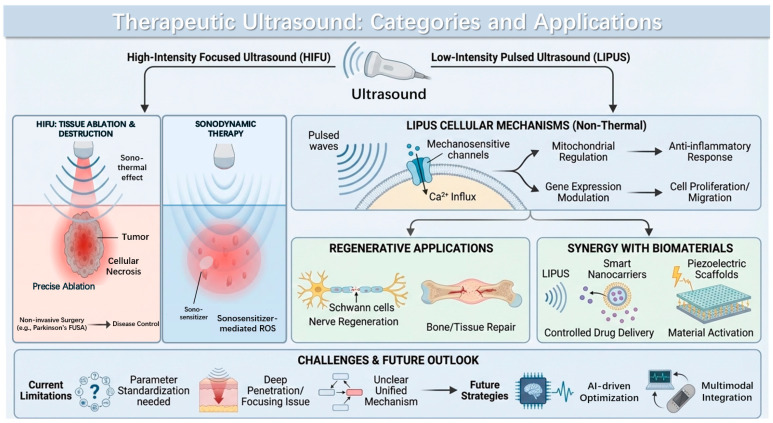 Figure 1
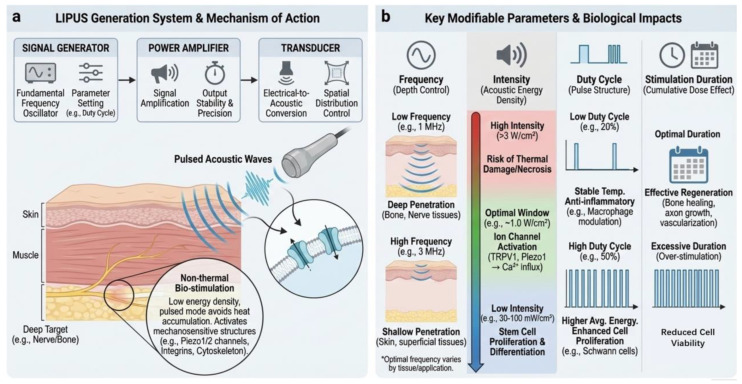 Figure 2
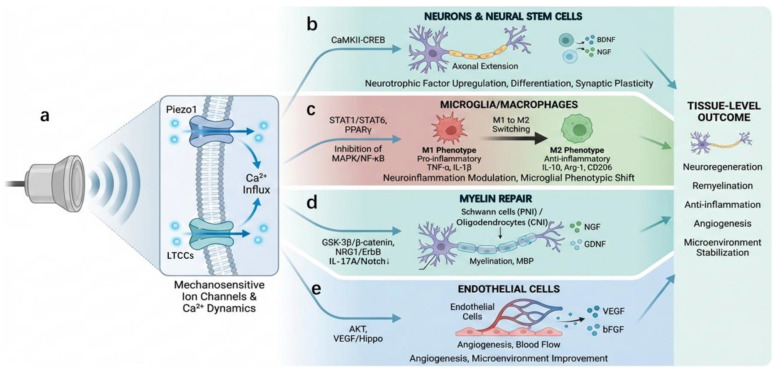 Figure 3
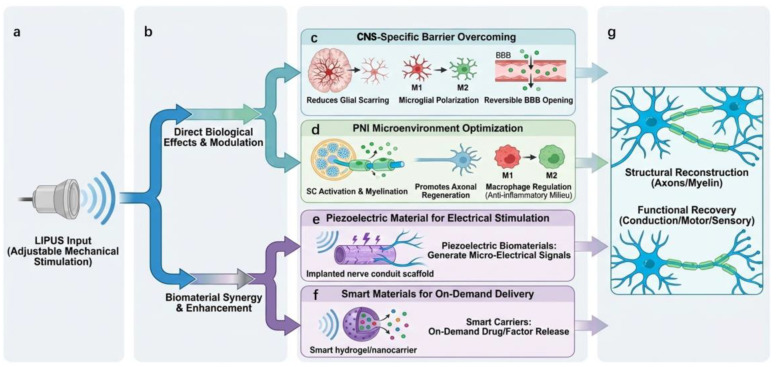 Figure 4
Peer Reviews
No public reviews on file for this paper yet. If you reviewed it on a platform where reviews are public (OpenReview, ICLR, NeurIPS, ICML), you can paste yours below so the community can read it here.
Videos
No videos yet. Explain this paper in a talk, walkthrough, or lecture? Add one.
Taxonomy
TopicsUltrasound and Hyperthermia Applications · Ultrasound and Cavitation Phenomena · Photoacoustic and Ultrasonic Imaging