Immersive Virtual Reality Exercise: Effects on Cortisol, Quality of Life, Cognitive Function, and Psychological Symptoms in Fibromyalgia
Gonzalo Arias-Álvarez, María Santamera-Lastras, Dina Guzmán-Oyarzo, Waldo Osorio-Torres, Benjamín Parada-Norambuena, Daniel Pecos-Martín, Jesús G. Ponce González, José Gómez-Pulido, Claudio Carvajal-Parodi

TL;DR
A six-week immersive virtual reality exercise program improved quality of life, emotional well-being, and cognitive function in women with fibromyalgia, though it did not affect cortisol levels.
Contribution
This study is the first to demonstrate the benefits of immersive virtual reality exercise for fibromyalgia patients across multiple psychological and cognitive domains.
Findings
Quality of life, depression, anxiety, and stress significantly improved after the iVRE program.
Cognitive performance, including visuospatial ability, language, and delayed recall, showed significant improvement.
No significant changes in salivary cortisol levels were observed despite other positive outcomes.
Abstract
Background and Objectives: Fibromyalgia (FM) is a chronic and complex condition characterized by widespread pain, fatigue, psychological burden, and cognitive impairment, posing significant challenges for treatment. Immersive virtual reality exercise (iVRE) has been proposed as an innovative therapeutic approach to increase adherence, motivation, and multidimensional benefits, but evidence in FM remains limited. This study aimed to evaluate the effects of a six-week iVRE program on cortisol levels, quality of life, cognitive function, and psychological symptoms in women with FM. Materials and Methods: A quasi-experimental pre–post design was conducted with 21 women (mean age 48.1 ± 10.7 years) diagnosed with FM, who completed twelve 30 min sessions of iVRE using Oculus Quest 2™ and the FitXR platform. Outcomes assessed pre- and post-intervention included salivary cortisol (ELISA),…
Genes, proteins, chemicals, diseases, species, mutations and cell lines named across the full text — each resolved to its canonical identifier and authoritative record.
Click any figure to enlarge with its caption.
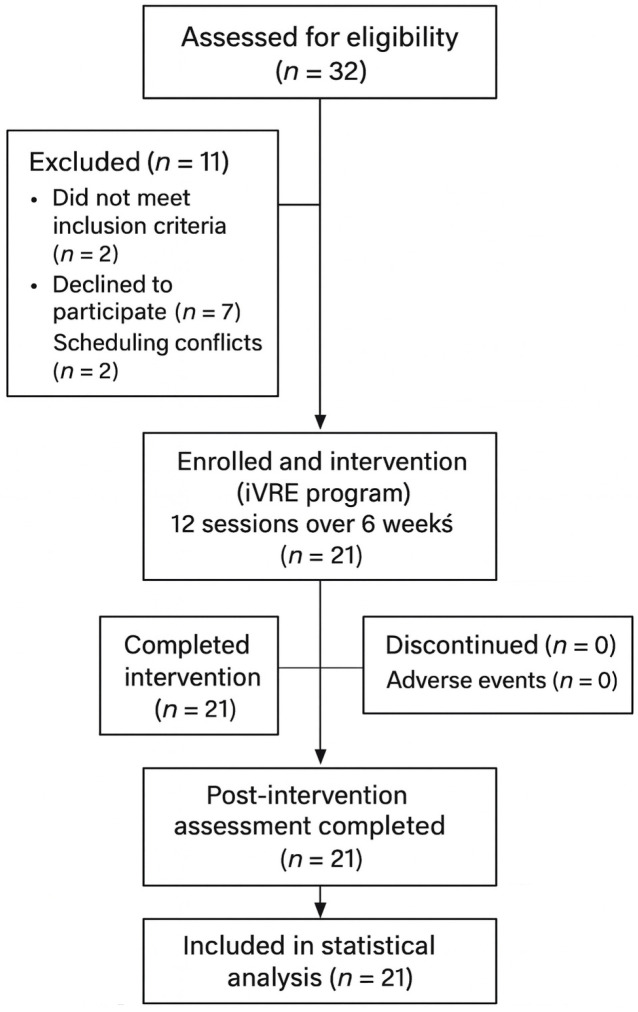 Figure 1
Peer Reviews
No public reviews on file for this paper yet. If you reviewed it on a platform where reviews are public (OpenReview, ICLR, NeurIPS, ICML), you can paste yours below so the community can read it here.
Videos
No videos yet. Explain this paper in a talk, walkthrough, or lecture? Add one.
Taxonomy
TopicsFibromyalgia and Chronic Fatigue Syndrome Research · Virtual Reality Applications and Impacts · Pediatric Pain Management Techniques