Concentric Versus Eccentric Exercise-Induced Fatigue on Proprioception, Motor Control and Performance of the Upper Limb in Handball Players: A Retrospective Study
Stelios Hadjisavvas, Michalis A. Efstathiou, Irene-Chrysovalanto Themistocleous, Manos Stefanakis

TL;DR
This study compared how concentric and eccentric fatigue affects shoulder control and performance in handball players, finding that both types of fatigue impair sensorimotor function, with small differences in specific tasks.
Contribution
The study provides new insights into contraction-mode differences in shoulder sensorimotor fatigue among handball players using a between-cohort comparison.
Findings
Concentric fatigue caused a greater increase in joint repositioning error at end-range internal rotation compared to eccentric fatigue.
Eccentric fatigue led to a larger decline in isometric force output in specific shoulder positions.
Both fatigue types reduced upper-limb performance and shoulder stability, but differences were task-specific.
Abstract
Background: Upper-limb performance in handball depends on accurate shoulder sensorimotor control under high loads and fatigue. This study examined between-cohort differences associated with concentric versus eccentric exercise-induced fatigue in shoulder proprioception, kinesthesia, functional stability, and isometric force output in professional male handball players. Methods: This was a retrospective, quasi-experimental (non-randomized) between-cohort comparison of two previously collected cohorts who completed either a concentric (n = 46) or eccentric (n = 33) fatigue protocol, with pre- and post-fatigue assessments of joint repositioning sense (absolute angular error, AAE), threshold to detection of passive movement (TTDPM), Y Balance Test Upper Quarter (YBT-UQ), and the Athletic Shoulder (ASH) test. Results: Fatigue significantly increased AAE across all tested angles (Time: all p…
Genes, proteins, chemicals, diseases, species, mutations and cell lines named across the full text — each resolved to its canonical identifier and authoritative record.
Click any figure to enlarge with its caption.
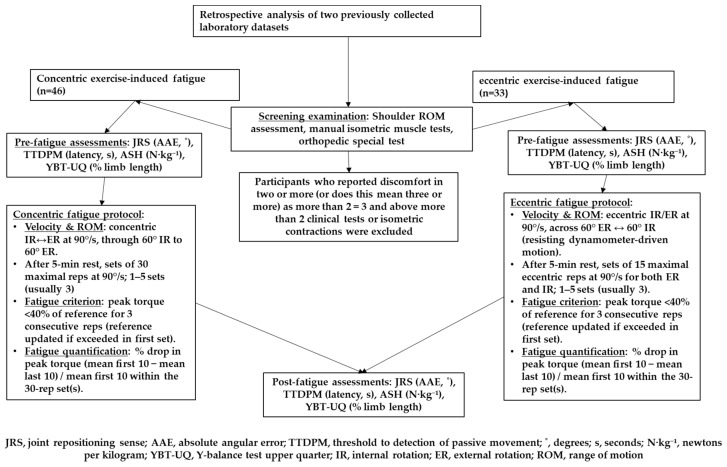 Figure 1
Peer Reviews
No public reviews on file for this paper yet. If you reviewed it on a platform where reviews are public (OpenReview, ICLR, NeurIPS, ICML), you can paste yours below so the community can read it here.
Videos
No videos yet. Explain this paper in a talk, walkthrough, or lecture? Add one.
Taxonomy
TopicsSports Performance and Training · Shoulder Injury and Treatment · Sports injuries and prevention