Remimazolam Bolus Prevents Emergence Agitation After Rhinologic Surgery: A Randomized, Triple-Blind, Controlled Trial
Grgur Prižmić, Filip Periš, Marinela Jozeljić Pešić, Ana Maria Mitar, Ana Bego, Sanja Pavičić Perković, Sanda Stojanović Stipić

TL;DR
A single dose of remimazolam at the end of nasal surgery prevents agitation after waking up from anesthesia without slowing recovery.
Contribution
This study shows remimazolam effectively prevents emergence agitation after rhinologic surgery in a controlled clinical trial.
Findings
Remimazolam reduced emergence agitation to 0% compared to 37.5% in the control group.
More patients in the remimazolam group achieved higher Aldrete scores at extubation.
No severe agitation or respiratory complications were observed in the remimazolam group.
Abstract
Background/Objectives: Emergence agitation (EA) is common after rhinologic surgery and may cause self-injury, bleeding, and prolonged post-anesthesia care unit (PACU) stay. Remimazolam is an ultra-short-acting benzodiazepine that may reduce EA without delaying recovery. The objective of this study was to evaluate the effect of a single dose of remimazolam administered at the end of surgery on the incidence of EA in adult patients undergoing nasal surgery. Methods: In this prospective, randomized, triple-blind, placebo-controlled trial, 62 adults undergoing elective rhinologic surgery under sevoflurane anesthesia received either remimazolam 0.1 mg/kg or saline immediately after sevoflurane discontinuation and before extubation. EA was assessed using the Richmond Agitation–Sedation Scale (RASS) at extubation and every 5 min for 30 min in the PACU. The primary outcome was presence of EA…
Genes, proteins, chemicals, diseases, species, mutations and cell lines named across the full text — each resolved to its canonical identifier and authoritative record.
Click any figure to enlarge with its caption.
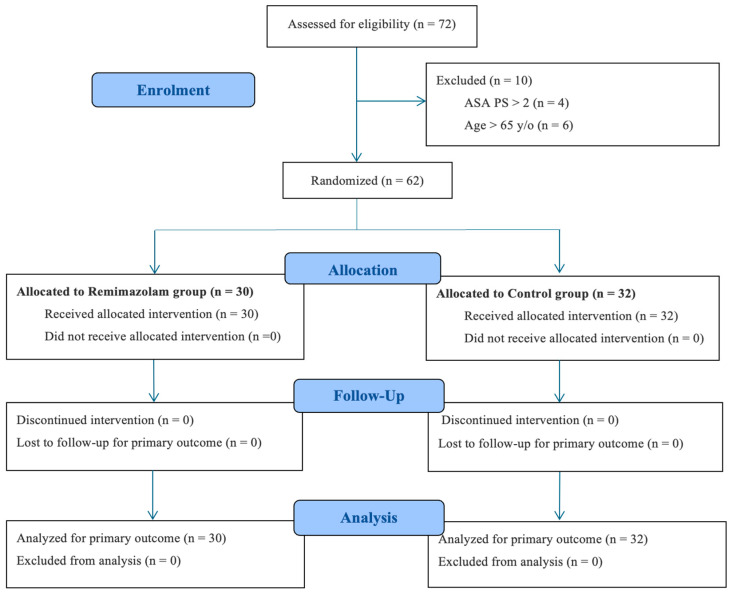 Figure 1
Peer Reviews
No public reviews on file for this paper yet. If you reviewed it on a platform where reviews are public (OpenReview, ICLR, NeurIPS, ICML), you can paste yours below so the community can read it here.
Videos
No videos yet. Explain this paper in a talk, walkthrough, or lecture? Add one.
Taxonomy
TopicsAnesthesia and Sedative Agents · Intensive Care Unit Cognitive Disorders · Airway Management and Intubation Techniques