Reclassifying Aortic Stenosis Severity: Combined Energy Loss Index and Global Longitudinal Strain Assessment Identifies Subgroups with Differential Myocardial Function and May Improve Risk Stratification in Aortic Stenosis
Ahmed Abdelmohsen Zayed, Michel El Khoury, Bahy Abofrekha, Oluwakorede Akele, Hadi Itani, Omar Khayat, Abdelrahman Abouelnas, Nadim Zaidan, Kevin Schesing

TL;DR
This study shows that a new method combining energy loss index and heart strain measurements can better identify aortic stenosis severity and heart function than traditional methods.
Contribution
The study introduces a novel reclassification method for aortic stenosis severity using energy loss index and global longitudinal strain to detect subclinical myocardial dysfunction.
Findings
ELI reclassified 29% of severe AS patients to moderate based on better myocardial function.
ELI showed stronger correlation with GLS than AVA in patients with preserved ejection fraction.
ELI remained an independent predictor of GLS when both parameters were analyzed together.
Abstract
Background: Traditional echocardiographic assessment of aortic stenosis (AS) using aortic valve area (AVA) may overestimate severity due to pressure recovery phenomena, while subclinical myocardial dysfunction remains undetected despite preserved ejection fraction. This study evaluated whether energy loss index (ELI)—which accounts for pressure recovery—demonstrates superior correlation with global longitudinal strain (GLS), a marker of subclinical myocardial dysfunction, compared to conventional AVA-based classification in patients with moderate-to-severe AS and preserved left ventricular ejection fraction (LVEF). Methods: This retrospective single-center study analyzed 149 patients with moderate-to-severe AS (AVA < 1.5 cm2) and LVEF > 50% from 2015 to 2019. Among 97 patients with severe AS by AVA (<1.0 cm2), ELI was calculated using the formula ELI = (AVA × Aa)/(Aa − AVA) ÷ BSA, where…
Genes, proteins, chemicals, diseases, species, mutations and cell lines named across the full text — each resolved to its canonical identifier and authoritative record.
Click any figure to enlarge with its caption.
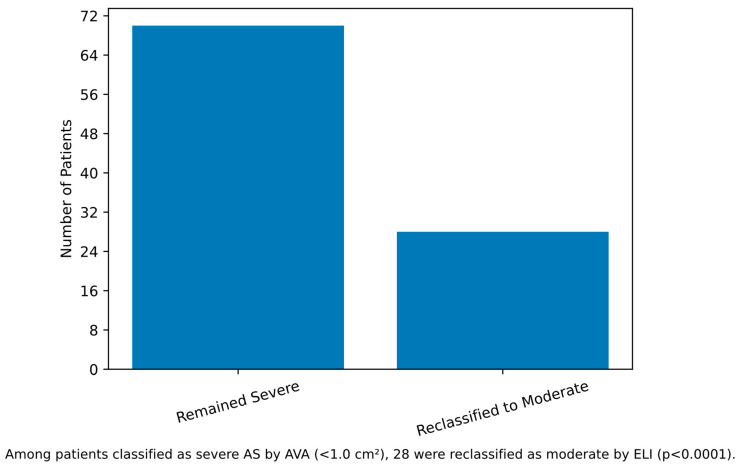 Figure 1
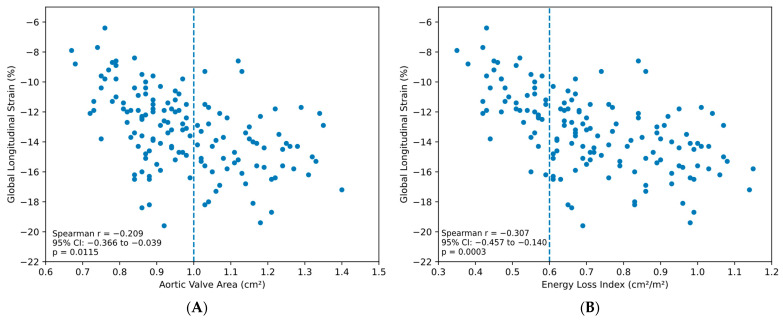 Figure 2
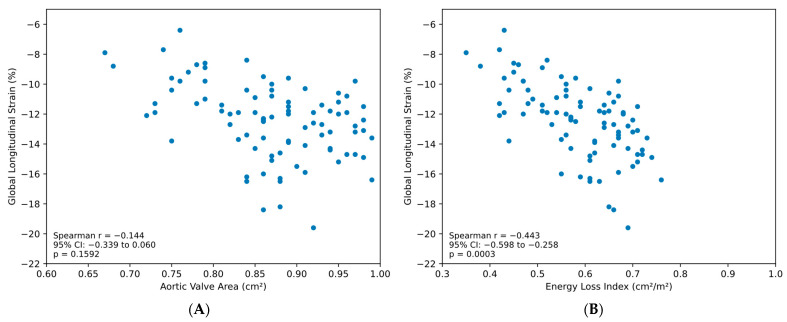 Figure 3
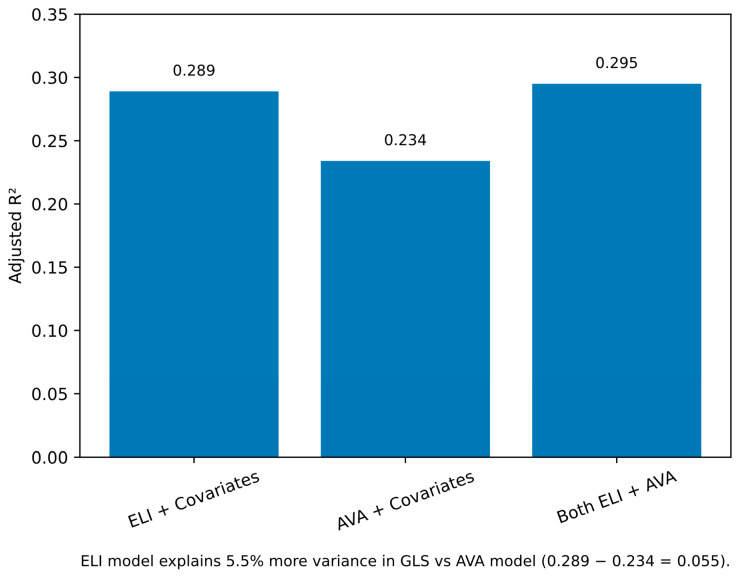 Figure 4
Peer Reviews
No public reviews on file for this paper yet. If you reviewed it on a platform where reviews are public (OpenReview, ICLR, NeurIPS, ICML), you can paste yours below so the community can read it here.
Videos
No videos yet. Explain this paper in a talk, walkthrough, or lecture? Add one.
Taxonomy
TopicsCardiac Valve Diseases and Treatments · Cardiovascular Function and Risk Factors · Cardiovascular Health and Disease Prevention