Concentration-Dependent Anticancer Effects of Melittin-Functionalized Nanomaterials
Alex Câmpian, Adrian Florea

TL;DR
This paper reviews how melittin attached to nanoparticles affects cancer cells differently depending on concentration, showing how nanocarriers can change melittin's potency and selectivity.
Contribution
The paper identifies three distinct concentration regimes of melittin-functionalized nanomaterials and their effects on tumor cells.
Findings
Nanoparticle association reduces melittin's lytic potency, requiring higher concentrations for cytotoxicity.
Targeting and release mechanisms enable tumor-selective re-potentiation of melittin.
Concentration-dependent effects define translational limits and opportunities for melittin-based nanomedicines.
Abstract
Melittin-functionalized nanoparticles have emerged as a strategy to harness the potent anticancer activity of melittin while mitigating its narrow therapeutic window. Across diverse nanocarrier platforms, biological outcomes are highly dependent on the effective melittin concentration presented to tumour cells. This review systematically examines concentration-dependent anticancer effects of melittin-functionalized nanoparticles, focusing on quantitative dose–response metrics such as IC50 values, shifts in cytotoxic potency relative to free melittin, and concentration-linked safety margins. Along with some aspects concerning the molecular mechanisms of melittin, this review synthesizes evidence from preclinical studies to analyze how nanoparticle functionalization reshapes the concentration–effect relationship governing anticancer efficacy. This review concluded that there are three…
Genes, proteins, chemicals, diseases, species, mutations and cell lines named across the full text — each resolved to its canonical identifier and authoritative record.
Click any figure to enlarge with its caption.
 Figure 1
 Figure 2
 Figure 3
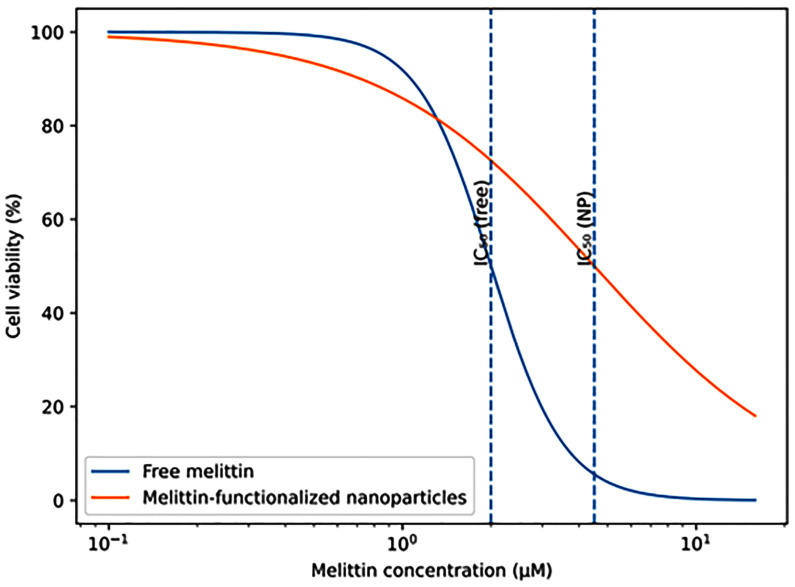 Figure 4
Peer Reviews
No public reviews on file for this paper yet. If you reviewed it on a platform where reviews are public (OpenReview, ICLR, NeurIPS, ICML), you can paste yours below so the community can read it here.
Videos
No videos yet. Explain this paper in a talk, walkthrough, or lecture? Add one.
Taxonomy
TopicsHealthcare and Venom Research · Bee Products Chemical Analysis · Ultrasound and Hyperthermia Applications