Directional Asymmetry of Crossover Neuromuscular Fatigue Following Unilateral Handgrip Exercise in Adults and Prepubertal Children
Aymen Ben Othman, Wissem Dhahbi, Manel Bessifi, Halil İbrahim Ceylan, Valentina Stefanica, Rihab Moncer, Helmi Ben Saad

TL;DR
This study found that fatigue from exercising the dominant hand causes greater fatigue in the opposite hand than non-dominant hand exercise in both adults and children.
Contribution
The study reveals directional asymmetry in crossover neuromuscular fatigue and shows functional equivalence in children before peak height velocity.
Findings
Dominant-limb fatigue causes 2.5- to 3.5-fold greater contralateral performance decrements than non-dominant-limb fatigue.
Crossover fatigue effects extend to heterologous proximal muscles without magnitude differences.
Pre-peak-height-velocity children show equivalent crossover fatigue to adults, indicating mature interhemispheric transfer mechanisms.
Abstract
Background and Objectives: This study investigated whether crossover neuromuscular fatigue following unilateral handgrip exercise exhibits directional asymmetry, testing whether dominant-limb fatigue produces greater contralateral performance decrements than non-dominant-limb fatigue in adults and pre-peak-height-velocity children. Materials and Methods: Thirty-three healthy, right-handed males (16 adults: 22.5 ± 1.6 years; 17 pre-peak-height-velocity boys: 11.2 ± 0.8 years, maturity offset −2.2 ± 0.4 years) completed three counterbalanced experimental sessions (48–72 h apart): dominant-arm fatigue, non-dominant-arm fatigue, and control. The fatigue protocol consisted of 20 consecutive 6 s maximal voluntary isometric handgrip contractions. Primary outcomes were percentage changes in maximal voluntary isometric contraction of the contralateral limb across handgrip, elbow flexor, and…
Genes, proteins, chemicals, diseases, species, mutations and cell lines named across the full text — each resolved to its canonical identifier and authoritative record.
Click any figure to enlarge with its caption.
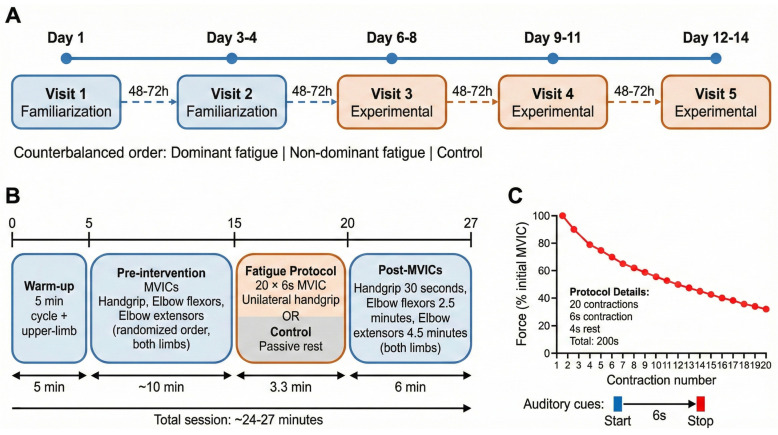 Figure 1
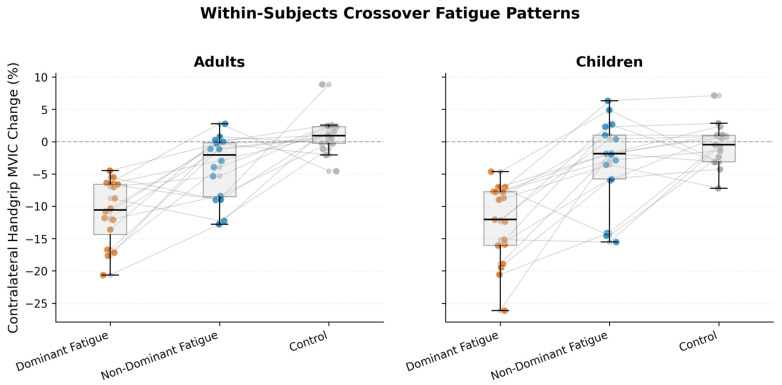 Figure 2
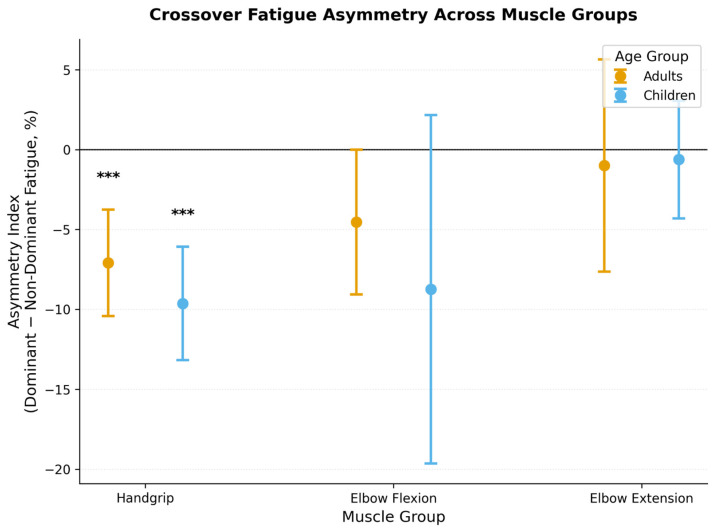 Figure 3
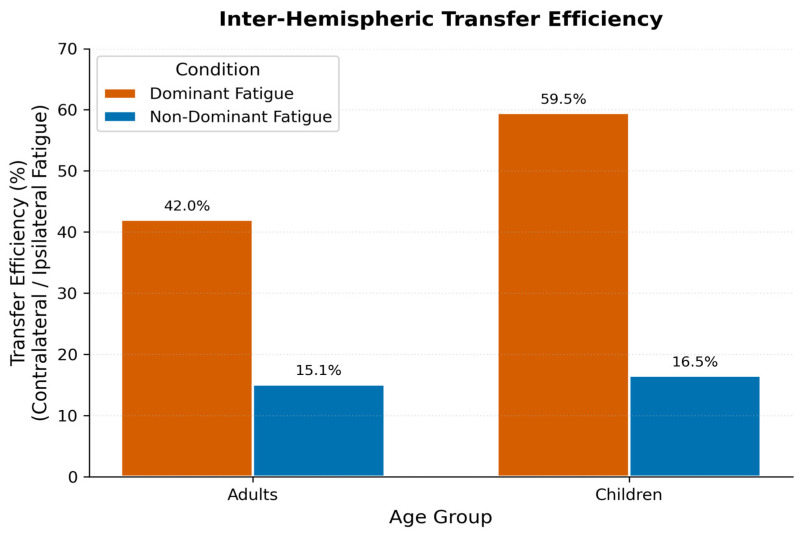 Figure 4
Peer Reviews
No public reviews on file for this paper yet. If you reviewed it on a platform where reviews are public (OpenReview, ICLR, NeurIPS, ICML), you can paste yours below so the community can read it here.
Videos
No videos yet. Explain this paper in a talk, walkthrough, or lecture? Add one.
Taxonomy
TopicsMuscle activation and electromyography studies · Musculoskeletal pain and rehabilitation · Motor Control and Adaptation