A Taxonomy of Six Perceptual Cues Underlying Photorealism in 3D-Rendered Architectural Scenes: A Cue-Based Narrative Review
Matija Grašić, Andrija Bernik, Vladimir Cviljušac

TL;DR
This paper identifies six visual cues that people use to judge photorealism in 3D architectural renderings, showing that realism depends more on perceptual consistency than scene complexity.
Contribution
The paper introduces a taxonomy of six perceptual cues that consistently influence photorealism judgments in 3D architectural scenes.
Findings
Perceived photorealism relies on six consistent visual cues rather than scene complexity.
Realism judgments depend on cue consistency and plausibility for shape, material, and spatial layout inferences.
Photorealism emerges from alignment of rendered images with learned perceptual expectations from real-world experience.
Abstract
Perceived photorealism in architectural 3D rendering is not determined solely by physical accuracy or rendering complexity but also by a limited set of visual cues that observers rely on when judging realism. This literature review synthesizes findings from 41 peer-reviewed studies spanning perception science, computer graphics, and immersive visualization, with the aim of identifying the cues that most strongly contribute to perceived photorealism in rendered scenes. Convergent evidence from psychophysical experiments, user studies in virtual and augmented reality, and rendering-oriented analyses indicate that six cue categories consistently dominate realism judgments. Across the reviewed literature, realism judgments depend less on scene complexity or the number of visual elements and more on the consistency and plausibility of these cues for supporting inferences about shape,…
Genes, proteins, chemicals, diseases, species, mutations and cell lines named across the full text — each resolved to its canonical identifier and authoritative record.
Click any figure to enlarge with its caption.
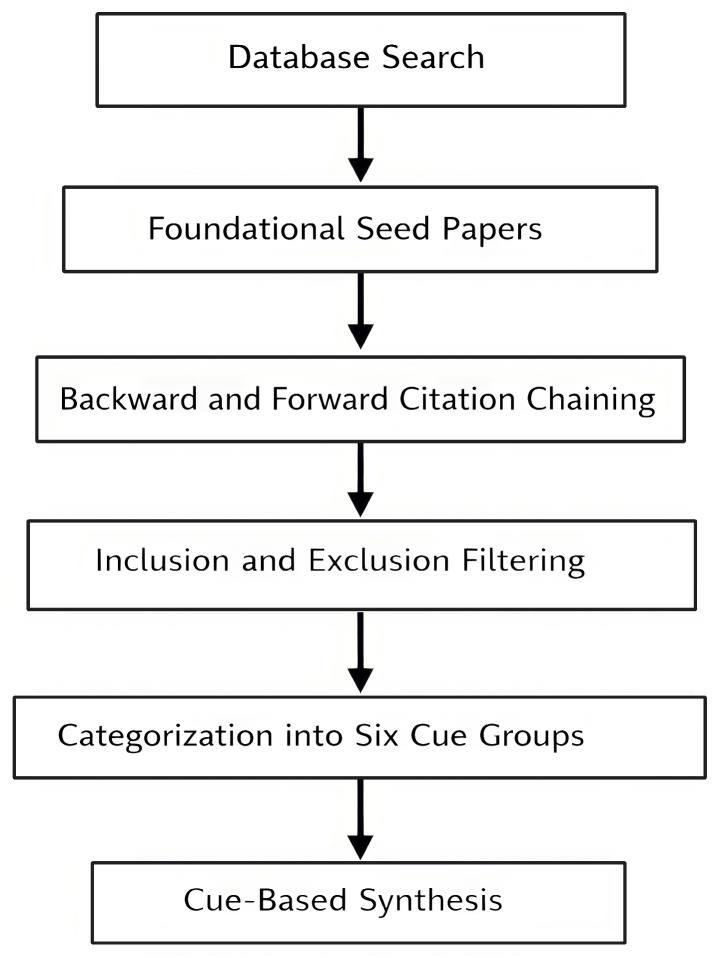 Figure 1
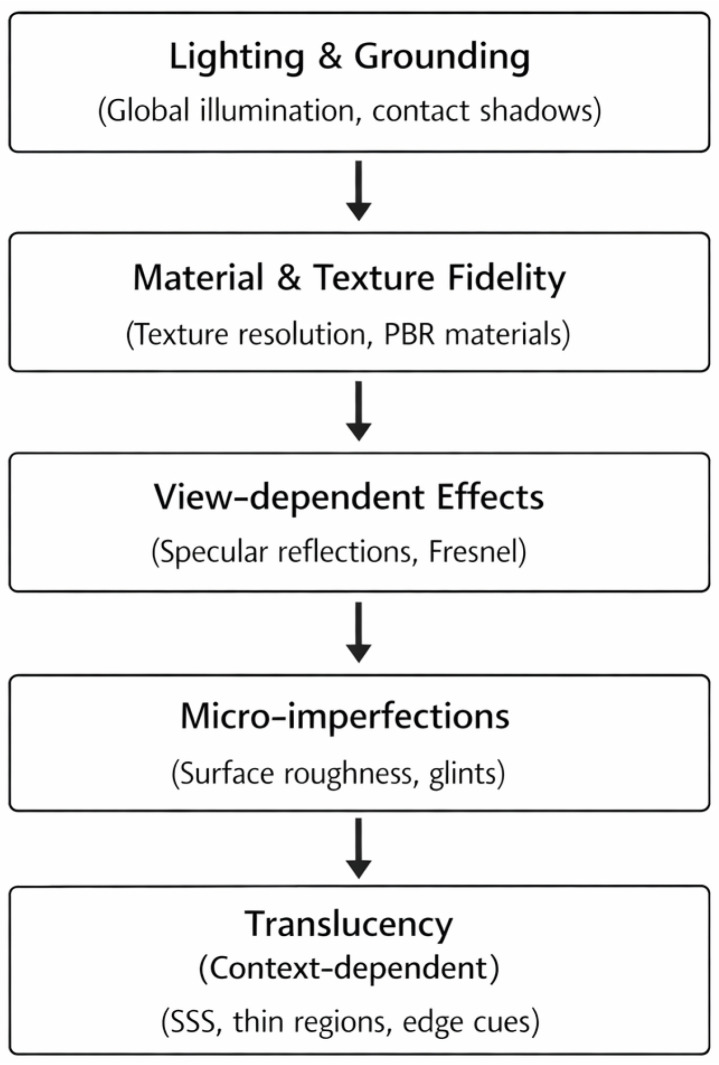 Figure 2
Peer Reviews
No public reviews on file for this paper yet. If you reviewed it on a platform where reviews are public (OpenReview, ICLR, NeurIPS, ICML), you can paste yours below so the community can read it here.
Videos
No videos yet. Explain this paper in a talk, walkthrough, or lecture? Add one.
Taxonomy
TopicsAesthetic Perception and Analysis · Spatial Cognition and Navigation · Architecture and Art History Studies