The Role of Artificial Intelligence and Professional Expertise in Adapted Physical Activity Prescription for Orthopedic Rehabilitation
Martina Sortino, Bruno Trovato, Rita Chiaramonte, Antonio Carrera, Marco Sapienza, Federico Roggio, Giuseppe Musumeci

TL;DR
Expert professionals create higher-quality physical activity plans for orthopedic rehabilitation compared to AI alone or novices using AI, showing that AI is a helpful tool but not a replacement for expertise.
Contribution
This study demonstrates that AI can partially bridge the expertise gap in physical activity prescription when used by novices, but cannot replace expert judgment.
Findings
Expert protocols scored highest in quality, followed by novice professionals using AI, with AI alone scoring lowest.
AI support improved protocol quality for novices in most conditions but failed to match expert performance in safety and appropriateness.
AI-generated protocols showed greater variability across different orthopedic conditions.
Abstract
Background: Adapted Physical Activity (APA) prescription is a complex decision-making process that integrates clinical guidelines and individual patient characteristics and remains strongly dependent on clinician experience. Generative artificial intelligence (AI) has recently emerged as a potential decision-support tool in exercise prescription; however, its interaction with professional expertise is still unclear. This study compared the perceived quality of APA protocols developed by expert professionals, novice professionals supported by AI, and AI operating autonomously across multiple orthopedic conditions. Methods: In this observational cross-sectional study, five real orthopedic prescriptions (scoliosis, low back pain, osteoporosis, high risk of falls, and osteoarthritis) were used to generate three APA protocols per condition: expert professional (EP), novice professional with…
Genes, proteins, chemicals, diseases, species, mutations and cell lines named across the full text — each resolved to its canonical identifier and authoritative record.
Click any figure to enlarge with its caption.
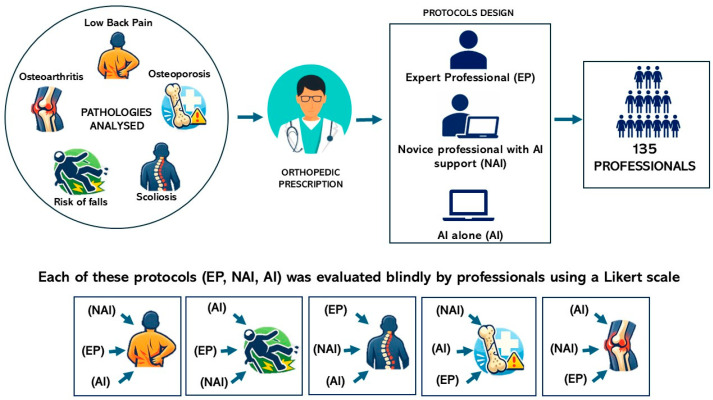 Figure 1
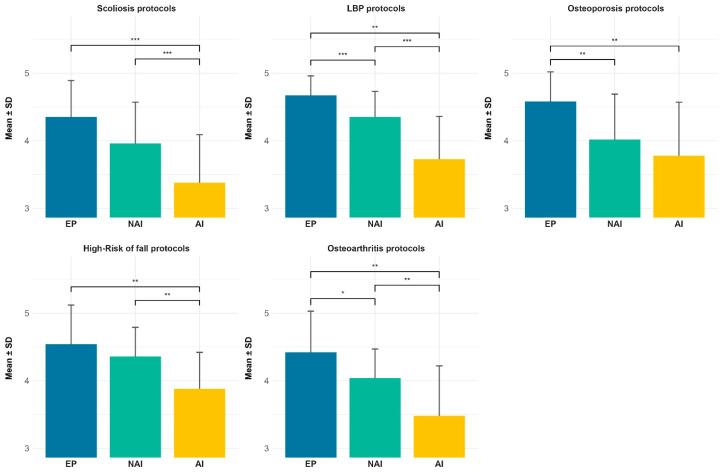 Figure 2
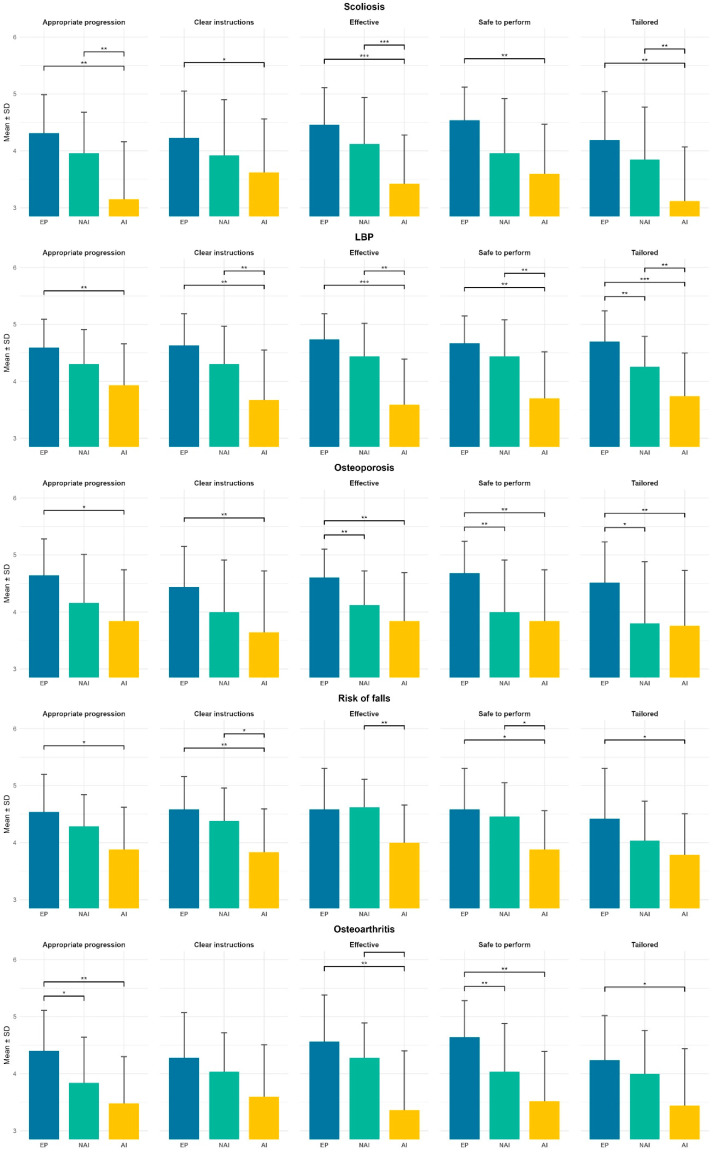 Figure 3
Peer Reviews
No public reviews on file for this paper yet. If you reviewed it on a platform where reviews are public (OpenReview, ICLR, NeurIPS, ICML), you can paste yours below so the community can read it here.
Videos
No videos yet. Explain this paper in a talk, walkthrough, or lecture? Add one.
Taxonomy
TopicsArtificial Intelligence in Healthcare and Education · Cerebral Palsy and Movement Disorders · Stroke Rehabilitation and Recovery