Mirror Visual Feedback Selectively Attenuates Crossover Fatigue in Distal Upper Limb Musculature: A Randomized Controlled Crossover Investigation Comparing Children and Adults
Aymen Ben Othman, Wissem Dhahbi, Manel Bessifi, Vlad Adrian Geantă, Vasile Emil Ursu, David G. Behm, Karim Chamari, Anis Chaouachi

TL;DR
Mirror visual feedback reduces crossover fatigue in hand muscles during handgrip exercises, with similar effects in children and adults.
Contribution
This study demonstrates that mirror visual feedback can selectively reduce crossover fatigue in distal upper limb musculature without age-dependent differences.
Findings
Mirror visual feedback maintained non-dominant handgrip force at rest-equivalent levels, unlike vision occlusion.
Crossover fatigue was significantly reduced in handgrip but not in elbow flexion or extension.
Children and adults showed similar magnitudes of mirror-induced fatigue attenuation.
Abstract
This investigation examined whether mirror visual feedback modulates crossover fatigue magnitude during unilateral handgrip exertion and whether efficacy demonstrates age-dependent and muscle-group-specific characteristics. Thirty-three participants stratified by developmental stage (adults: n = 17, 24.64 ± 5.38 years; children: n = 16, 11.87 ± 0.79 years) completed a randomized controlled crossover protocol incorporating three visual feedback conditions: mirror reflection of the exercised limb, occluded vision (no-mirror), and passive rest control. Participants performed unilateral dominant handgrip fatigue induction (20 × 6 s maximal voluntary isometric contractions) while bilateral force production was quantified pre-intervention and post-intervention across handgrip, elbow flexion, and elbow extension domains. Linear mixed-effects models with participant-specific random intercepts…
Genes, proteins, chemicals, diseases, species, mutations and cell lines named across the full text — each resolved to its canonical identifier and authoritative record.
Click any figure to enlarge with its caption.
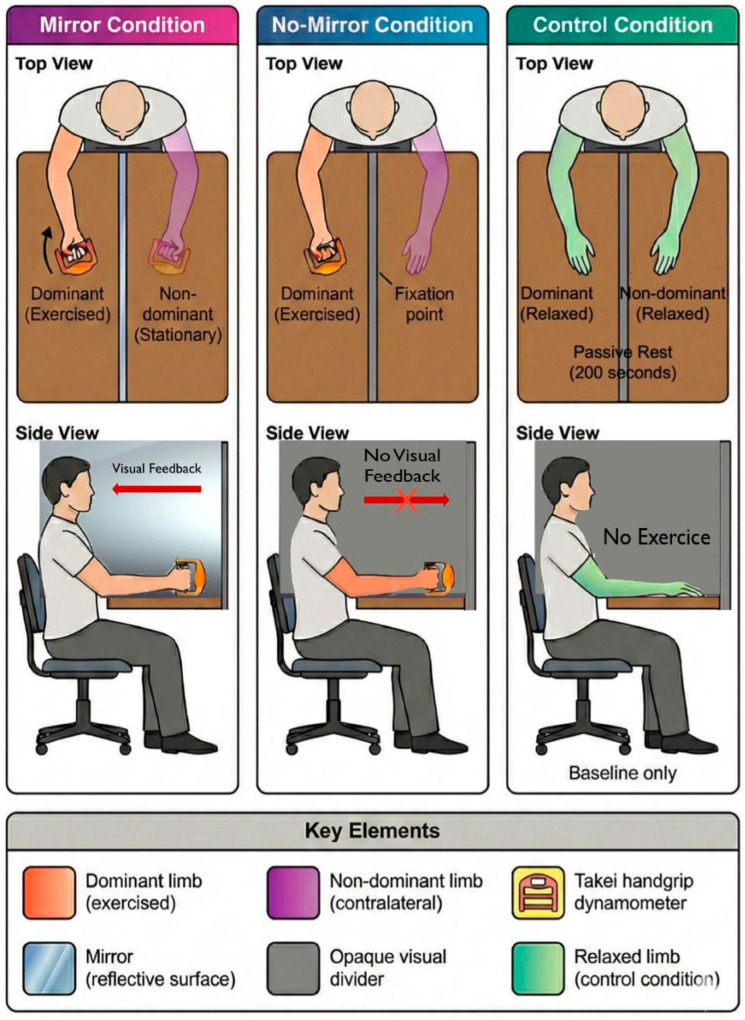 Figure 1
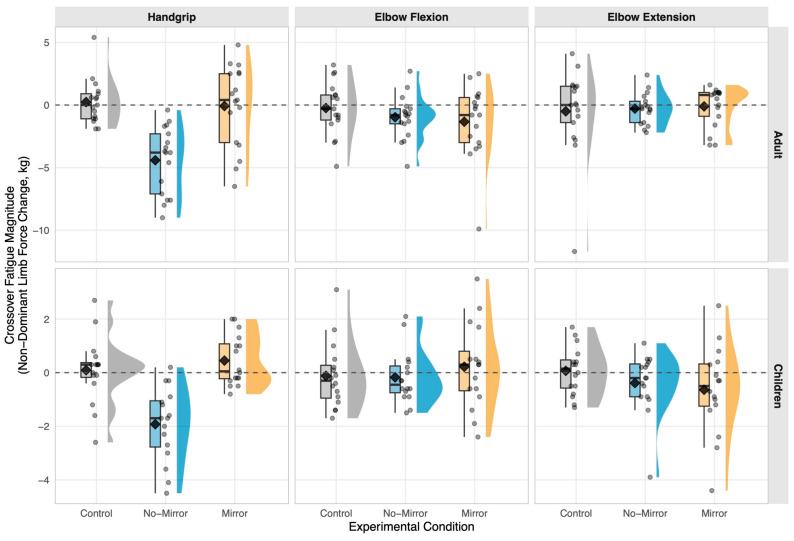 Figure 2
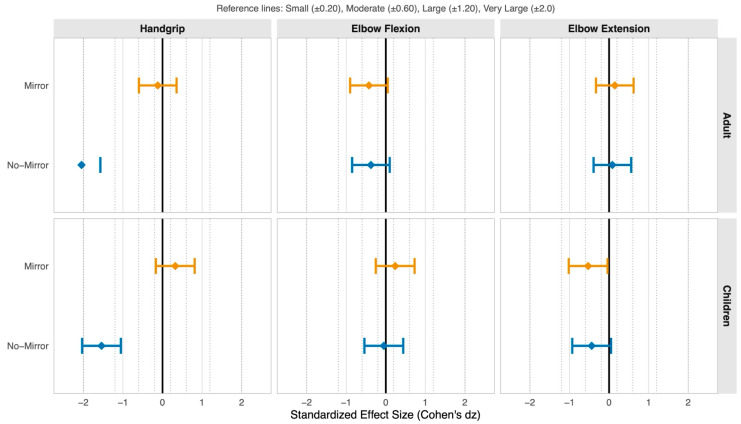 Figure 3
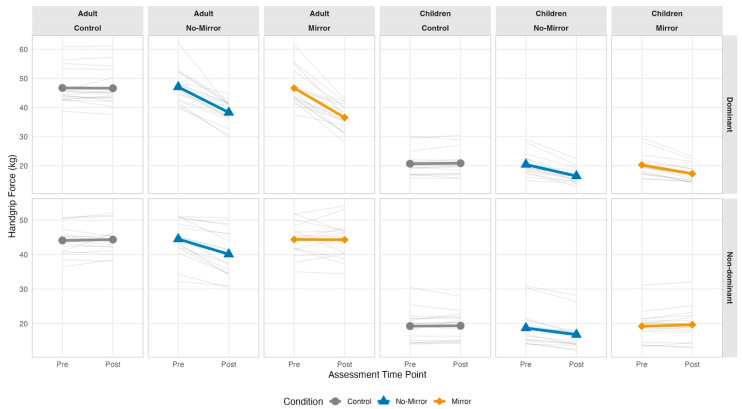 Figure 4
Peer Reviews
No public reviews on file for this paper yet. If you reviewed it on a platform where reviews are public (OpenReview, ICLR, NeurIPS, ICML), you can paste yours below so the community can read it here.
Videos
No videos yet. Explain this paper in a talk, walkthrough, or lecture? Add one.
Taxonomy
TopicsMuscle activation and electromyography studies · Motor Control and Adaptation · Sports injuries and prevention