Unraveling the Signaling Networks: How Exogenous Substances Mitigate Heat Stress in Edible Fungi
Jinjin Wen, Huilin Jing, Bin Chen, Zhenhe Wang, Jiajia Wang, Peng Yan, Chaohui Zhang, Guang Zhang

TL;DR
This review explores how external substances help edible fungi withstand heat stress by protecting cells and managing stress responses.
Contribution
The paper categorizes exogenous substances into three groups and outlines four key mechanisms by which they mitigate heat stress in edible fungi.
Findings
Exogenous substances regulate antioxidant systems to reduce reactive oxygen species.
They preserve cell wall and membrane integrity under heat stress.
Substances modulate gene expression and carbon metabolism to enhance stress tolerance.
Abstract
Heat stress (HS), induced by global climate warming, is one of the major limiting factors in edible fungi production. HS suppresses mycelial growth and fruiting body formation by causing excessive accumulation of intracellular reactive oxygen species (ROS), disrupting the integrity of cell membranes and cell walls, and impairing cellular metabolism. Increasing evidence suggests that the application of exogenous substances (ESs) effectively mitigates HS in edible fungi. Based on the recent literature, this review categorizes ESs into three groups—core signaling molecules, plant growth regulators, and cytoprotective agents—and summarizes their beneficial effects against HS in edible fungi. The underlying mechanisms of ES-mediated alleviation of heat-induced damage primarily involve four pathways: (1) regulation of antioxidant systems; (2) preservation of cell wall and membrane structural…
Genes, proteins, chemicals, diseases, species, mutations and cell lines named across the full text — each resolved to its canonical identifier and authoritative record.
Click any figure to enlarge with its caption.
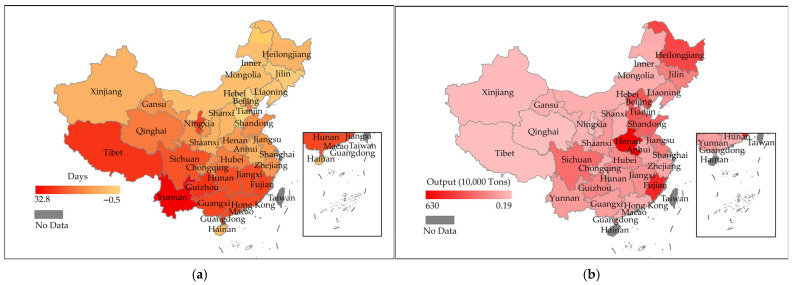 Figure 1
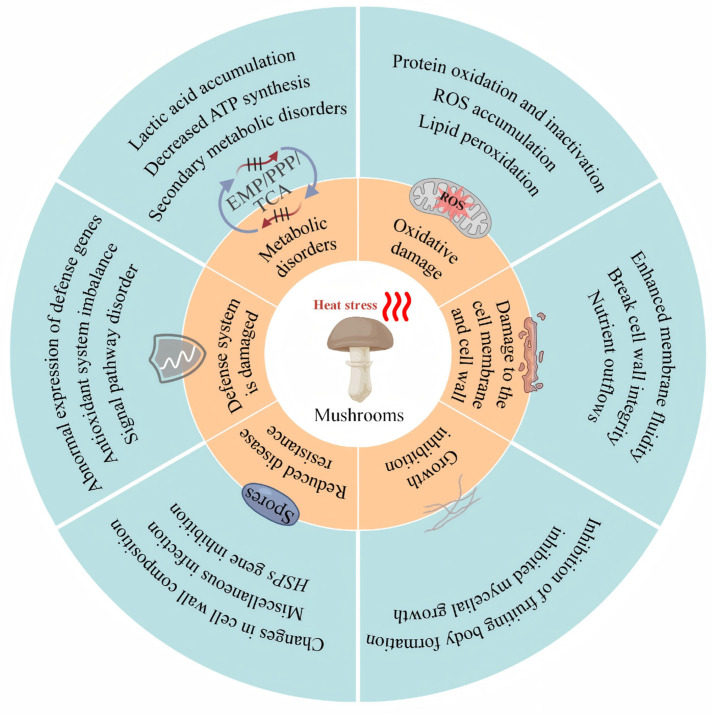 Figure 2
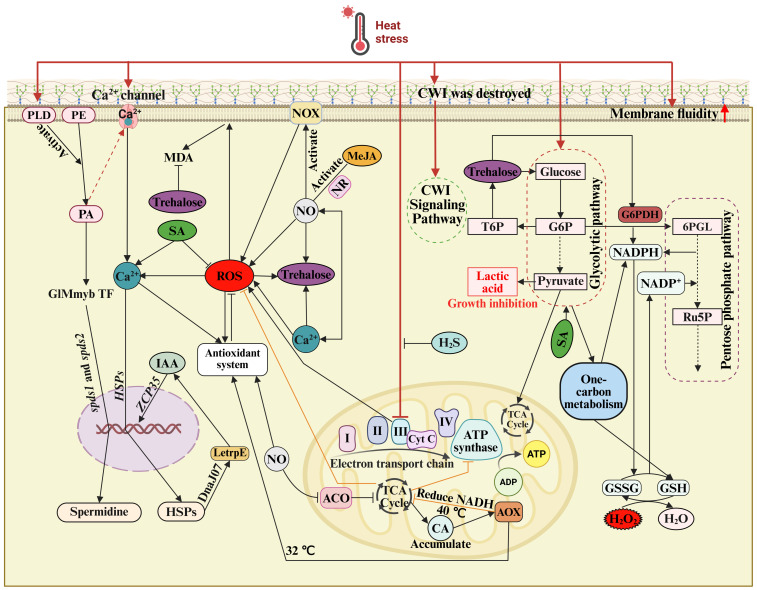 Figure 3
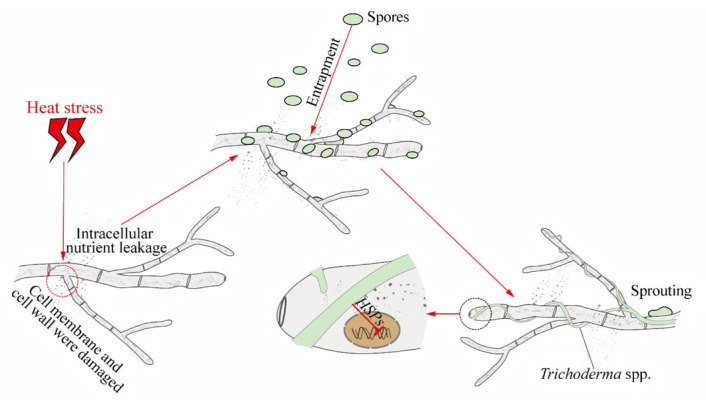 Figure 4
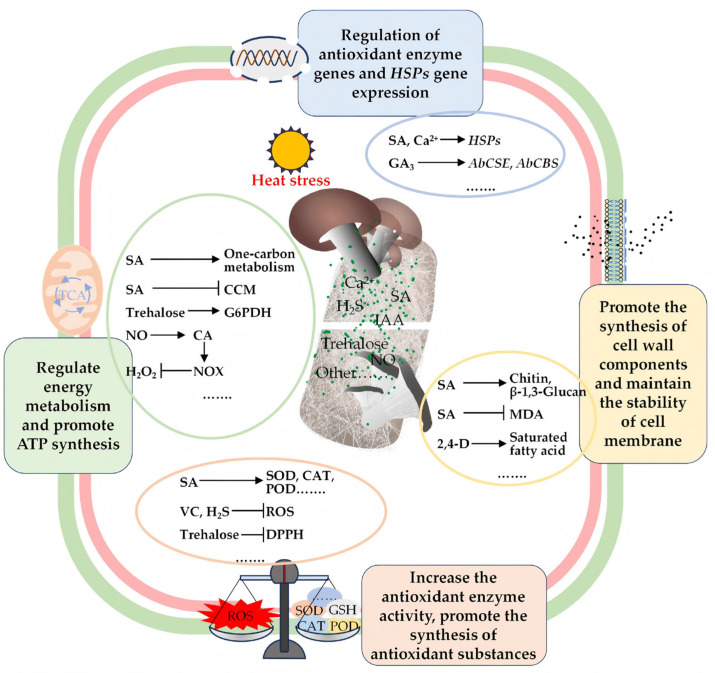 Figure 5
Peer Reviews
No public reviews on file for this paper yet. If you reviewed it on a platform where reviews are public (OpenReview, ICLR, NeurIPS, ICML), you can paste yours below so the community can read it here.
Videos
No videos yet. Explain this paper in a talk, walkthrough, or lecture? Add one.
Taxonomy
TopicsFungal Biology and Applications · Fungal and yeast genetics research · Mycorrhizal Fungi and Plant Interactions