Prevalence and Associated Factors of Depression Among Emergency Physicians in South Korea: Findings from the 2025 Korean Emergency Physician Survey
Min Jae Kim, In Hwan Yeo, Mi Jin Lee, Ji Hun Kim, Hyung Min Lee, Kwang Hyun Cho, Kyung Hye Park, Eu Sun Lee, Joon Bum Park, Sanghun Kim, Ji Eun Kim, Han Zo Choi, Kyungseok Park

TL;DR
This study finds that 15% of South Korean emergency physicians show depressive symptoms, linked to work stress, poor sleep, and lack of social support.
Contribution
The study identifies specific psychosocial and lifestyle factors associated with depression among emergency physicians in South Korea.
Findings
14.9% of surveyed emergency physicians screened positive for depressive symptoms.
Depression was associated with perceived work burdens, poor sleep quality, and verbal abuse at work.
Protective factors included being married, better sleep, and higher psychosocial wellness scores.
Abstract
Background and Objectives: Emergency physicians practice in high-pressure environments and face occupational stressors that may affect their mental health. This study was designed to evaluate the prevalence of depression among emergency physicians in South Korea and examined environmental, sociolegal, and individual factors associated with depressive symptoms in the post-pandemic period. Materials and Methods: This nationwide cross-sectional study analyzed data from the 2025 Korean Emergency Physician Survey. Screening positive for depressive symptoms was defined as a Patient Health Questionnaire-9 (PHQ-9) score ≥ 10, indicating moderate-to-severe depressive symptom severity. Measures included the PHQ-9, the Korean Epworth Sleepiness Scale (KESS), and the Adult APGAR, a brief self-administered instrument assessing overall wellness. Multivariable logistic regression was performed to…
Genes, proteins, chemicals, diseases, species, mutations and cell lines named across the full text — each resolved to its canonical identifier and authoritative record.
Click any figure to enlarge with its caption.
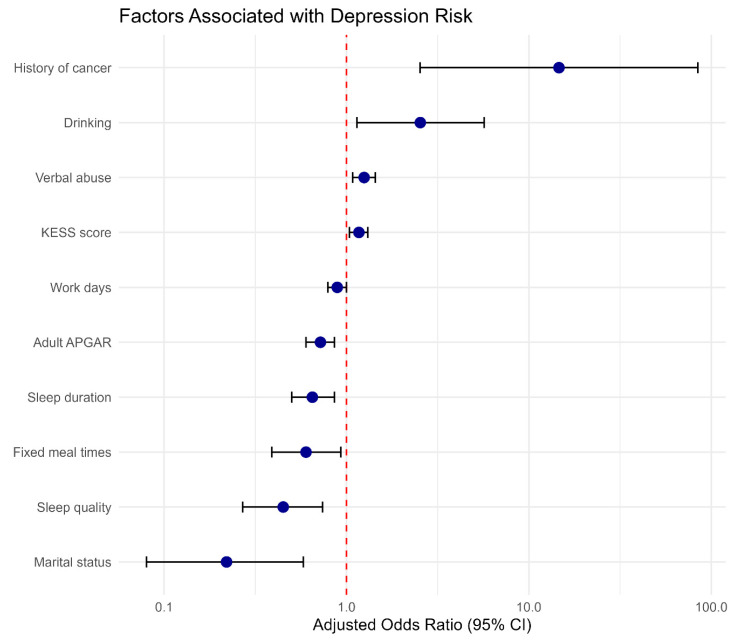 Figure 1
Peer Reviews
No public reviews on file for this paper yet. If you reviewed it on a platform where reviews are public (OpenReview, ICLR, NeurIPS, ICML), you can paste yours below so the community can read it here.
Videos
No videos yet. Explain this paper in a talk, walkthrough, or lecture? Add one.
Taxonomy
TopicsHealthcare professionals’ stress and burnout · COVID-19 and Mental Health · Posttraumatic Stress Disorder Research