Bright Light Therapy in Psychiatric Disorders: Mechanisms, Clinical Procedures and Evidence
Simone Pardossi, Letizia Bossini, Veronica Milani, Maria Beatrice Rescalli, Alessandro Cuomo

TL;DR
This review explores how bright light therapy affects mood and circadian rhythms, and its effectiveness in treating psychiatric disorders like depression and bipolar disorder.
Contribution
The paper provides a comprehensive review of BLT's mechanisms, clinical procedures, and evidence across various psychiatric conditions.
Findings
BLT is effective for seasonal affective disorder and shows antidepressant effects in major depressive and bipolar disorders.
BLT influences mood via retinal pathways to the SCN and limbic system, affecting circadian rhythms and hormonal systems.
Emerging evidence suggests BLT may help with insomnia and other psychiatric symptoms like sexual dysfunction.
Abstract
Light is the primary zeitgeber for circadian rhythms, and also through these mechanisms, is closely related to mood regulation. Bright light therapy (BLT) is a therapeutic intervention that specifically exploits this physiological mechanism. This review summarizes the clinical procedures of BLT, the mechanisms through which light influences circadian rhythms and mood, and the evidence supporting BLT in psychiatric disorders. BLT is administered by considering device distance, treatment duration, and light intensity. Through pathways originating in the retina and projecting to the Suprachiasmatic Nucleus (SCN), light might generate signals within the central nervous system that influence not only circadian regulation but also mood, via connections involving the limbic system, the lateral habenula, and interactions with the hormonal system. At the clinical level, the strongest evidence…
Genes, proteins, chemicals, diseases, species, mutations and cell lines named across the full text — each resolved to its canonical identifier and authoritative record.
Click any figure to enlarge with its caption.
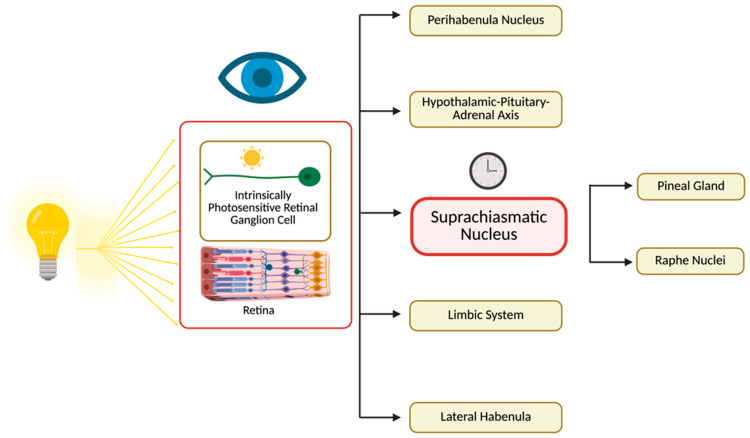 Figure 1
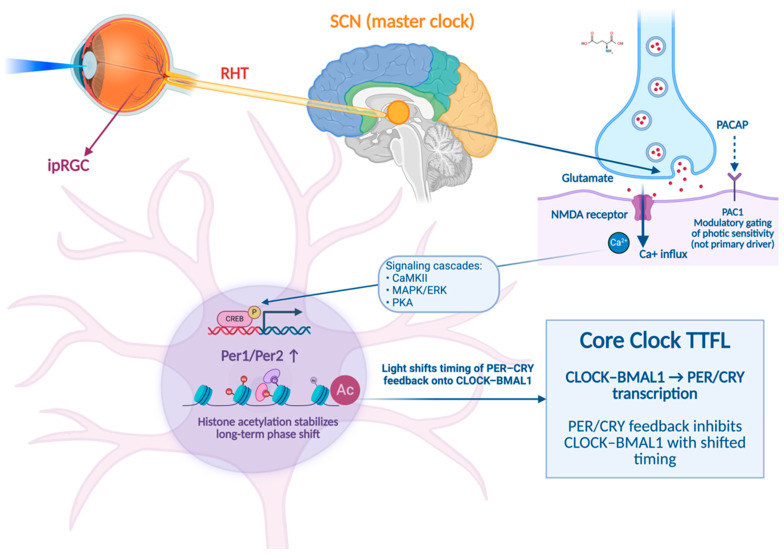 Figure 2
Peer Reviews
No public reviews on file for this paper yet. If you reviewed it on a platform where reviews are public (OpenReview, ICLR, NeurIPS, ICML), you can paste yours below so the community can read it here.
Videos
No videos yet. Explain this paper in a talk, walkthrough, or lecture? Add one.
Taxonomy
TopicsCircadian rhythm and melatonin · Laser Applications in Dentistry and Medicine · Photoreceptor and optogenetics research