Adverse Newborn Outcomes by Insurance Status Among Patients with Severe Maternal Morbidity in Maryland: 2020–2023
Porcia Manandhar, Carrie Wolfson, Jeanne Sheffield, Michelle Phillips, Ernest Graham, Robert Atlas, Pamela Chin, Joanne Olaku, Robyn Duafala, Brittany L. Cline, Irina Burd, Jenifer Fahey, Kimberly Jones-Beatty, Krista M. Mehlhaff, Monica B. Jones, Kathryn Buchanan

TL;DR
This study finds that Medicaid-insured patients with severe maternal complications are more likely to have adverse newborn outcomes compared to those with commercial insurance.
Contribution
The study provides new evidence on disparities in newborn outcomes by insurance type among patients with severe maternal morbidity.
Findings
Medicaid patients had 2.2 to 2.6 times higher odds of adverse newborn outcomes after adjusting for socio-demographic and medical factors.
Comorbidities and most primary SMM causes increased the odds of adverse newborn outcomes.
Medicaid patients were younger, more racially diverse, and had later prenatal care initiation compared to commercially insured patients.
Abstract
Background: Adverse newborn outcomes in patients with severe maternal morbidity (SMM) are understudied, and this study examines their association with insurance type (Medicaid vs. commercial) in patients who experienced SMM. The aim of this study is to examine disparities in preterm birth, low birthweight, and neonatal intensive care (NICU) admission among Medicaid vs. commercially insured patients with severe maternal morbidity in Maryland. Methods: This cross-sectional study analyzed data from 588 SMM patients enrolled in Maryland’s Severe Maternal Morbidity (SMM) Surveillance Program (August 2020–December 2023). We utilized unadjusted and multivariable logistic regression models to evaluate the relationship between primary insurance type and the outcomes of interest: preterm birth (<37 weeks), low birthweight (<2500 g), and neonatal intensive care unit (NICU) admissions. Results: Of…
Genes, proteins, chemicals, diseases, species, mutations and cell lines named across the full text — each resolved to its canonical identifier and authoritative record.
Click any figure to enlarge with its caption.
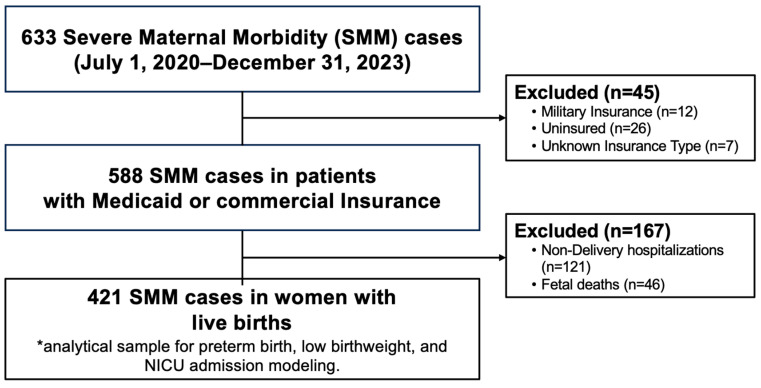 Figure 1
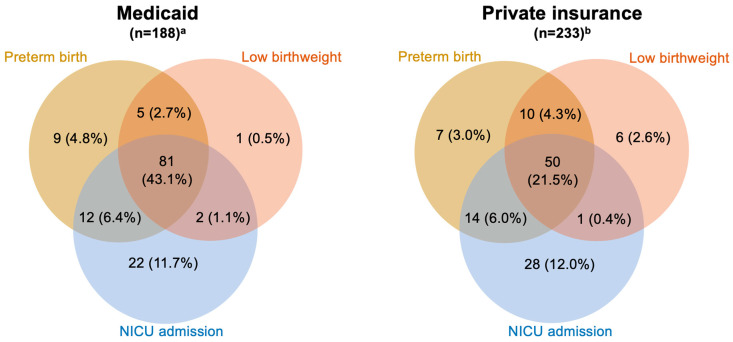 Figure 2
Peer Reviews
No public reviews on file for this paper yet. If you reviewed it on a platform where reviews are public (OpenReview, ICLR, NeurIPS, ICML), you can paste yours below so the community can read it here.
Videos
No videos yet. Explain this paper in a talk, walkthrough, or lecture? Add one.
Taxonomy
TopicsMaternal and fetal healthcare · Maternal and Perinatal Health Interventions · Preterm Birth and Chorioamnionitis