Translational Fidelity Decline in the Aging Oocyte and Embryo Development
Charalampos Voros, Fotios Chatzinikolaou, Georgios Papadimas, Ioannis Papapanagiotou, Aristotelis-Marios Koulakmanidis, Diamantis Athanasiou, Kyriakos Bananis, Antonia Athanasiou, Aikaterini Athanasiou, Charalampos Tsimpoukelis, Athanasios Karpouzos, Maria Anastasia Daskalaki

TL;DR
This paper explores how aging affects oocyte and embryo development by impairing the accuracy of protein synthesis, which could explain reproductive failures in older women.
Contribution
The paper introduces translational fidelity decline as a novel and underrecognized mechanism underlying reproductive aging and embryo developmental arrest.
Findings
Translational fidelity is critical for proteome integrity and cellular function in oocytes and embryos.
Age-related defects in translational control can disrupt spindle assembly and early cleavage dynamics.
The follicular microenvironment plays a key role in maintaining translational fidelity.
Abstract
Female reproductive aging is associated with a progressive decline in oocyte competence and reduced success in assisted reproductive technologies. While chromosomal abnormalities, mitochondrial dysfunction, and DNA damage have been extensively studied, these mechanisms do not fully explain developmental arrest in chromosomally euploid embryos or the variability in embryo competence. Human oocytes enter a transcriptionally quiescent state during meiotic maturation and rely almost entirely on the regulated translation of stored maternal messenger RNAs to support fertilization and early embryonic development until zygotic genome activation. In this context, translational fidelity becomes a critical determinant of proteome integrity and cellular function. Age-related alterations affecting ribosomal RNA integrity, transfer RNA modification, aminoacylation accuracy, and translational…
Genes, proteins, chemicals, diseases, species, mutations and cell lines named across the full text — each resolved to its canonical identifier and authoritative record.
Click any figure to enlarge with its caption.
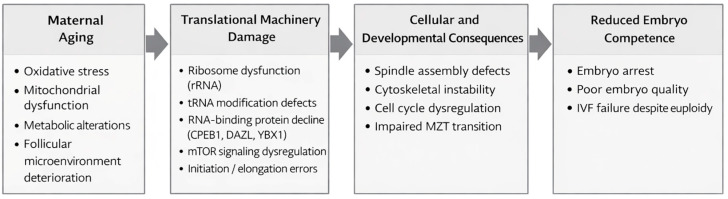 Figure 1
Peer Reviews
No public reviews on file for this paper yet. If you reviewed it on a platform where reviews are public (OpenReview, ICLR, NeurIPS, ICML), you can paste yours below so the community can read it here.
Videos
No videos yet. Explain this paper in a talk, walkthrough, or lecture? Add one.
Taxonomy
TopicsReproductive Biology and Fertility · RNA Research and Splicing · Sperm and Testicular Function