Shifts with Nights and Migraine Prevalence Among Nurses: A Systematic Review and Meta-Analysis
Piedad Gómez-Torres, Azahara Ruger-Navarrete, Laura Lasso-Olayo, Isabel Blázquez-Ornat, David Peña-Otero, Sergio Galarreta-Aperte

TL;DR
A review of studies on nurses found no strong evidence that night shifts increase migraine prevalence compared to day-only schedules.
Contribution
This is the first nurse-specific systematic review and meta-analysis on the relationship between night shifts and migraine prevalence.
Findings
Night-inclusive schedules were not significantly associated with higher migraine prevalence compared to day-only schedules.
Secondary comparisons of night-work intensity showed inconclusive results due to limited data and inconsistent definitions.
The evidence base is small and heterogeneous, making it difficult to draw firm conclusions or policy recommendations.
Abstract
What are the main findings? In a nurse-specific systematic review and meta-analysis (4 observational studies; total N = 3843, analyzable N = 3323), night-inclusive schedules (fixed nights and/or rotating shifts including nights) were not associated with a statistically significant difference in 1-year migraine prevalence versus day-only/non-night schedules (pooled PR = 0.95, 95% CI 0.82–1.10; I2 = 0%).Secondary night-work intensity comparisons were inconclusive (high vs. low: PR = 1.24, 95% CI 0.46–3.36; high vs. zero nights: PR = 0.85, 95% CI 0.38–1.93), with non-harmonized exposure thresholds and few contributing studies limiting precision and consistency. In a nurse-specific systematic review and meta-analysis (4 observational studies; total N = 3843, analyzable N = 3323), night-inclusive schedules (fixed nights and/or rotating shifts including nights) were not associated with a…
Genes, proteins, chemicals, diseases, species, mutations and cell lines named across the full text — each resolved to its canonical identifier and authoritative record.
Click any figure to enlarge with its caption.
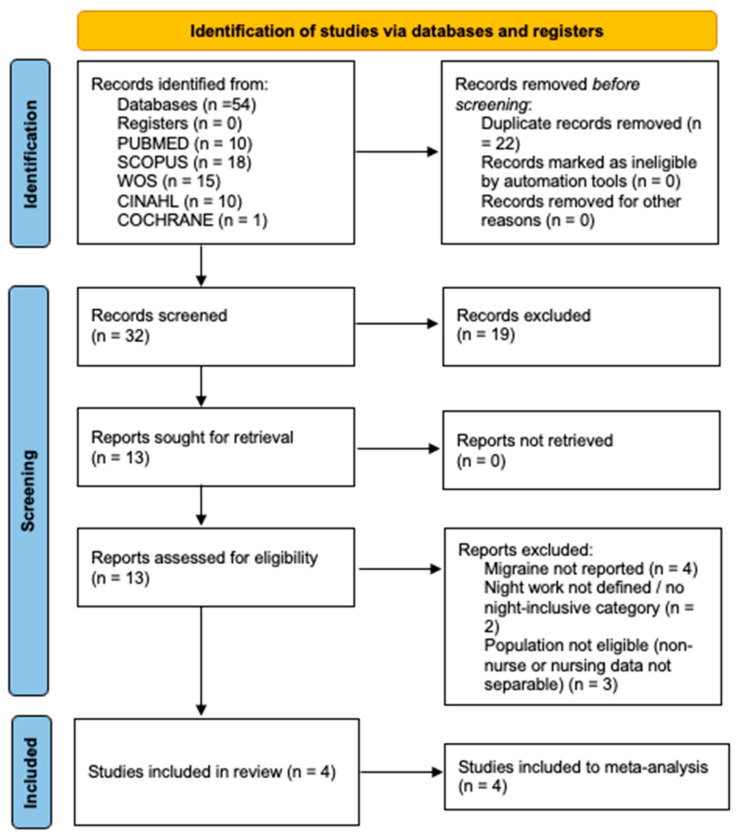 Figure 1
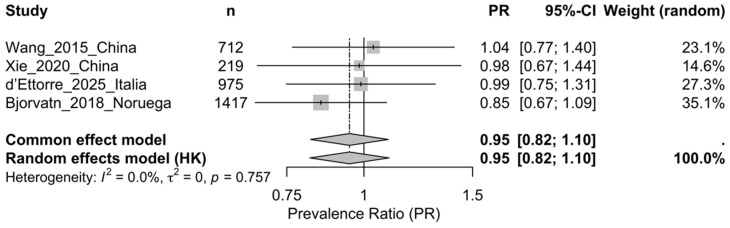 Figure 2
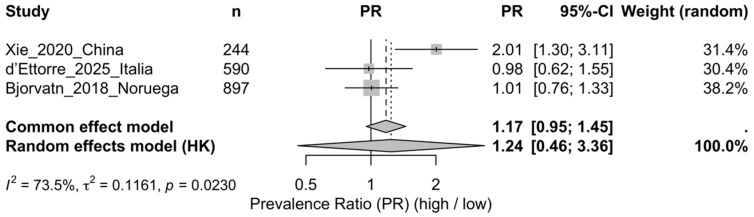 Figure 3
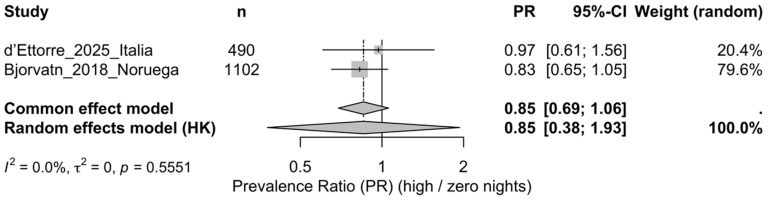 Figure 4
Peer Reviews
No public reviews on file for this paper yet. If you reviewed it on a platform where reviews are public (OpenReview, ICLR, NeurIPS, ICML), you can paste yours below so the community can read it here.
Videos
No videos yet. Explain this paper in a talk, walkthrough, or lecture? Add one.
Taxonomy
TopicsSleep and Work-Related Fatigue · Circadian rhythm and melatonin · Sleep and related disorders