Influence of Playing Site and Weekly Training Frequency on Physical Performance in Elite Padel Players
Adrián González-Jiménez, Diego Muñoz, Adrián Castaño-Zambudio, Bernardino J. Sánchez-Alcaraz, Iván Martín-Miguel

TL;DR
This study examines how playing side and training frequency affect physical performance in elite padel players.
Contribution
The study provides new insights into physical and physiological differences among elite padel players based on their playing side.
Findings
Left-side players showed higher Yo-Yo performance and estimated VO2max compared to right-side players.
Dominant hands showed significantly greater isometric handgrip strength than non-dominant hands.
Weekly training frequency did not significantly influence physical performance metrics.
Abstract
Objectives: The physical and physiological characteristics of padel players are essential for appropriate training load prescription; however, this area remains underexplored. Therefore, this hypothesis-driven study aimed to analyse physical and physiological differences in male padel players according to playing side. A secondary objective was to observe the influence of training volume on these parameters. Methods: Fourteen high-level male players competing in professional circuits or top-level regional competitions participated in this cross-sectional study using directional (one-tailed) testing. Results: Vertical jump performance differed significantly between the countermovement jump (CMJ) and the Abalakov jump (ABK) (p < 0.001), with lower values in the CMJ (40.98 cm) compared with the ABK (46.96 cm). Isometric handgrip strength showed significant inter-limb differences (p <…
Click any figure to enlarge with its caption.
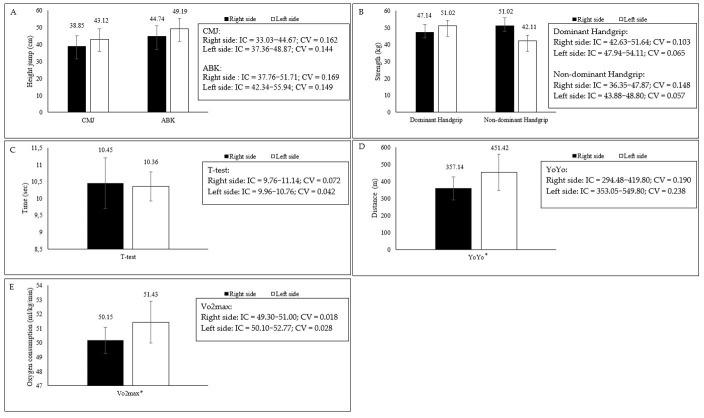 Figure 1
Peer Reviews
No public reviews on file for this paper yet. If you reviewed it on a platform where reviews are public (OpenReview, ICLR, NeurIPS, ICML), you can paste yours below so the community can read it here.
Videos
No videos yet. Explain this paper in a talk, walkthrough, or lecture? Add one.
Taxonomy
TopicsSports Performance and Training · Sports Dynamics and Biomechanics · Sports injuries and prevention