Beyond the Genomic Storm: Evaluating Tabernanthalog as a Potential Scaffold for Silent Neuroplasticity and Broad-Spectrum Therapy
Ivan Anchesi, Ivana Raffaele, Maria Francesca Astorino, Maria Lui, Marco Calabrò, Giovanni Luca Cipriano

TL;DR
Tabernanthalog (TBG) is a non-hallucinogenic compound with broad therapeutic potential for psychiatric and neurological conditions, offering neuroplastic benefits without the risks of traditional psychedelics.
Contribution
TBG is presented as a novel scaffold for developing therapies that induce neuroplasticity without hallucinogenic or cardiotoxic effects.
Findings
TBG shows efficacy in preclinical models of neuropathic pain, visceral pain, and cancer-related cognitive impairment.
TBG induces structural neuroplasticity without triggering the typical psychedelic gene expression patterns.
TBG interacts with multiple targets, including nAChRs, NMDA receptors, and mGlu2 receptors.
Abstract
The clinical renaissance of psychedelic medicine has highlighted the therapeutic potential of rapid-acting neuroplastogens, or “psychoplastogens,” for psychiatric disorders. However, the widespread application of classical psychedelics—such as psilocybin and LSD—and the atypical dissociative ibogaine is severely limited by their hallucinogenic properties and, particularly in the case of ibogaine, life-threatening cardiotoxicity. Addressing these limitations, Tabernanthalog (TBG) has emerged as a frontrunner in the field. This non-hallucinogenic analog of ibogaine was rationally designed to eliminate interactions with the human ether-à-go-go-related gene (hERG, KCNH2) potassium channel, thereby mitigating cardiotoxic risks. While initially characterized for its anti-addictive and antidepressant-like properties, recent data from 2024–2025 have significantly expanded its therapeutic…
Genes, proteins, chemicals, diseases, species, mutations and cell lines named across the full text — each resolved to its canonical identifier and authoritative record.
Click any figure to enlarge with its caption.
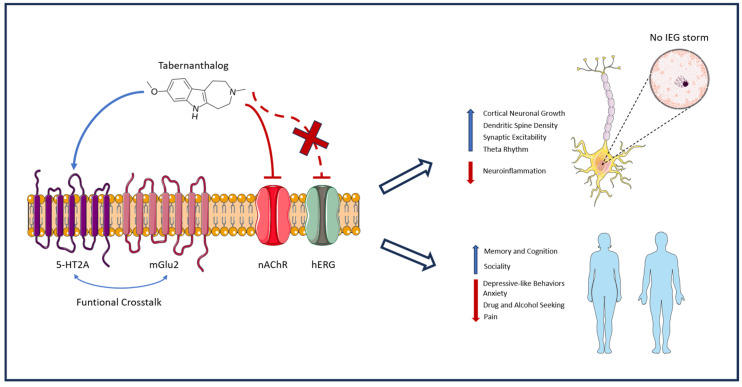 Figure 1
Peer Reviews
No public reviews on file for this paper yet. If you reviewed it on a platform where reviews are public (OpenReview, ICLR, NeurIPS, ICML), you can paste yours below so the community can read it here.
Videos
No videos yet. Explain this paper in a talk, walkthrough, or lecture? Add one.
Taxonomy
TopicsPsychedelics and Drug Studies · Forensic Toxicology and Drug Analysis · Nicotinic Acetylcholine Receptors Study