Machine Learning Models for Predicting Bleeding Risk in Anticoagulated Patients with Atrial Fibrillation and Venous Thromboembolism: A Comparative Evidence Synthesis
Winnie Z. Y. Teo, Maggie Wing Yin Wong, Fang Jin Lim, Emmeliene Su-Min Ong, Nesaretnam Barr Kumarakulasinghe, Eng Soo Yap

TL;DR
Machine learning models predict bleeding risk better than traditional methods in patients with heart rhythm issues and blood clots, but more research is needed to confirm their usefulness in real-world settings.
Contribution
This study compares machine learning models with conventional clinical scores for predicting bleeding risk in anticoagulated patients with atrial fibrillation and venous thromboembolism.
Findings
Machine learning models like random forest and XGBoost outperformed traditional tools in predicting bleeding events.
Deep learning ensembles achieved the highest area under the curve (AUC) values in both atrial fibrillation and venous thromboembolism populations.
The improvement in accuracy over traditional scores was modest, with AUC differences ranging from 0.05 to 0.15.
Abstract
Background: Accurate prediction of bleeding events in patients receiving oral anticoagulants remains a key challenge in the management of atrial fibrillation (AF) and venous thromboembolism (VTE). Machine learning (ML) algorithms have emerged as powerful tools that capture complex, nonlinear interactions among risk factors, potentially offering superior accuracy. Objectives: To synthesize evidence comparing ML-based bleeding risk models with conventional clinical scores in anticoagulated AF and VTE populations. Methods: We conducted a systematic review with narrative synthesis of studies published between 2015 and 2025 applying ML algorithms to predict bleeding events in anticoagulated AF or VTE patients. Results: Thirteen studies were identified (seven AF and six VTE), including 464,523 participants in total. ML algorithms such as random forest (RF), extreme gradient boosting…
Genes, proteins, chemicals, diseases, species, mutations and cell lines named across the full text — each resolved to its canonical identifier and authoritative record.
Click any figure to enlarge with its caption.
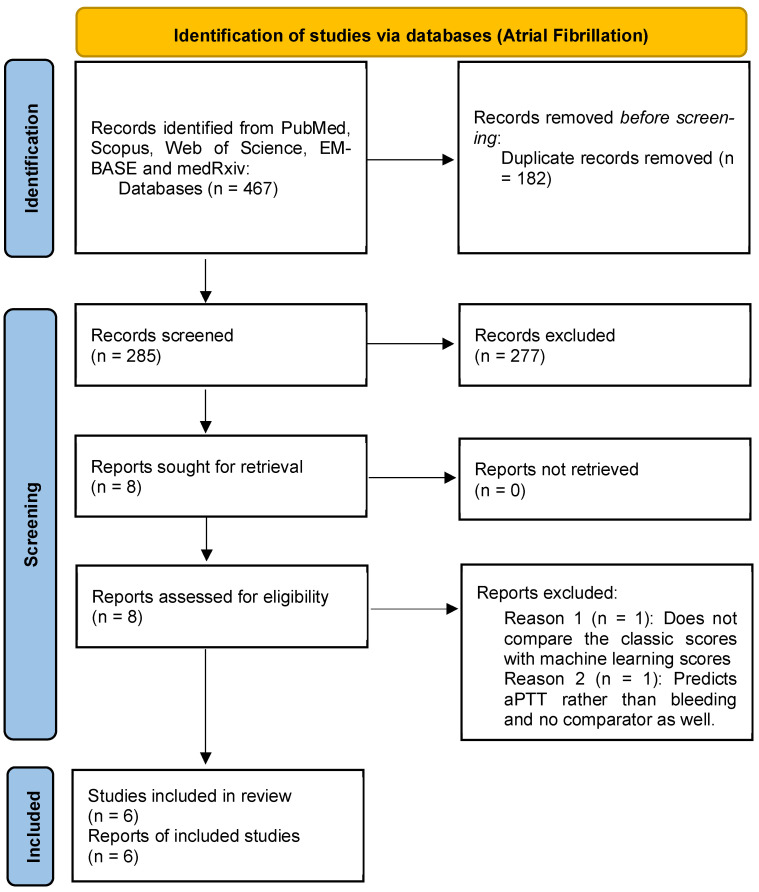 Figure 1
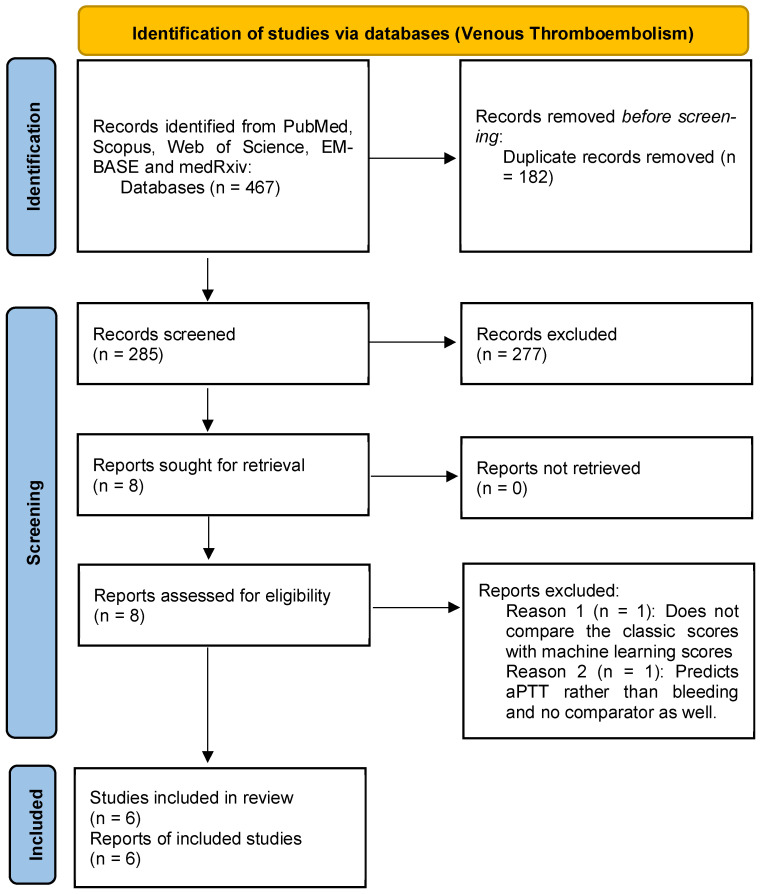 Figure 2
Peer Reviews
No public reviews on file for this paper yet. If you reviewed it on a platform where reviews are public (OpenReview, ICLR, NeurIPS, ICML), you can paste yours below so the community can read it here.
Videos
No videos yet. Explain this paper in a talk, walkthrough, or lecture? Add one.
Taxonomy
TopicsAtrial Fibrillation Management and Outcomes · Venous Thromboembolism Diagnosis and Management · Imbalanced Data Classification Techniques