Deficiency of PTEN Confers Hypersensitivity to Fatty Acid-Mediated ER Stress in Transformed Hepatocytes
Olaya Yassin, Odai Darawshi, Fangfang Wang, Youwei Zhang, Ata Abbas, William C. Merrick, William Cheung, Antony Antoniou, Shakti P. Pattanayak, Boaz Tirosh

TL;DR
PTEN-deficient liver cancer cells are highly sensitive to fatty acids, leading to cell stress and death, suggesting dietary or drug strategies could target these tumors.
Contribution
PTEN-deficient hepatocytes show unique vulnerability to fatty acid-induced ER stress and apoptosis, offering new therapeutic opportunities.
Findings
PTEN-deficient HepG2 cells undergo ER stress and apoptosis when exposed to fatty acids, unlike control cells.
PTEN KO cells show increased triglycerides and impaired lipid droplet formation, along with reduced β-oxidation.
PTEN-deficient tumors grow faster on normal diets but slower on high-fat diets, indicating metabolic vulnerability.
Abstract
Deletion of the tumor suppressor gene phosphatase and tensin homolog (PTEN) in hepatocellular carcinoma (HCC) is associated with a poor response to therapy and reduced survival. In mice, the deletion of PTEN in hepatocytes generates steatosis; however, on the background of steatosis not all emerging HCC cells lack PTEN, suggesting that steatosis confers a metabolic liability to proliferating PTEN-deficient hepatocytes. Here, we show that PTEN-deficient HepG2 cells develop terminal stress in the endoplasmic reticulum (ER) and profound apoptosis when exposed to a mixture of oleic and palmitic acids, while control cells do not. Lipidomic analyses before and after the treatment indicate a higher increase in triglycerides in PTEN KO cells, as well as profound differences in phospholipid concentrations. Although the triglyceride content increases, the coalescence into lipid droplets was…
Genes, proteins, chemicals, diseases, species, mutations and cell lines named across the full text — each resolved to its canonical identifier and authoritative record.
Click any figure to enlarge with its caption.
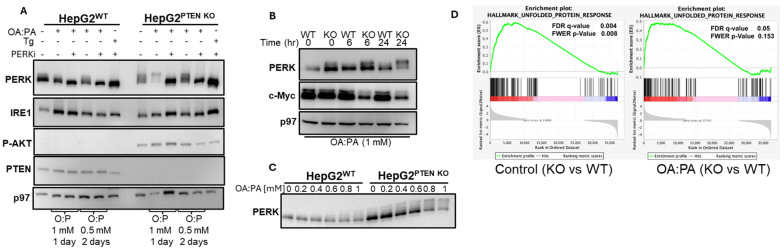 Figure 1
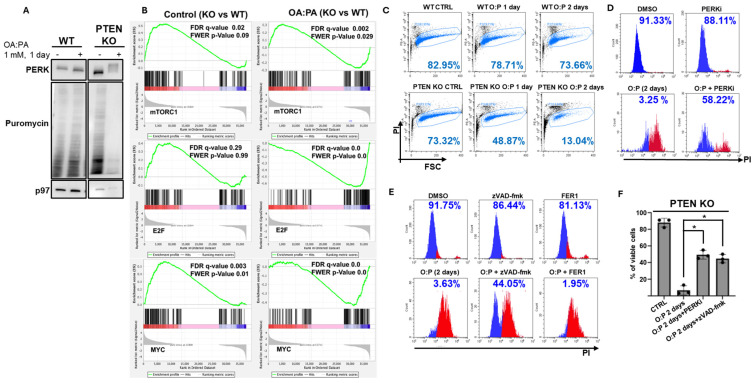 Figure 2
 Figure 3
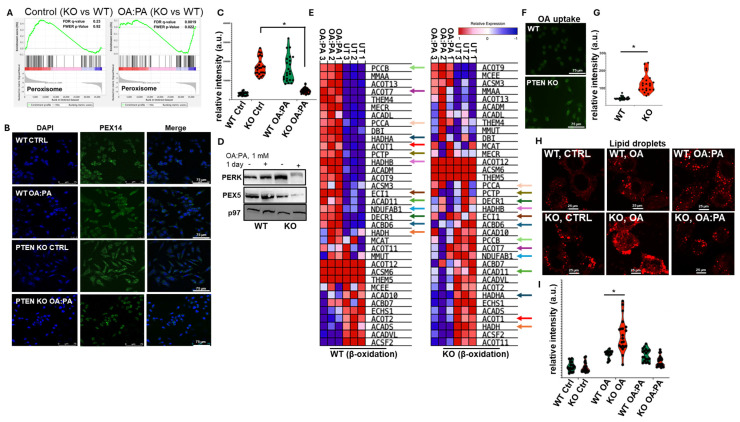 Figure 4
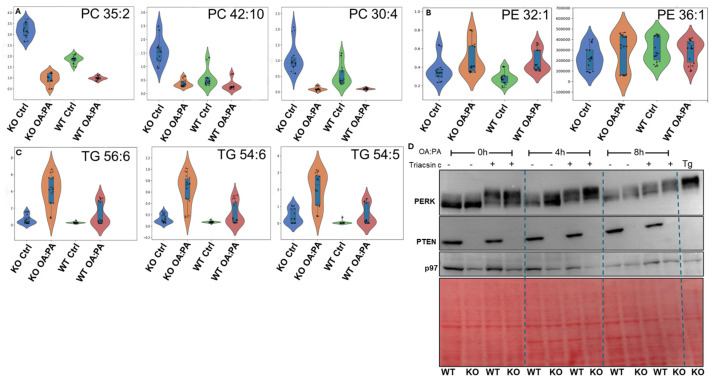 Figure 5
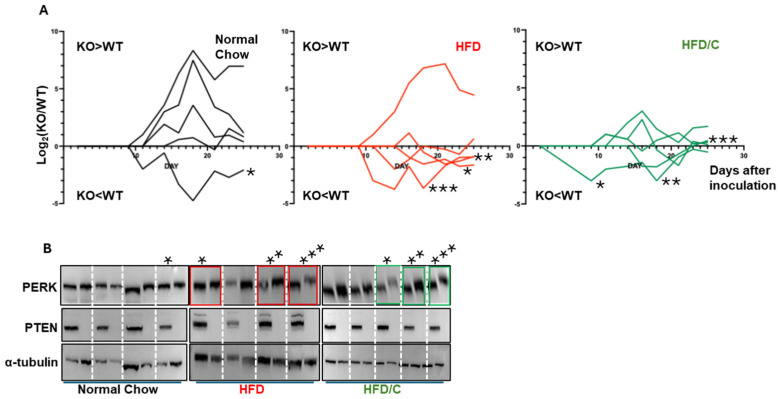 Figure 6
Peer Reviews
No public reviews on file for this paper yet. If you reviewed it on a platform where reviews are public (OpenReview, ICLR, NeurIPS, ICML), you can paste yours below so the community can read it here.
Videos
No videos yet. Explain this paper in a talk, walkthrough, or lecture? Add one.
Taxonomy
TopicsPI3K/AKT/mTOR signaling in cancer · Cancer, Lipids, and Metabolism · Lipid metabolism and biosynthesis