Healthcare Providers’ Perspectives on Generative Artificial Intelligence (GenAI) Adoption, Adaptation, Assimilation, and Use in the United States
Obinna O. Oleribe, Marissa Brash, Adati Tarfa, Ricardo Izurieta, Simon D. Taylor-Robinson

TL;DR
U.S. healthcare providers see generative AI as useful for patient care but face limited training and concerns about job loss and ethics.
Contribution
The study reveals a gap between clinician interest in GenAI and institutional readiness, emphasizing the need for training and governance.
Findings
86.9% of clinicians believe GenAI is useful in patient care, with confidence increasing over time.
Only 42.4% of clinicians have received formal GenAI training, and 23.2% report organizational AI adoption.
Top benefits include documentation efficiency and error reduction, while barriers include limited AI literacy and fear of job displacement.
Abstract
What are the main findings? Most U.S. clinicians in the study perceive GenAI as useful in patient care, with confidence increasing over time, indicating strong momentum for adoption.Formal GenAI training and organizational adoption remain limited, creating a misalignment between clinician interest and system-level preparedness.Clinicians primarily value GenAI for documentation efficiency and error reduction, while barriers center on limited AI literacy and workforce displacement fears. Most U.S. clinicians in the study perceive GenAI as useful in patient care, with confidence increasing over time, indicating strong momentum for adoption. Formal GenAI training and organizational adoption remain limited, creating a misalignment between clinician interest and system-level preparedness. Clinicians primarily value GenAI for documentation efficiency and error reduction, while barriers…
Genes, proteins, chemicals, diseases, species, mutations and cell lines named across the full text — each resolved to its canonical identifier and authoritative record.
Click any figure to enlarge with its caption.
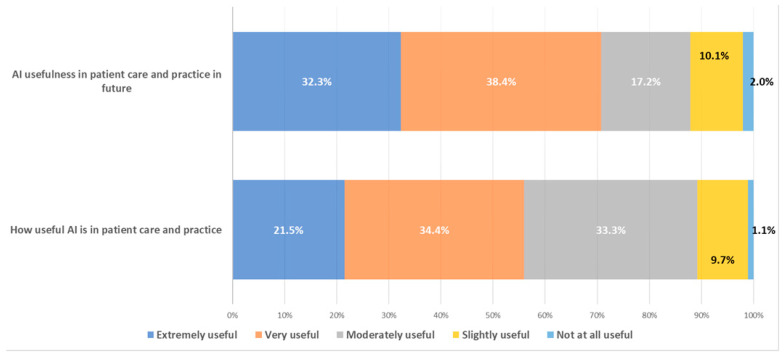 Figure 1
Peer Reviews
No public reviews on file for this paper yet. If you reviewed it on a platform where reviews are public (OpenReview, ICLR, NeurIPS, ICML), you can paste yours below so the community can read it here.
Videos
No videos yet. Explain this paper in a talk, walkthrough, or lecture? Add one.
Taxonomy
TopicsArtificial Intelligence in Healthcare and Education · AI in Service Interactions · Ethics and Social Impacts of AI